














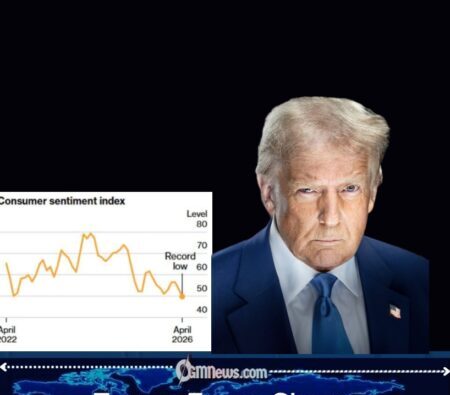
President Donald Trump, the current U.S. president serving a second term, has recorded his lowest approval rating of the term as growing dissatisfaction over the war with Iran and worsening cost-of-living pressures weighs heavily on American voters. A new Reuters/Ipsos poll found that only 34 percent of Americans approve of his performance in office, down from 36 percent in the previous survey.
The latest figures reflect mounting public concern over inflation, rising fuel prices, and uncertainty surrounding U.S. foreign policy. Analysts say the decline could have serious implications for Republicans ahead of the November midterm elections, where control of Congress will again be contested.
Trump Approval Rating Continues Downward Slide
The Reuters/Ipsos poll, conducted over four days and completed on Monday, shows Trump’s popularity continuing a downward trend that began shortly after he returned to office in January 2025. At the start of his second term, 47 percent of Americans approved of his performance. That figure has now fallen by 13 percentage points.
The new rating places Trump near the lowest numbers of his political career. During his first administration between 2017 and 2021, his approval often remained around 40 percent, with the lowest point reaching 33 percent. The current 34 percent suggests growing voter fatigue and unease.
Political observers note that while partisan loyalty remains strong among core supporters, independent voters and suburban households appear increasingly skeptical of the administration’s direction.
Cost of Living Emerges as Major Weakness
One of the most striking findings from the poll is the public’s frustration over the economy, particularly household expenses. Only 22 percent of respondents said they approve of Trump’s handling of the cost of living, down from 25 percent in the previous survey.
Trump had campaigned in the 2024 election on promises to lower prices after years of inflation under the previous administration. However, many families now report worsening financial pressure due to higher transport, food, and energy costs.
His broader approval rating on economic management stands at 27 percent, lower than any reading from his first administration and below the weakest economic ratings recorded by former President Joe Biden.
Iran Conflict Drives Fuel Price Surge
Public anger has also been linked to the ongoing conflict involving the United States, Israel, and Iran. Since military operations began on February 28, gasoline prices in the United States have reportedly surged by more than 40 percent, reaching around $4.18 per gallon.
The disruption of oil shipments through the Persian Gulf, where a significant share of global oil trade passes, has contributed to tightening supplies and rising international energy prices. Although a ceasefire was reached earlier this month, threats and instability continue to affect global markets.
For many American households, higher fuel costs quickly translate into more expensive groceries, travel, and daily necessities, further deepening dissatisfaction with the administration.
Mixed Support Within Republican Base
Despite the decline in national approval, Trump continues to enjoy strong backing among Republican voters. According to the survey, 78 percent of Republicans still approve of his leadership.
However, the data also shows signs of internal concern. About 41 percent of Republican respondents disapproved of Trump’s handling of living costs, suggesting economic issues may be creating cracks within the party’s support base.
Republican strategists are expected to monitor these numbers closely, particularly in swing districts where economic concerns often outweigh party loyalty.
Independents Lean Toward Democrats Ahead of Midterms
Independent registered voters, often decisive in close elections, appear to be shifting toward Democrats. When asked which party they would support in congressional elections, Democrats led Republicans by 14 points, 34 percent to 20 percent.
At the same time, one in four independent voters said they remain undecided, leaving room for both parties to influence the final outcome before November.
If the trend continues, Democrats could gain momentum in battleground races, especially in areas where inflation and energy prices dominate political debate.
Security Incident Adds New Uncertainty
Most responses in the poll were collected before a dramatic security incident at the White House Correspondents’ Association dinner, where Trump was expected to speak. Authorities said an armed suspect was stopped before entering the venue, and federal prosecutors later charged the individual with attempting to assassinate the president.
It remains unclear whether the event will affect public opinion in the coming weeks. Historically, such incidents can generate sympathy for leaders, but they can also intensify broader concerns about national security and political tensions.
Future polls may offer clearer insight into whether the incident changes perceptions of Trump’s leadership.
Political Stakes Rise for Both Parties
With approval numbers falling and economic pressure increasing, the months ahead could prove critical for Trump and the Republican Party. The administration now faces the challenge of stabilizing energy prices, easing household burdens, and reassuring voters on foreign policy.
For Democrats, the latest polling offers a possible opening to regain influence in Congress. Yet with many voters still undecided, the political environment remains fluid.
As the midterm elections approach, public opinion on prices, war, and leadership may determine the balance of power in Washington.
https://shorturl.fm/5TtQZ