









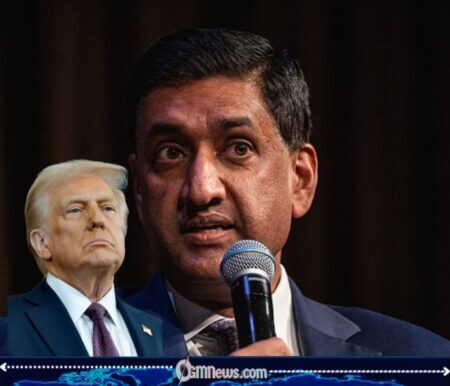
Democratic Congressman Ro Khanna has ignited fresh debate over U.S. foreign policy following a pointed critique of current U.S. President Donald Trump during a televised Fox News appearance. In a moment that quickly gained traction across political circles, Khanna contrasted Trump’s approach to global affairs with that of former President Barack Obama, raising concerns about the depth of policy deliberation at the highest level of government.
Khanna’s remarks, delivered in a measured yet firm tone, centered on the importance of informed decision-making in matters of international diplomacy. By drawing a direct comparison between two administrations, the congressman sought to frame a broader conversation about leadership standards, particularly during periods of geopolitical tension.
A Direct Critique on National Television
Speaking during an interview on Fox News, Khanna did not shy away from challenging President Trump’s handling of foreign policy issues. He argued that while Obama was known for carefully studying complex global dynamics, Trump’s approach appeared more reactive and influenced by external voices.
Khanna’s assertion that “Obama actually did his homework” contrasted sharply with his claim that Trump relied heavily on the counsel of allies such as Benjamin Netanyahu. This framing underscored Khanna’s concern that U.S. foreign policy decisions may lack independent strategic depth when shaped predominantly by external leadership perspectives.
Comparing Leadership Styles: Obama vs. Trump
The comparison between Obama and Trump formed the core of Khanna’s argument. According to the congressman, Obama’s tenure was marked by extensive briefings, deliberative processes, and engagement with a wide range of expert opinions before reaching decisions.
In contrast, Khanna suggested that Trump’s leadership style prioritizes instinct and personal alliances over structured analysis. While supporters of the current administration argue that such decisiveness can be advantageous in fast-moving crises, critics like Khanna warn that it risks oversimplifying complex international issues.
Reactions Across the Political Spectrum
Khanna’s comments have drawn mixed reactions from political stakeholders. Some Democratic colleagues echoed his concerns, emphasizing the need for rigorous policy evaluation and independent judgment in foreign affairs. They argue that Khanna’s critique reflects broader anxieties within the party regarding America’s global posture.
Meanwhile, Republican figures and Trump allies have pushed back, defending the president’s approach as pragmatic and results-oriented. They contend that strong relationships with key allies, including Israel, are essential for advancing U.S. interests and maintaining stability in volatile regions.
The Role of Media in Shaping the Narrative
The exchange on Fox News highlights the influential role of media platforms in shaping public discourse. By providing a stage for direct and often unscripted debate, networks like Fox News continue to serve as arenas where competing political narratives are tested and amplified.
Khanna’s appearance also underscores how lawmakers increasingly use televised interviews to communicate policy critiques directly to the public, bypassing traditional legislative channels. This dynamic has contributed to a more immediate and, at times, polarized political conversation.
Broader Implications for U.S. Foreign Policy
At its core, Khanna’s critique raises fundamental questions about how U.S. foreign policy should be formulated. Should decisions rely primarily on established alliances and executive instinct, or should they be grounded in extensive research and multilateral consultation?
As global challenges—from security conflicts to economic partnerships—grow more complex, the debate highlighted by Khanna’s remarks is likely to remain central. The discussion reflects an ongoing tension between differing philosophies of leadership and governance in Washington.
A Debate That Resonates Beyond One Interview
While the immediate focus remains on Khanna’s remarks, the broader implications extend far beyond a single media appearance. His critique taps into enduring questions about accountability, expertise, and the processes that guide presidential decision-making.
As the political landscape continues to evolve, such exchanges may play a pivotal role in shaping public expectations of leadership—particularly in the realm of international relations, where the stakes remain exceptionally high.

Logging in is a breeze and the site stability is amazing even during peak hours....