









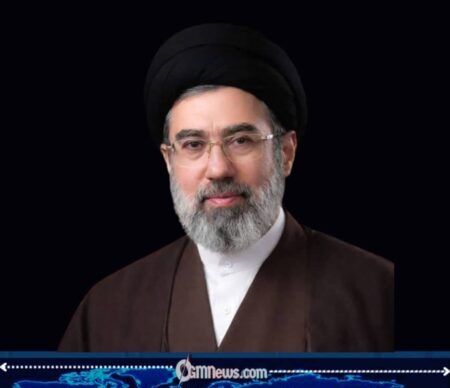
Mojtaba Khamenei delivered a defiant first public message after assuming Iran’s highest leadership role, declaring that the country has both the capability and determination to continue striking what he described as “important targets” belonging to Israel and the United States. The statement comes amid a rapidly escalating conflict that has heightened tensions across the Middle East and raised global concerns about a wider regional war.
In the message broadcast through Iranian state channels, Khamenei also acknowledged support from several countries he said have shown solidarity with Iran, including Vladimir Putin’s Russia and Xi Jinping’s China. Analysts say the remarks reflect Tehran’s attempt to project strength and emphasize international partnerships while facing mounting military and economic pressure from the United States and Israel.
Mojtaba Khamenei’s First Statement Signals Defiance
In his initial address as Iran’s supreme leader, Mojtaba Khamenei framed the ongoing confrontation as a struggle for national sovereignty and resistance against foreign aggression. He said Iran possesses the military capacity to target strategic sites connected to both Israel and the United States if hostilities continue.
According to reports by international outlets including The Associated Press and The Guardian, the message was carefully crafted to reassure domestic audiences that Iran’s leadership remains committed to defending the country despite ongoing military pressure. The speech also emphasized national unity and praised Iran’s armed forces for their role in the conflict.
Observers note that Mojtaba Khamenei used the message to establish his leadership tone early in his tenure, signaling continuity with Iran’s long-standing security doctrine while warning adversaries that Tehran would respond forcefully to future attacks.
Iran’s Strategic Warning to the United States and Israel
The statement contained direct warnings to both Washington and Tel Aviv, indicating that Iran’s military operations could expand if the conflict intensifies. Analysts say the remarks were intended to deter further strikes by demonstrating that Tehran retains offensive capabilities despite ongoing hostilities.
The warning comes at a time when the administration of Donald Trump has increased military pressure on Iran, including the deployment of additional forces and expanded air operations in the region. U.S. officials have argued that these actions are necessary to counter security threats and protect American interests.
Iranian officials, however, maintain that their military activities are defensive in nature and aimed at deterring what they describe as aggression by Israel and its allies. The sharp rhetoric from both sides has intensified concerns among diplomats about the risk of further escalation.
Strait of Hormuz Remains a Strategic Flashpoint
Another key issue raised indirectly in the statement involves the strategic importance of the Strait of Hormuz, a narrow maritime corridor through which roughly one-fifth of the world’s oil supply passes.
Security analysts warn that any disruption to shipping in this area could have immediate consequences for global energy markets. Even the possibility of conflict near the strait has already contributed to volatility in oil prices and heightened concern among energy-importing nations.
Iran has historically viewed the strait as a critical strategic asset and has occasionally suggested it could restrict traffic through the waterway in response to military pressure. Experts say such a move would dramatically escalate the economic and geopolitical consequences of the conflict.
Support from International Allies
In his message, Mojtaba Khamenei expressed appreciation for countries that have shown diplomatic or political support for Iran during the crisis. He specifically referenced nations that Tehran considers strategic partners in opposing Western influence.
Russia and China have maintained complex positions during the conflict, urging restraint while also criticizing certain U.S. and Israeli military actions. Both countries have historically maintained economic and political ties with Iran and have called for diplomatic solutions to prevent further escalation.
Analysts say Mojtaba Khamenei’s acknowledgement of these nations underscores Iran’s effort to strengthen alliances that could help offset international pressure and economic sanctions imposed by Western governments.
Global Reaction and Uncertain Path Forward
The speech has drawn strong reactions from governments around the world, many of which are urging restraint and renewed diplomatic efforts. Western leaders have expressed concern that escalating rhetoric could complicate attempts to reduce tensions in the region.
Security experts warn that the war’s trajectory remains uncertain. Continued military exchanges, threats involving strategic waterways, and the involvement of global powers could widen the conflict if diplomatic channels fail.
For now, Mojtaba Khamenei’s first public message appears aimed at signaling both resolve and readiness for prolonged confrontation, while the international community continues searching for ways to prevent the crisis from spiraling into a broader regional war.

The vibes here are amazing and the winning streaks are real. It feels just like...