



















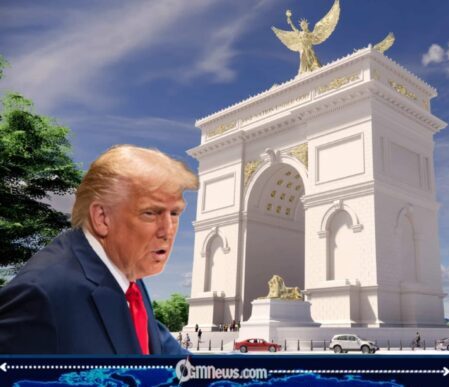
The Washington Arch has moved one step closer to becoming a permanent feature of the nation’s capital after the National Capital Planning Commission granted preliminary approval despite overwhelming public opposition. The decision immediately intensified debate over whether the ambitious project represents a celebration of American history or an unprecedented reshaping of Washington’s historic landscape, with the unresolved question of federal height restrictions ensuring that the controversy is far from over.
Washington Arch Faces Legal and Public Resistance
President Donald J. Trump’s proposed 250-foot triumphal arch would stand near the Virginia end of Memorial Bridge, close to Arlington National Cemetery, as part of broader efforts to commemorate America’s 250th anniversary while reshaping prominent areas of the nation’s capital. Eight commissioners voted in favour of preliminary approval, one opposed the proposal and three voted present. However, commissioners postponed deciding whether the Height of Buildings Act applies to the project after arguments were presented that the law may not bind the federal government.
Public testimony revealed overwhelming resistance to the proposal. Many speakers argued that the monument’s scale would interrupt the historic visual connection between the Lincoln Memorial and Arlington National Cemetery, a symbolic landscape designed to represent national reconciliation after the Civil War. Others questioned traffic impacts, pedestrian safety and whether Congress should authorise such a monument. Even with preliminary approval secured, the commission indicated that final consideration is expected in September.
Historic Preservation and Broader National Debate
The Washington Arch has already received design approval from the U.S. Commission of Fine Arts, but several significant questions remain beyond aesthetics. Federal planning staff previously recommended revisions to improve compliance with existing height regulations, while aviation authorities have also examined whether the structure could affect nearby flight operations because of its proximity to Ronald Reagan Washington National Airport. Although regulators have not identified an immediate aviation hazard, additional safety requirements could become necessary if construction proceeds.
Funding has also emerged as another point of discussion. President Trump previously suggested the monument could be financed largely through private donations raised alongside fundraising for the White House ballroom project. More recent information indicates that public funds will also contribute to both initiatives, although the White House has not released a final cost estimate for the arch itself. The combination of funding questions, legal uncertainty and preservation concerns has ensured that the proposal continues to generate national attention well beyondo architectural circles.
The Washington Arch now stands at the centre of a broader conversation about presidential legacy, historic preservation and the limits of executive influence over the nation’s capital. Whether the project ultimately rises above Washington’s skyline or remains an ambitious proposal will likely depend on forthcoming legal interpretations, regulatory decisions and continued public scrutiny. OGM News will continue monitoring developments ahead of the commission’s expected final review in September.

[…] […]