






























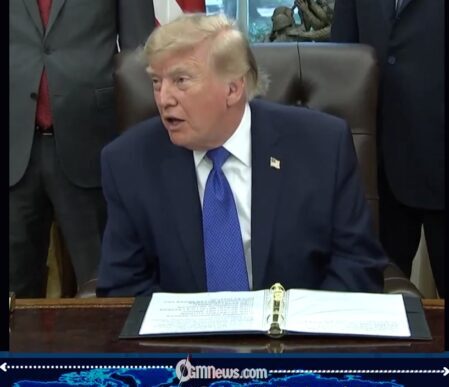
The Republican Party may have discovered an unlikely political headache hiding behind America’s artificial-intelligence boom: the data center. President Donald J. Trump, the current U.S. president, has thrown his full weight behind the rapidly expanding industry, arguing that communities rejecting data centers risk being left behind economically. But with voters increasingly worried about electricity bills, water consumption, noise, pollution and the physical transformation of their neighborhoods, some Republicans are reportedly wondering whether the president has picked the perfect hill to fight on — or the perfect hill to lose an election on. Recent reporting shows that opposition to data centers has become a growing bipartisan issue ahead of the 2026 midterms.
Trump Says “Let Data Reign” as Republicans Quietly Reach for the Brakes
According to the trusted material supplied to OGM News, Trump’s political team had already been considering a more cautious strategy, urging Republican candidates to argue that data centers should pay for their own electricity and water and that communities should receive tangible benefits. Instead, Trump’s public intervention took a much sharper tone, with the president describing communities that reject data centers as potentially choosing to remain “backwards and poor.”
The political comedy almost writes itself: Republican candidates are trying to tell voters, “We hear your concerns,” while the president is effectively telling those same voters to reconsider their economic classification. Meanwhile, the administration’s enthusiasm for AI infrastructure reflects a broader strategic argument that America must win the global artificial-intelligence race, particularly against China. Trump has repeatedly portrayed data centers as important engines of investment, jobs, tax revenue and technological power.
The Data Center Has Become the New Political Hot Potato
The problem for Republicans is that resistance to data centers is no longer confined to one ideological camp. Polling and political analysis indicate substantial opposition among Americans, including Republicans, while candidates in both parties have increasingly attempted to distance themselves from projects that voters believe could increase utility costs or place pressure on local water and power systems. The issue has become particularly sensitive in states such as Virginia, Texas and elsewhere, where rapid construction has collided with local concerns.
That leaves GOP candidates facing a rather awkward political equation: embrace Trump’s vision of an AI-powered America and risk irritating voters at town-hall meetings, or criticize data centers and risk irritating the president. In the satirical newsroom version of events, campaign advisers may soon be handing candidates two buttons — one reading “AI FUTURE” and the other reading “PLEASE DON’T RAISE MY ELECTRIC BILL” — and advising them to press neither until after Election Day. Recent reports suggest the backlash is serious enough that data centers have become a significant political liability in several competitive races.
For now, Trump’s message remains unmistakable: America should embrace the data-center boom rather than fear it. But the political question confronting Republicans is whether voters will see these giant computing facilities as symbols of prosperity or as symbols of higher bills, industrial expansion and decisions being made far away from their communities. With the 2026 midterms approaching, OGM News will continue watching whether Trump’s “let data reign” campaign strengthens the Republican message — or becomes the unexpected issue that leaves GOP candidates wishing the data had never arrived


Casinoabc999? Good Site. The interface is sleek, and there is a lot of stuff to...