





























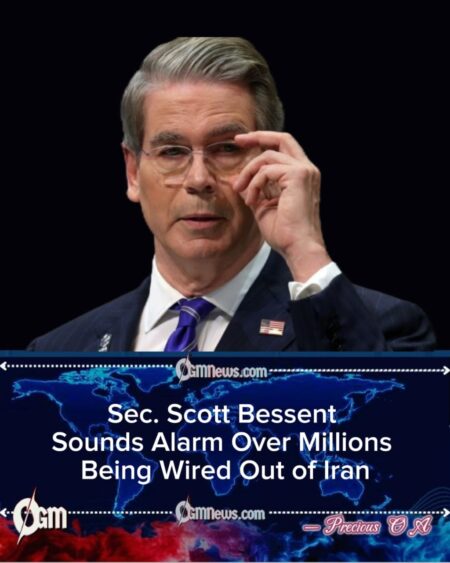
Sec. Scott Bessent revealed that U.S. financial monitoring teams have identified large-scale capital movements out of Iran, describing patterns that suggest coordinated efforts to transfer millions of dollars beyond the country’s borders. He said the flows appear structured rather than random, indicating organized networks moving funds through layered channels.
Sec. Scott Bessent explained that these transfers have been observed over a sustained period, rather than as a single anomaly. Analysts believe the activity reflects strategic decisions made by individuals or entities seeking to shield assets from domestic uncertainty, regulatory pressure, or anticipated geopolitical developments.
Sec. Scott Bessent added that the scale of the movement has elevated concerns within financial oversight circles. While not all transfers are necessarily illegal, the size, timing, and routing patterns have prompted deeper scrutiny into whether sanctioned actors may be attempting to reposition capital abroad.
Patterns Emerging in International Transfers
Sec. Scott Bessent noted that the observed transactions frequently move through intermediary financial hubs before reaching final destinations. This layered routing can make the original source of funds more difficult to trace and may complicate enforcement actions.
Sec. Scott Bessent said that data indicates repeated use of certain corridors that link Middle Eastern and Asian banking systems to offshore jurisdictions. These routes, while legitimate in many cases, are also commonly associated with attempts to reduce transparency.
Sec. Scott Bessent emphasized that analysts are comparing current patterns with historical data to determine whether the present activity represents a spike above normal baseline flows. Early findings suggest the pace and volume are higher than long-term averages.
Legal Implications and the Sec. Scott Bessent Framework
Sec. Scott Bessent outlined that existing U.S. financial compliance frameworks provide mechanisms to flag, investigate, and, where necessary, restrict suspicious transfers. These tools are designed to uphold sanctions regimes and deter illicit financial practices.
Sec. Scott Bessent said that enforcement teams are working closely with international partners to share intelligence and align oversight measures. Cooperative monitoring increases the likelihood that complex transfer chains can be reconstructed and assessed for compliance.
Sec. Scott Bessent indicated that where violations are confirmed, the consequences could include asset freezes, penalties, and further sanctions. He stressed that the objective is not only punitive but also preventative, discouraging future misuse of financial systems.
Reaction From Financial Institutions
Major international banks have responded by reviewing their exposure to Iranian-linked transactions. Compliance departments are reassessing due diligence procedures to ensure that no prohibited funds pass through their systems.
Several financial institutions have reinforced internal monitoring thresholds, triggering alerts at lower transaction values than before. This heightened sensitivity reflects caution amid evolving geopolitical and regulatory risks.
Industry groups have also issued guidance reminding member banks of their obligations under existing sanctions laws. The guidance encourages proactive reporting of suspicious activity to national regulators.
Broader Geopolitical Context
The movement of large sums of capital often reflects more than simple financial strategy. Analysts point to political uncertainty, currency stability concerns, and international negotiations as factors that can influence decisions to relocate wealth.
Regional observers suggest that asset migration can be both a defensive measure and a signal of expectations about future policy shifts. Large-scale capital movement is frequently interpreted as a barometer of economic confidence.
At the same time, governments view such flows through a security lens, particularly when they intersect with sanctioned economies. Monitoring therefore extends beyond financial compliance into broader strategic assessments.
What Comes Next
Regulatory agencies are expected to expand data-sharing agreements to improve cross-border visibility into complex transactions. Enhanced cooperation could make it more difficult for illicit networks to exploit jurisdictional gaps.
Financial institutions will likely continue tightening internal controls, especially for accounts or entities linked to high-risk regions. These steps aim to protect banks from reputational and legal exposure.
Ultimately, the findings could influence future policy decisions, including potential updates to sanctions enforcement and compliance standards. As investigations continue, the issue of capital flight is poised to remain a focal point in international financial oversight discussions.

Casinoabc999? Good Site. The interface is sleek, and there is a lot of stuff to...