























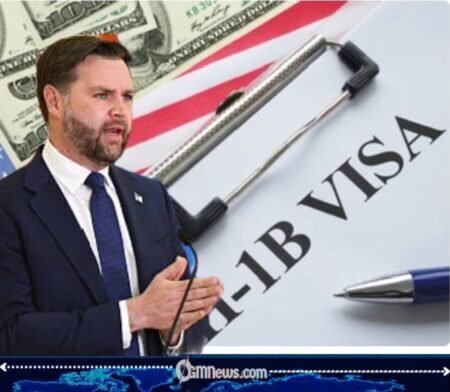
Vice President JD Vance has taken a prominent stance in the ongoing immigration and employment debate, urging college students to pressure Republican Senate candidates to support eliminating the H-1B visa program. Presenting the issue as a direct threat to job opportunities for American graduates, Vance framed his appeal as both an economic and political call to action.
By positioning students as key influencers, Vance is elevating the discussion beyond traditional policy circles and into campuses nationwide. His remarks have quickly sparked conversation among political analysts, business leaders, and young voters alike.
JD Vance’s Argument Against the H-1B Visa Program
At the core of JD Vance’s position is the belief that the H-1B visa program disadvantages American graduates entering the workforce. He argues that the system allows companies to hire foreign professionals in ways that may reduce opportunities for domestic job seekers.
Vance has emphasized that while the program was designed to address skill shortages, it is increasingly being used in sectors where qualified American candidates are available. This, he contends, creates an uneven playing field for young professionals attempting to secure employment after graduation.
His stance reflects a broader economic perspective that prioritizes domestic labor and calls for stricter oversight—or elimination—of immigration pathways perceived to impact local job markets.
Mobilizing Students as Political Stakeholders
A defining element of JD Vance’s approach is his call for direct student involvement in political advocacy. By encouraging college students to engage with Republican Senate candidates, he is promoting grassroots influence over party policy.
This strategy highlights the growing importance of youth participation in shaping national debates. Students, particularly those approaching graduation, are uniquely positioned to respond to policies that affect employment prospects and economic mobility.
However, this move also introduces a new layer of political engagement on campuses, where views on immigration and labor policy can vary widely. The response from student communities is expected to play a role in how the issue evolves.
Mixed Reactions from Industry and Policy Experts
JD Vance’s proposal has drawn mixed reactions from business leaders and policy analysts. Many industry representatives argue that the H-1B visa program is essential for filling specialized roles, particularly in technology, healthcare, and engineering.
They warn that eliminating the program could lead to talent shortages and reduce the global competitiveness of American companies. Some also suggest that companies may shift operations abroad if access to skilled workers becomes restricted.
On the other hand, critics of the program echo Vance’s concerns, advocating for reforms that prioritize American workers. While not all support a full ban, there is growing discussion around tightening regulations and increasing transparency in hiring practices.
Political Impact Within the Republican Party
JD Vance’s call to action is likely to influence internal dynamics within the Republican Party. His position aligns with a segment of the party that supports stricter immigration controls and prioritizes domestic employment.
At the same time, it may create tension with more business-oriented Republicans who view the H-1B program as economically beneficial. As Senate candidates respond to Vance’s appeal, their positions could shape party platforms and campaign strategies.
The issue is expected to become a point of debate in upcoming elections, with candidates navigating the balance between economic growth and workforce protection.
Alignment with the Trump Administration’s Agenda
The stance taken by JD Vance aligns with broader themes under President Donald Trump, who is currently serving a second term. Immigration policy has remained a central pillar of the administration’s agenda, with a focus on protecting American jobs.
Supporters of this approach argue that restricting programs like H-1B reinforces economic nationalism and supports domestic workers. They see Vance’s position as a continuation of efforts to reshape immigration policies in favor of U.S. citizens.
Critics, however, caution that such measures could have unintended consequences for industries reliant on global talent, highlighting the complexity of balancing economic and workforce priorities.
A Defining Moment for Workforce Policy
As JD Vance continues to advocate for changes to the H-1B visa program, the debate is set to remain a central issue in U.S. politics. His call for student-led advocacy introduces a new dimension, potentially expanding public engagement in policy discussions.
The outcome will depend on legislative developments, political responses, and shifting public opinion. For American students and graduates, the stakes are particularly significant, as the policies debated today could shape future job opportunities.
Ultimately, JD Vance’s push underscores a broader national conversation about how to balance the demands of a global economy with the need to protect and promote domestic employment.

[…] […]