
























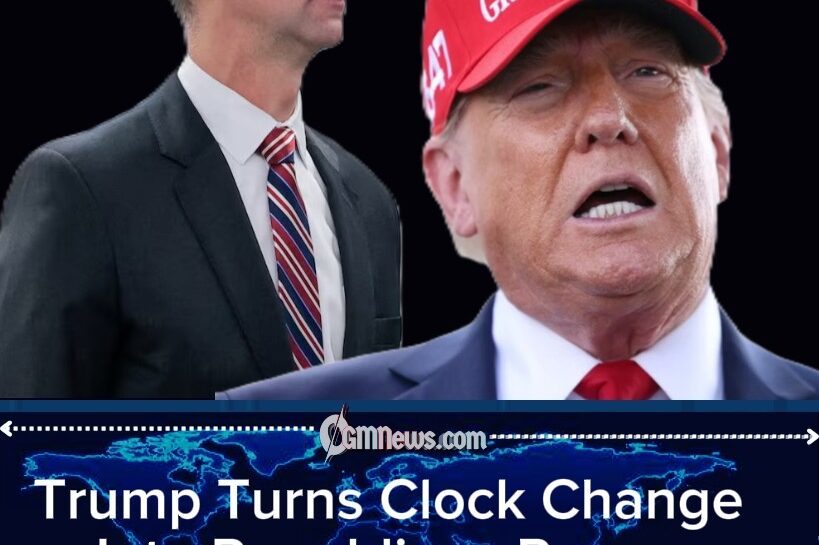



President Donald Trump has made it unmistakably clear that he intends to be the biggest name on the ballot in November—even though his name will not actually appear there. Addressing Republicans at the first-ever national midterm convention in Dallas, Trump urged voters to “pretend” he was on the ballot and promised to campaign personally in competitive congressional races across the country.
The move is a calculated political gamble. Republicans are defending their control of Congress in an election environment that has become increasingly difficult for the president’s party, while Trump’s approval ratings have fallen into the low-to-mid 30s in several recent surveys.
Donald Trump Wants Every Republican Race to Feel Like His Own
Trump’s message to the Dallas crowd was effectively a request for voters to treat the 2026 midterms as another presidential election. He argued that Republicans traditionally perform strongly when he is personally on the ticket, then challenged supporters to recreate that political atmosphere without his name appearing on the ballot. “So I’m asking you to pretend that I’m on the ballot,” he declared.
OGM News understands the strategy as a classic Donald Trump political manoeuvre: if congressional candidates cannot turn November into a referendum on themselves, Donald Trump appears ready to turn it into a referendum on him instead. He said he would visit around 35 competitive races and hold rallies for Republican Senate and House candidates, essentially offering himself as a travelling campaign headquarters—with considerably more television coverage.
The unusual convention itself underlines how seriously Trump and Republican leaders are taking the contest. Unlike the traditional presidential nominating conventions, the Dallas gathering has no presidential nomination to decide; its purpose is to rally the party ahead of November and place Trump’s political influence at the centre of the campaign.
The Donald Trump Strategy Comes With a Political Warning Label
There is, however, an awkward problem hiding behind the applause. Recent polling has shown Donald Trump’s approval struggling, while economic frustrations and dissatisfaction over the administration’s handling of the Iran war have created vulnerabilities for Republican candidates. One recent Financial Times/Focaldata poll put Trump’s approval at 33%, while a University of Massachusetts Amherst poll found 32% approval and 64% disapproval.
That creates the central contradiction of the Republican strategy: Trump may be the party’s most powerful mobilising force, but he could also become the most convenient target for Democratic candidates. Some Republicans in competitive districts have therefore kept their distance from the Dallas event, preferring to campaign at home rather than place themselves directly inside Trump’s political spotlight.
For OGM News, the satirical picture is almost too convenient: a president who is not running for Congress asking America to imagine that he is, while congressional candidates are left wondering whether they should put their own faces on campaign posters or simply print another photograph of Trump. Behind the humour, though, lies a serious electoral calculation—the November result could determine whether Trump retains a cooperative Congress or faces a dramatically stronger congressional check during the remainder of his presidency.
Donald Trump has therefore transformed a conventional midterm campaign into something resembling a personal political sequel, promising to travel from race to race and make his presidency part of every major contest. Whether that strategy produces Republican victories or gives Democrats even more reason to mobilise will become clearer as November approaches. For now, readers should watch OGM News for further updates as Trump’s “I’m on the ballot” strategy moves from the Dallas convention stage to the campaign trail.

[…] […]