





























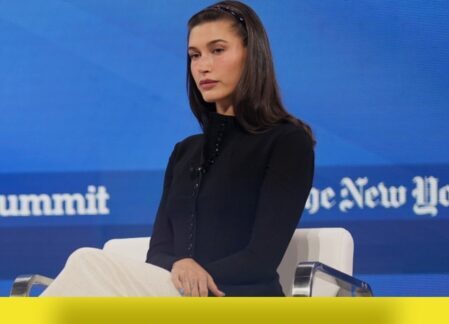
Optimism has apparently become a controversial subject on social media after Hailey Bieber found herself defending her choice of words while discussing the extraordinary success of her beauty company, Rhode. The entrepreneur attracted online criticism after describing the mindset behind her company’s billion-dollar acquisition deal as “optimistical delusion,” prompting some internet users to question whether the word she used actually existed. However, rather than quietly accept the criticism, Bieber has responded in a manner that suggests she is not interested in allowing online grammar enthusiasts to take over the conversation about her business achievement.
The Word That Turned Hailey Bieber’s Business Achievement Into a Grammar Debate
The controversy followed Bieber’s appearance at the New York Times DealBook Summit in New York City on November 18, 2026, where she discussed the journey behind Rhode’s remarkable growth and its acquisition by e.l.f. Beauty. During the conversation, she revealed that selling the company for less than $1 billion was never part of her ambition. She explained that the figure was the minimum amount she had been willing to accept, describing the target as an ambitious goal that initially seemed almost unbelievable. When asked about the confidence required to pursue such an achievement, she attributed it to what she called “optimistical delusion.” The expression quickly attracted attention, but not necessarily for the reasons she might have expected.
Following the interview, social media users began questioning her use of the word “optimistical,” with some critics suggesting that she had invented an unnecessary variation of the word optimistic. Others turned the comment into an opportunity for jokes and grammatical corrections. Bieber subsequently responded through her Instagram Story on November 20, sharing a dictionary definition that described “optimistical” as a version of “optimistic.” She accompanied the screenshot with the brief expression, “anyways…,” seemingly dismissing the criticism without getting drawn into an extended online argument. Her response has since added another layer to the discussion, raising questions about how much attention public figures should give to criticism that has little connection to their professional achievements.
Optimism, Rhode’s Billion-Dollar Deal and the Business Strategy Behind the Success
Beyond the vocabulary dispute, Rhode’s business journey provides important context for understanding why Bieber’s comments attracted attention. Founded in 2022, the skincare and beauty company quickly developed a strong following through its minimalist product identity, digital marketing strategy and celebrity-driven visibility. In May 2025, e.l.f. Beauty announced an agreement to acquire Rhode in a transaction valued at up to $1 billion.
The proposed structure included $600 million in cash, $200 million in newly issued e.l.f. shares and a potential additional $200 million in performance-based payments tied to the company’s growth over three years. At the time of the announcement, Rhode had generated $212 million in net sales during the 12 months ending March 31, 2025. These figures demonstrate that the acquisition was supported by substantial commercial performance rather than celebrity recognition alone.
The transaction was subsequently completed on August 5, 2025, with Rhode becoming a wholly owned subsidiary of e.l.f. Beauty. Bieber retained an important position within the business, continuing as its founder and taking on responsibilities as Chief Creative Officer and Head of Innovation, alongside a strategic advisory role.
The acquisition also gave Rhode access to a larger international distribution network, including opportunities through Sephora. Her remarks about ambition therefore offer an interesting perspective on the combination of confidence, market positioning, product development and commercial execution required to build a valuable beauty company. Nevertheless, it is important to distinguish the widely reported $1 billion headline valuation from the guaranteed amount paid at closing, since part of the announced consideration depended on future business performance.
Bieber’s latest response also highlights the complicated relationship between celebrity culture and social media scrutiny. During the summit, she acknowledged that dealing with public criticism is not always easy, explaining that years of intense attention have helped her develop resilience, although she still finds it difficult to completely ignore negative comments. Her experience illustrates how public figures can find their professional achievements overshadowed by seemingly minor controversies.
While correcting language and debating word choices are ordinary parts of online conversations, the disproportionate attention sometimes given to such issues can distract from more meaningful discussions about business, innovation and entrepreneurship. In this instance, the debate has also brought renewed attention to the thinking behind Rhode’s remarkable commercial journey.
Ultimately, the disagreement over one word is unlikely to overshadow Rhode’s business milestone, but it has provided another example of how quickly social media can redirect a conversation. Optimism, ambition and the willingness to pursue seemingly unrealistic goals may have played a role in Bieber’s entrepreneurial journey, but her company’s commercial performance also reflects strategic decisions and a wider business operation. Whether critics accept her vocabulary or not, the billionaire businesswoman has made her position clear. Buzz Legit will continue to follow developments surrounding Hailey Bieber, Rhode and the evolving conversation about celebrity entrepreneurship.



I was looking for a reliable spot to unwind and this platform exceeded my expectations....