
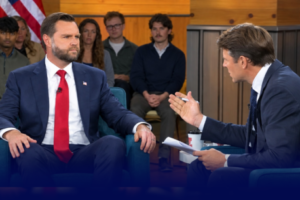




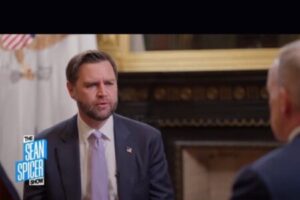
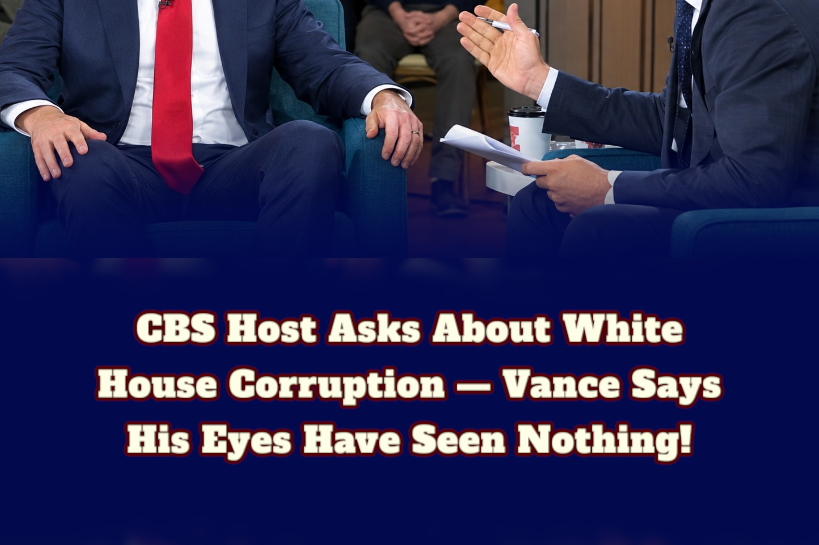




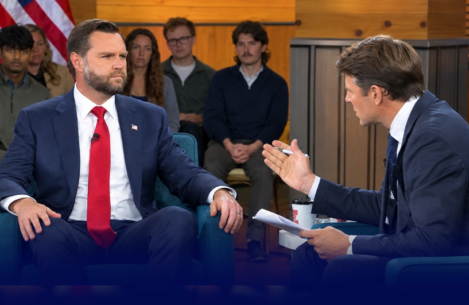
Vice President JD Vance has defended President Donald Trump against questions about corruption inside the White House, telling CBS News anchor Tony Dokoupil that he has never seen anything suggesting Trump was involved in corrupt conduct. The exchange took place during a televised town hall on October 17, 2026, where Dokoupil pressed Vance on concerns that the president’s personal business interests could influence government decisions. When Dokoupil asked whether Vance had seen anything inside the White House that made him “squeamish,” Vance initially reframed the question around whether Trump’s decisions had been influenced by his business interests. Dokoupil interrupted to clarify that he was asking whether Vance had personally witnessed anything troubling. JD Vance then answered: “I’ve never seen anything like that from the President.” The exchange has renewed questions about transparency, potential conflicts of interest and how much scrutiny the administration is willing to accept.
A Question About Corruption, an Answer About What JD Vance Has Seen
The exchange became notable because Dokoupil was asking about Vance’s personal observations, not simply inviting him to explain the president’s position. JD Vance acknowledged that Washington is a corrupt place but said he had not seen evidence that Trump participated in or sanctioned corruption. He also said that anyone selling access to the White House should face consequences. Those are significant qualifications: Vance’s statement describes what he says he has personally observed, not an independent determination that no corruption or conflicts of interest exist. The distinction matters because a public official’s lack of personal knowledge does not, by itself, settle questions about conduct that may require documentary evidence, independent investigation or testimony from others.
And here is where the political theatre becomes almost too convenient. When a journalist asks whether something troubling has happened, a politician can answer narrowly, broaden the question or defend the president’s character. But none of those approaches necessarily resolves the underlying issue. One might wonder whether the White House has a special vocabulary in which “I haven’t seen it” means the matter can be filed away under “nothing to investigate.” Of course, that is satire, not a finding of wrongdoing. The serious point is that public confidence depends on transparent evidence and credible oversight, not merely on whether a senior official says he has personally witnessed misconduct.
Trump’s Business Interests and the Demand for Accountability
The questions about Trump’s business interests are part of a wider debate over presidential ethics and the separation between public office and private financial benefit. During the town hall, Dokoupil cited concerns about Trump’s cryptocurrency earnings and reports involving U.S. Ambassador to Greece Kimberly Guilfoyle, who was accused of seeking a $100,000 payment from someone hoping for assistance from the administration. Guilfoyle has denied wrongdoing, and Trump has denied having conflicts of interest. JD Vance said that anyone selling access to the White House should face consequences. These allegations and denials should be assessed individually; they do not establish that Trump or Guilfoyle committed a crime.
The broader question, however, is legitimate: what safeguards ensure that government decisions serve the public rather than private interests? Transparency around financial dealings, enforceable ethics rules, independent investigations and congressional oversight are among the mechanisms designed to address that concern. JD Vance has said he would follow the law if a future Democratic-controlled Congress launched investigations or issued subpoenas. That assurance matters, but the real test of accountability is whether the administration cooperates with lawful scrutiny even when the questions are politically uncomfortable. In a democracy, neither the president’s supporters nor his critics should have to rely on personal assurances alone when evidence can be examined independently.
JD Vance’s exchange with Tony Dokoupil highlights the difference between defending a president and establishing whether the administration’s conduct meets the standards expected of public office. Vance says he has not personally witnessed corruption by Trump, while the questions raised at the town hall underscore continuing public concerns about financial interests, access to power and transparency. Allegations should not be mistaken for proof, but neither should denials replace independent scrutiny. As questions about presidential ethics and government accountability continue, OGM News will follow the evidence, the responses and any further developments in this story.
https://addlinks.pro/C5V1O