










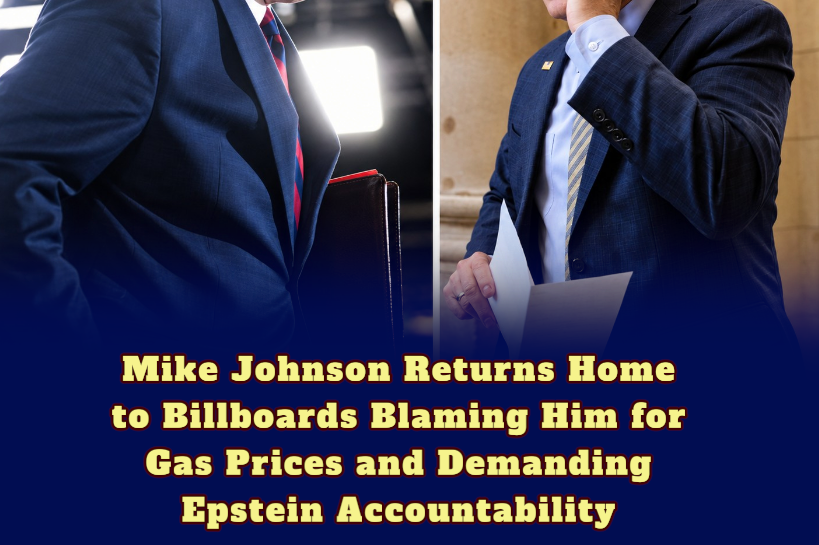














Louisiana, USA — House Speaker Mike Johnson may have returned home to Louisiana after spending time navigating Washington’s political battles, but the welcome waiting for him appears to be anything but relaxing. According to material shared by Joe Gallina of Call for Activism, billboards targeting Johnson over gasoline prices and his handling of accountability surrounding Jeffrey Epstein’s associates are appearing across Louisiana’s 4th Congressional District. If the campaign gains traction, Johnson could discover that surviving a fight for the Speaker’s gavel is one thing; convincing voters to keep him in Congress is another.
The political message is unmistakable: opponents want to turn national frustrations into local electoral consequences. One billboard reportedly blames Johnson for gas prices, while another questions whether he has done enough to hold Epstein’s alleged accomplices accountable. In Washington, political leaders can spend days negotiating power among lawmakers, but back home, voters may have much simpler questions: What has their representative done for them, and why should they give him another term?
Mike Johnson’s Reelection: Billboards Bring Washington’s Political Baggage to Louisiana
The reported billboard campaign puts two politically sensitive issues directly in front of voters: the cost of living and public demands for transparency in the Epstein case. Gasoline prices are a particularly effective political target because motorists encounter their financial consequences repeatedly, often without caring which party controls Congress. Blaming the Speaker personally for prices, however, is a political argument rather than proof that he alone is responsible; fuel costs are affected by global oil markets, refining capacity, distribution costs, taxes and government policy.
The Epstein-related messaging carries a different kind of political risk. The public has continued to demand answers about the powerful people connected to Epstein’s sexual-abuse network and whether those who committed crimes have been held accountable. Mike Johnson’s critics are using that demand to challenge his leadership and credibility. But a billboard is an accusation, not a judicial finding, and any claim that a specific individual obstructed accountability must be supported by evidence. The political challenge for Johnson is that even questions he disputes can become campaign ammunition when voters already distrust Washington.
Louisiana’s Election Rules Could Complicate Mike Johnson’s Path
The material supplied by Call for Activism also claims that Louisiana’s congressional election arrangements changed following a Supreme Court ruling in April, that the May 16 partisan primaries were canceled, and that the November 3 election could feature three Republican candidates. Under the scenario described, Johnson could fail to secure more than 50 percent of the vote, potentially forcing a December 12 runoff. If those dates and rules are confirmed by Louisiana election authorities, the possibility of a runoff would give his opponents an additional reason to compete aggressively for attention before voting begins.
The political arithmetic is straightforward: multiple candidates from the same party can divide votes, and a crowded field can make it harder for a front-runner to secure an outright majority. That does not automatically mean Mike Johnson is in danger of losing, nor does it establish that he is “petrified,” as Gallina’s commentary suggests. It does mean that a campaign designed to amplify dissatisfaction could matter if the race is competitive. Conrad Cable, identified in the supplied material as Johnson’s Democratic opponent, is reportedly mounting an intensive campaign ahead of early voting. The effectiveness of that effort will depend on voter turnout, candidate support, campaign organization and the accuracy of the reported election timetable.
Mike Johnson’s return to Louisiana may be developing into a test of whether national political controversies can be converted into local electoral pressure. The reported billboards seek to connect household expenses and demands for accountability to the Speaker’s leadership, while the possibility of a crowded race could add uncertainty to the contest. The billboard claims, election dates and procedural changes require confirmation from authoritative sources before they can be treated as established facts. OGM News will continue following the story, examining the evidence and monitoring developments that could shape Johnson’s political future.

[…] […]