
























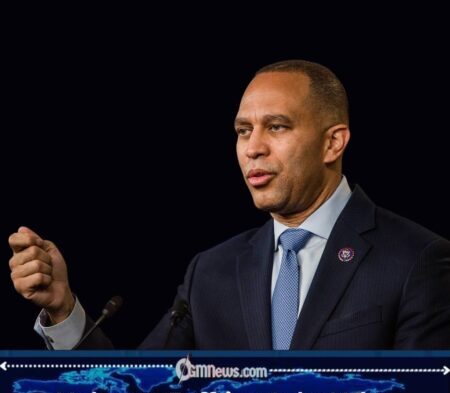
House Democratic Leader Hakeem Jeffries has reignited a fierce argument over the federal government’s approach to waste, fraud and abuse, contrasting the daily Social Security income of an average recipient with the enormous value of federal contracts connected to Elon Musk’s companies. In remarks on the House floor, Jeffries said the average Social Security recipient receives about $65 a day, while describing Musk as receiving roughly $8 million a day through federal contracts. His argument was that if Washington is genuinely searching for waste, fraud and abuse, it should not begin by focusing on seniors living on modest benefits.
Hakeem Jeffries Puts $65 Against $8 Million
Hakeem Jeffries’ comparison was designed to highlight what he sees as a striking difference in scale. His remarks came amid the 2025 congressional battle over federal spending and the Trump administration’s push, through the Department of Government Efficiency, to reduce government spending. Jeffries argued that Social Security recipients had already earned their benefits through years of work and contributions.
But there is a little mathematical fine print behind the dramatic $8 million figure. During a congressional hearing, Rep. Greg Casar said Musk’s companies had been promised about $3 billion through close to 100 federal contracts and presented that figure as approximately $8 million per day. That calculation describes the value of contracts over time; it should not be interpreted as Musk personally collecting $8 million in cash every 24 hours. Musk’s companies have, however, received substantial government contracts and other forms of government support over the years.
Hakeem Jeffries Challenges the Target of the Hunt
Hakeem Jeffries’ broader argument was that a campaign against waste, fraud and abuse should examine government spending comprehensively rather than place disproportionate pressure on ordinary beneficiaries. He accused Republicans of using the spending debate to threaten programs such as Social Security while protecting wealthy interests, a characterization that represents Jeffries’ political argument rather than an independently established conclusion.
The dispute became particularly combustible because the Trump administration and its allies have themselves emphasized eliminating waste and fraud. The White House has argued that substantial improper payments and fraud exist across federal benefit programs and has defended efforts to identify them, while independent fact-checking has noted that estimates of federal fraud cover the government broadly and should not simply be attributed to Social Security recipients.
For Hakeem Jeffries, however, the political question remains remarkably simple: if Washington is going hunting for wasted taxpayer money, why should the search begin with the person receiving roughly $65 a day rather than with the much larger financial relationships surrounding government contractors? The answer depends heavily on how one defines waste, fraud, improper payments and legitimate government contracts — definitions that have become part of the larger battle over federal spending.
As the argument over Social Security, government contracts and the Trump administration’s spending cuts continues, Hakeem Jeffries’ $65-versus-$8-million comparison is likely to remain part of the political conversation. OGM News will continue following the money, the mathematics and the competing claims — because in Washington, apparently even a calculator can become a political battlefield.


[…] […]