


























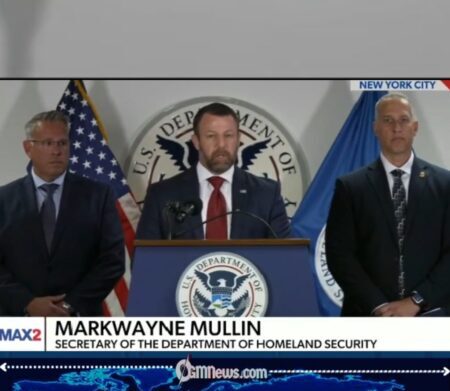
Markwayne Mullin, Homeland Security Secretary is celebrating what he described as a major victory for the Trump administration’s immigration crackdown, announcing that Operation Rotten Apple resulted in the arrests of 2,197 undocumented migrants across New York between July 27 and August 29. Mullin said the operation had taken more than 2,100 “criminals” off the streets, portraying the month-long enforcement campaign as a direct challenge to New York’s sanctuary policies.
The operation targeted people whom federal authorities said had criminal records, including individuals convicted of serious offences such as murder, rape, kidnapping and drug trafficking. The Department of Homeland Security highlighted several cases to demonstrate the type of suspects targeted, although the broader description of all 2,197 people arrested as “criminals” is a characterization from the administration rather than an independently verified description of every person detained.
Mullin Says Operation Rotten Apple Made New York Safer
Mullin presented the operation as evidence that the federal government can dramatically increase immigration enforcement even when local political leaders refuse to cooperate. He accused New York’s sanctuary-city and sanctuary-state policies of making it harder for federal immigration officers to take custody of people who are subject to immigration enforcement.
The secretary’s message was blunt: federal agents would continue carrying out immigration operations regardless of opposition from state and local officials. In announcing the results, Mullin said Operation Rotten Apple had made New York safer and warned politicians who oppose federal immigration enforcement that cooperation with Washington would be preferable to resistance.
Among those highlighted by DHS was Bogdan Detrovich Gren, a Ukrainian national whom authorities said was unlawfully in the United States and had convictions involving kidnapping, abduction resulting in death, weapons possession and murder. Federal officials also cited other detainees with serious criminal histories, including convictions or arrests involving sexual offences and child-related crimes.
For the Trump administration, those cases provide the political headline it wants: dangerous offenders being removed from American communities. But the operation also raises a more complicated question about immigration enforcement—namely, how many of those arrested were convicted criminals, how many had immigration violations without serious criminal convictions, and what ultimately happens to each person taken into custody.
New York’s Sanctuary Politics Collide With Trump’s Immigration Agenda
The operation has intensified the long-running confrontation between the Trump administration and Democratic leaders in New York. Mullin specifically pointed to New York City Mayor Zohran Mamdani and Governor Kathy Hochul, saying the operation was conducted without their cooperation. Federal officials argue that sanctuary policies prevent immigration officers from obtaining access to some people who might otherwise be transferred into federal custody.
New York officials and immigration advocates, however, have argued that limiting local cooperation with federal immigration enforcement protects immigrant communities and prevents local policing from becoming an extension of federal immigration authorities. That disagreement has transformed immigration enforcement into another major political battlefield between Washington and Democratic-led states and cities.
The name Operation Rotten Apple itself has attracted attention, partly because the phrase is not entirely new. A previous federal and local law-enforcement operation in New York also carried the same name in 2009, when authorities targeted drug-trafficking organisations in the Bronx and charged 53 alleged members of narcotics rings. The current operation is a separate immigration-enforcement campaign.
For Mullin and the Trump administration, however, the latest operation represents something bigger than an arrest statistic. It is being presented as a demonstration that the federal government intends to pursue its immigration agenda aggressively even in jurisdictions where local authorities object. With nearly 2,200 people taken into custody during the operation, the administration has produced a number large enough to dominate the political conversation.
Yet the battle is unlikely to end with the announcement of the arrest figures. Questions surrounding due process, detention, deportation, criminal histories and the role of local governments are likely to remain at the centre of the immigration debate. Critics will also scrutinise whether aggressive enforcement can be maintained without producing cases involving people who pose no serious public-safety threat.
For now, Mullin is celebrating what he considers a decisive victory, while New York’s political leadership faces renewed pressure over its approach to federal immigration enforcement. The Trump administration has made clear that it intends to continue the crackdown, and Operation Rotten Apple may become a model for similar operations elsewhere.
OGM News will continue monitoring the fallout from Operation Rotten Apple, the Trump administration’s immigration crackdown and the escalating confrontation between federal authorities and New York officials. With more than 2,100 arrests announced in just 30 days, the operation has already become a major political flashpoint—but the next question is whether the arrests will translate into lasting changes on New York’s streets or an even bigger battle over immigration policy.

Ae888covenuscasino, okay, I'm curious. Gonna check out this site and try to find some amazing...