
















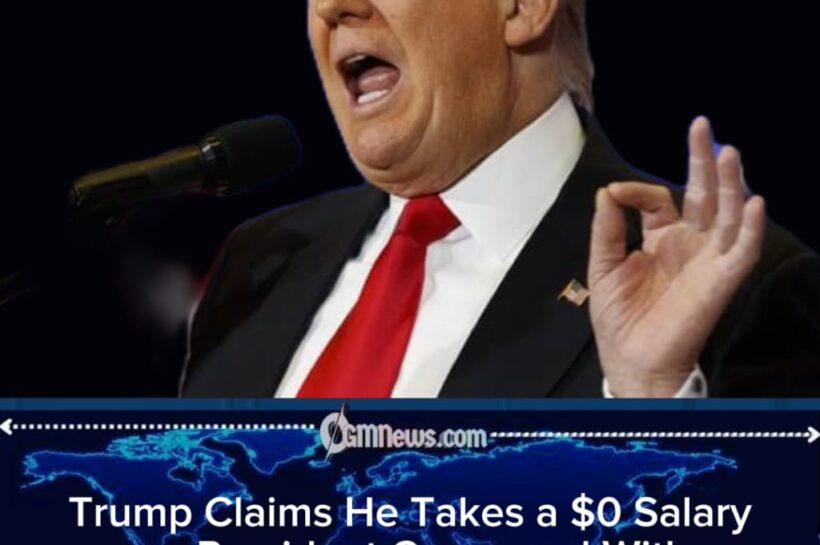













President Donald Trump appears to have discovered a remarkably durable political button in American politics: say “communist” loudly enough, repeatedly enough and with sufficient presidential confidence, and somebody somewhere may start checking whether the neighbourhood has secretly been converted into Moscow. His latest campaign against what he describes as a “radical” Democratic Party has found receptive ears among some Republican voters in deeply conservative South Carolina, raising the question of whether Trump’s red-baiting strategy is successfully reshaping the political conversation ahead of November’s midterm elections. Recent developments suggest the answer is, at least politically, looking increasingly complicated.
THE ‘COMMUNIST’ WORD HAS BECOME TRUMP’S FAVOURITE CAMPAIGN ACCESSORY
At a Myrtle Beach rally, Trump repeatedly attacked Democrats as communists and “radical left lunatics”, reportedly mentioning communists or communism 13 times in the speech. The message was delivered with the urgency of a man apparently worried that socialism might be hiding behind every ballot box, waiting for its opportunity to nationalise the voting machines. Yet the underlying political strategy is hardly new: American conservatives have historically used accusations of communism and socialism as powerful weapons against left-wing opponents.
The difference this time is the increasingly broad definition of the word. Progressive politicians associated with democratic socialism have become convenient targets, even though experts quoted in recent reporting stress that figures such as Zohran Mamdani, Bernie Sanders and Alexandria Ocasio-Cortez are not communists. In the Trump political universe, however, the ideological distance between “socialist”, “radical leftist” and “communist” sometimes appears to be roughly the width of a campaign slogan.
SOUTH CAROLINA VOTERS SHOW THE MESSAGE CAN STILL LAND
South Carolina provided a useful laboratory for the strategy. Republican voters there recently selected Darline Graham, the sister of the late Senator Lindsey Graham, as the party’s nominee for the Senate seat. President Trump endorsed her and personally campaigned for her, while his political operation also spent heavily to support her candidacy. Graham ultimately defeated Representative Ralph Norman in the August 25 runoff, giving Trump another high-profile demonstration of the influence his endorsement can exert in Republican politics.
Among Republican voters interviewed in South Carolina, concerns about socialism and the Democratic Party’s leftward movement were clearly visible. Some voters expressed anxiety about democratic-socialist candidates and insisted that traditional American freedoms must be protected. Others appeared less interested in carefully separating communism from democratic socialism than in making sure that absolutely nobody accidentally turned South Carolina into what they imagined New York might already have become. The result is a political environment where the word “communist” can sometimes arrive at the polling station before the candidate does.
The larger question, however, is whether Trump’s strategy can travel beyond the safest Republican territory. South Carolina is one of the country’s strongest Republican states, and Democrats have not won a statewide election there in two decades. That makes it fertile ground for Trump’s message, but it also means that success there cannot automatically prove that the same rhetoric will persuade moderates, independents or voters in competitive states.
Trump’s critics argue that the strategy deliberately blurs important distinctions between communism, socialism and democratic socialism while portraying political opponents as enemies of the nation. Supporters, meanwhile, see the rhetoric as a useful warning against what they regard as an increasingly radical Democratic movement. In other words, America has once again arrived at that familiar political intersection where one side says, “This is communism,” while the other side says, “Please open a dictionary.”
For now, the strategy appears to be doing something Trump needs it to do: energising his Republican base. Whether it can persuade voters who are not already standing firmly inside the MAGA tent remains the much larger test. With the November midterms approaching, Democrats will have to decide whether to spend their energy rebutting the “communist” label or changing the conversation toward issues such as the economy, affordability, jobs and governance.
The importance of the story is therefore bigger than one speech or one South Carolina election. Trump’s anti-communist campaign is becoming a central piece of the Republican effort to define Democrats before voters make their midterm choices, and the early evidence suggests that the message can still resonate strongly in conservative America. But whether “communist” remains a magic political alarm bell or eventually becomes just another overused campaign word is a question the November elections may answer. OGM News will continue watching the political temperature — and, naturally, checking whether anyone has finally found the alleged communist hiding place.



[…] […]