













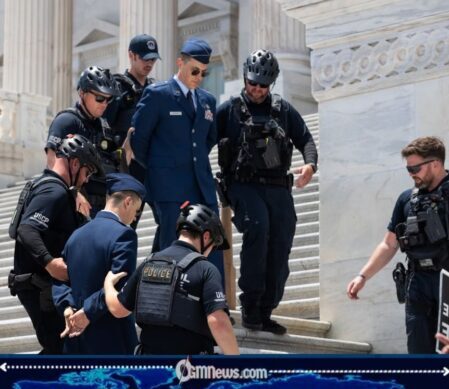
Trump criticism has taken an extraordinary turn for U.S. Air Force Maj. Jason Watson, who is now facing formal criminal charges under the Uniform Code of Military Justice after publicly calling for the impeachment and removal of President Donald J. Trump. The development follows Watson’s arrest at the U.S. Capitol in July, a subsequent military detention and his decision to continue speaking publicly about his opposition to the president. What began with a protest sign reading “Impeach Convict Remove” has now become a serious military justice case, proving once again that Washington can turn a few words into an entire legal department’s workload. (KESQ)
Did a Capitol Protest Cross the Military’s Red Line? Air Force Major Now Faces Charges
Watson, an active-duty Air Force major, was arrested on July 1 after appearing in uniform on the steps of the U.S. Capitol and calling for Congress to impeach and remove Trump and Vice President JD Vance. He criticized the administration over issues including the U.S. war with Iran, while holding a sign demanding impeachment, conviction and removal. The Air Force subsequently announced that it would investigate the incident, emphasizing that allegations of misconduct are taken seriously and that the military has an obligation to remain politically nonpartisan. (CNA)
The matter escalated after Watson later appeared publicly to explain why he had accepted the professional risks associated with his protest. On August 18, he was detained by the Air Force and placed in pretrial confinement after the service said there was probable cause supporting allegations of continued misconduct. His attorney said Watson had informed his chain of command about his intentions and had subsequently been ordered to wear his uniform before his detention. The case therefore moved beyond a Capitol protest into an internal military disciplinary process with potentially serious consequences for his career. (CNN Transcripts)
Rare Charges Put Military Discipline and Political Dissent on a Collision Course
The latest development is substantially more serious than the initial investigation. According to a charging document shared by Watson’s attorney, he faces three alleged violations of Article 88 for contemptuous remarks concerning Trump, five alleged violations of Article 92 for disobeying orders, and two alleged violations of Article 133 concerning conduct unbecoming an officer. The Article 88 allegations reportedly relate to comments made during a June interview, his July 1 Capitol protest and his August 17 television interview. (KESQ)
The unusual nature of the Article 88 allegations is particularly significant. A review cited in the latest reporting found only two convictions for contempt-of-officials charges since the modern UCMJ took effect in 1951. One involved Army Lt. Henry Howe, who was convicted after a Vietnam War protest in 1965; another involved former Marine Lt. Col. Stuart Scheller, who pleaded guilty in 2021 after publicly criticizing the Biden administration’s handling of the Afghanistan withdrawal. That history places Watson’s case in a very small category of military prosecutions, although being charged is not the same as being convicted. (KESQ)
The central tension is therefore bigger than one officer and one president. Active-duty service members face restrictions on partisan political activity, particularly when wearing the uniform, and Article 88 specifically addresses contemptuous language toward senior civilian officials. At the same time, Watson’s case raises difficult questions about where constitutional expression ends and military discipline begins. His critics can argue that an officer cannot simply transform a military uniform into a political campaign costume; his supporters can argue that punishing criticism of civilian leadership deserves careful scrutiny. The law, rather inconveniently for everyone seeking a simple social-media argument, requires those questions to be separated from political allegiance. (MarketScreener)
Trump criticism has now become the opening chapter of a case that could test the boundaries of political expression within America’s active-duty military. Watson’s formal charges do not establish guilt, and the military justice process still has to determine what actually happened and what penalties, if any, are justified. The coming proceedings could therefore prove more consequential than the original Capitol protest, offering a closely watched test of military discipline, political neutrality and the limits of dissent by serving officers. OGM News will continue watching the case as the next legal chapter unfolds.


This casino has been my consistent pick for weekend entertainment. The game selection is top...