









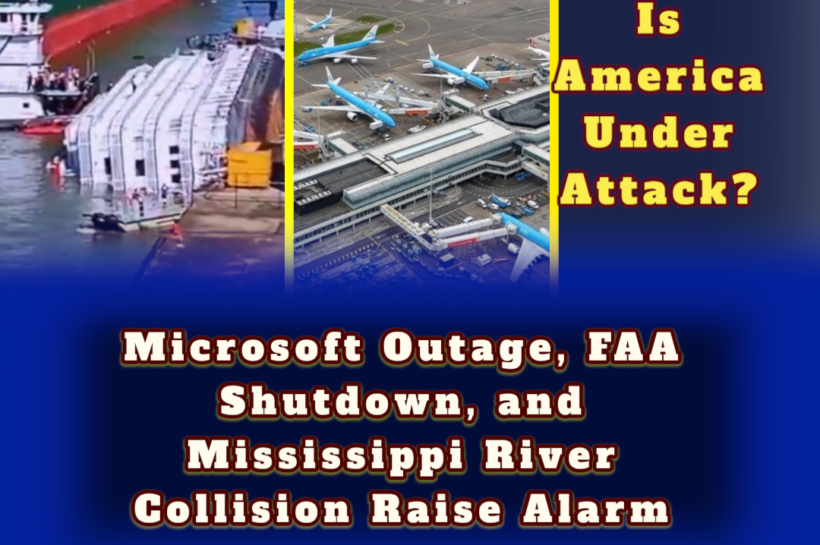












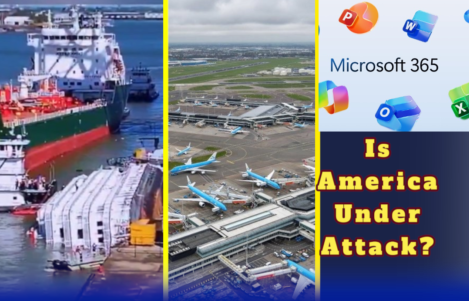
America on Edge — OGM News | Three alarming incidents, three different sectors, and one unsettling question: Is America experiencing an extraordinary run of technical failures and accidents, or is something more sinister unfolding behind the scenes? From Microsoft’s technology troubles to reports of a nationwide Federal Aviation Administration (FAA) shutdown and an oil-related vessel colliding with a cruise ship on the Mississippi River, the developments raise serious concerns about the resilience of America’s critical infrastructure. While there is no established evidence connecting these incidents to a coordinated attack, the troubling combination deserves public scrutiny. After all, when computers malfunction, aviation systems stumble, and vessels collide, Americans have every reason to ask whether the nation’s safety systems are functioning as they should.
America on Edge as Microsoft Goes Dark: When America’s Digital Backbone Suddenly Needs a Restart
America on Edge — OGM News | The first warning sign came on Thursday, November 12, when a widespread Microsoft 365 outage disrupted Outlook, Exchange Online, and services dependent on Microsoft’s email infrastructure. Businesses, government offices, and ordinary users encountered problems accessing essential digital tools. At one point, Downdetector recorded more than 130,000 reports of Outlook problems. Microsoft investigated server health-check failures and unresponsive infrastructure, while users wondered how a technology giant could leave so many people digitally stranded. Apparently, America’s productivity depends on a few servers remembering to wake up in the morning.
America on Edge — OGM News | Microsoft reported no indication that malicious activity caused the outage. Nevertheless, the disruption highlighted an uncomfortable reality: when businesses and public agencies rely heavily on interconnected technology platforms, a single service failure can produce consequences far beyond an inconvenient email notification. This is not proof of a cyberattack, but it is a reminder that digital resilience must be more than a reassuring slogan printed on a corporate presentation.
America on Edge as FAA Grounds America: Thousands of Flights Disrupted as Communications Fail
America on Edge — OGM News | Then came Friday’s aviation emergency. On November 13, the FAA imposed a nationwide ground stop following a telecommunications outage affecting the country’s 22 regional air traffic control centers. Departing aircraft were held on the ground as technicians investigated, while planes already airborne were permitted to land. By early evening, thousands of flights had been delayed or canceled, creating widespread disruption for passengers, airlines, cargo operations, and international travel. For a country that prides itself on technological superiority, having much of its aviation network suddenly unable to function normally is hardly the kind of American exceptionalism anyone ordered.
Homeland Security Secretary Markwayne Mullin said there was no indication that terrorism or deliberate sabotage had caused the communications failure. Officials also cautioned against connecting the FAA disruption to Microsoft’s outage without evidence. But that does not eliminate legitimate questions about aging infrastructure, system redundancy, emergency preparedness, and federal oversight. President Donald J. Trump’s administration now faces the challenge of ensuring that the public receives clear explanations and that investigators identify the actual failure rather than allow speculation to fill the information vacuum. When America’s skies become a nationwide waiting room, accountability should not be stuck on the runway.
America on Edge: Mississippi River Collision
America on Edge — OGM News | As the country absorbed news of the technology and aviation disruptions, a maritime emergency unfolded near downtown New Orleans. On Friday afternoon, the American Heritage, a river cruise ship operated by American Cruise Lines, was struck by the Atlantic Asphalt, an asphalt tanker, while the passenger vessel was docked on the Mississippi River. Approximately 130 passengers were aboard, and the impact caused the cruise ship to begin sinking. Passengers scrambled to escape as emergency responders and nearby vessels assisted with evacuations. Contrary to initial descriptions of an oil rig collision, the other vessel was an asphalt tanker, not an offshore drilling rig.
The U.S. Coast Guard and local emergency agencies responded, with New Orleans Mayor Helena Moreno confirming by approximately 4:30 p.m. that everyone aboard had been accounted for. The Coast Guard temporarily restricted navigation along part of the river while rescue operations continued. The incident raises serious questions about maritime navigation, vessel movements, and safety procedures, although the cause of the collision has not been established. Three major incidents within roughly two days certainly make for an unsettling news cycle, but their proximity in time does not establish a common cause. Sometimes the truth is less cinematic than a conspiracy thriller and more embarrassing: multiple critical systems can encounter serious trouble without anyone coordinating the chaos.
Is America Under Attack, or Are Its Systems Under Strain?
America on Edge — OGM News | The question deserves attention, but the evidence must determine the answer. Microsoft’s service disruption, the FAA’s nationwide ground stop, and the Mississippi River collision are serious developments with consequences for public safety, commerce, and confidence in essential infrastructure. As of this report, authorities have not established that the three incidents are connected or represent a coordinated attack. What Americans deserve now is a transparent investigation, credible explanations, and practical measures to prevent similar emergencies. OGM News will continue monitoring official findings, recovery efforts, and any verified developments that could change the understanding of these incidents. Until then, the most responsible question is not simply who might be attacking America, but whether America’s critical systems are sufficiently prepared when things go wrong.



https://addlinks.pro/QOrqA