


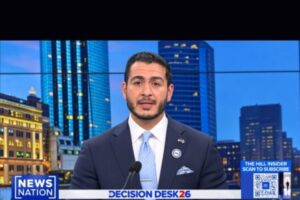





















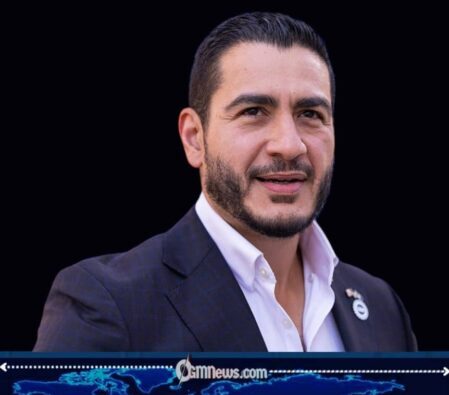
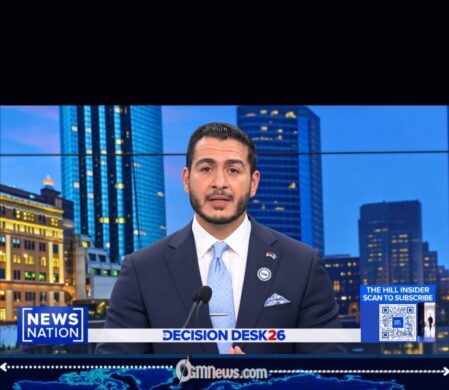
Abdul El-Sayed, the Michigan Democratic Senate candidate, has reignited the heated American argument over immigration enforcement, healthcare spending and the cost of military intervention, arguing that huge sums of public money could be better used to improve life at home. In the remarks supplied to OGM News, El-Sayed questioned the wisdom of directing hundreds of billions of dollars toward Immigration and Customs Enforcement (ICE), saying America could maintain a secure border and enforce immigration laws without resorting to deadly force.
His argument arrives amid an increasingly fierce 2026 debate over immigration enforcement under current President Donald J. Trump. Recent analysis estimated the cost of Trump’s mass-deportation programme at about $268.9 billion over his second term, while congressional legislation has also provided substantial new funding for ICE and other immigration-enforcement agencies.
The Billion-Dollar Question Behind the Border Debate
El-Sayed’s central complaint is less about whether America should have a border and more about what the country chooses to spend protecting it. In his formulation, the United States can enforce immigration policy while still respecting human life, effectively asking whether national security must always arrive carrying a very large cheque. The figure of $252 billion cited in the supplied remarks should be understood as El-Sayed’s political framing rather than a verified standalone ICE appropriation. Official Congressional Budget Office estimates show major new allocations for ICE and Customs and Border Protection, but the figures vary depending on which legislation and period are counted.
That distinction, however, does little to reduce the political drama. Federal immigration enforcement has become one of the most expensive and controversial components of the Trump administration’s domestic agenda, with billions allocated for personnel, detention, transportation, technology and deportation operations. A recent analysis put the broader projected cost of the administration’s deportation drive at $268.9 billion, giving critics like El-Sayed fresh ammunition to ask whether some of that money could instead strengthen healthcare, housing and other domestic priorities.
When Immigration Enforcement Meets the Healthcare Debate
El-Sayed has made healthcare a major part of his political message, arguing that America should invest more heavily in ordinary citizens instead of allowing public resources to disappear into what he views as an aggressive enforcement system. His criticism of ICE also follows a broader campaign position that the agency should be abolished and replaced with a different system capable of enforcing immigration laws without what he describes as paramilitary tactics.
And then comes the part that makes Washington’s budget spreadsheets look like comedy scripts: the politician is effectively asking whether America can afford to spend enormously on enforcement while millions of Americans continue arguing over the cost of medical care. His position is that a secure border and humane enforcement do not have to be enemies. Recent controversy surrounding ICE shootings and the agency’s planned nationwide body-camera rollout has intensified questions about transparency and accountability, with critics concerned that footage could be withheld when officials decide its release is not in the agency’s “best interests.”
For OGM News, the bigger political joke may be that America’s budget debate increasingly resembles a family argument over an enormous household bill: everybody agrees something must be paid, but nobody agrees whether the money should go toward the security gate, the hospital, the school roof or another foreign battlefield. El-Sayed’s warning about wars that America has “no business fighting” therefore connects his immigration criticism to his wider opposition to costly military intervention, particularly as the Trump administration faces continuing controversy over its foreign-policy decisions.
The argument is unlikely to disappear soon. Whether voters accept El-Sayed’s prescription or reject it as politically unrealistic, his message has placed the familiar American question of security versus spending priorities directly in the election spotlight. With immigration enforcement, healthcare and foreign policy all competing for public attention and federal dollars, OGM News will continue watching the political battle—and the numbers behind it—for what comes next.


[…] […]