




















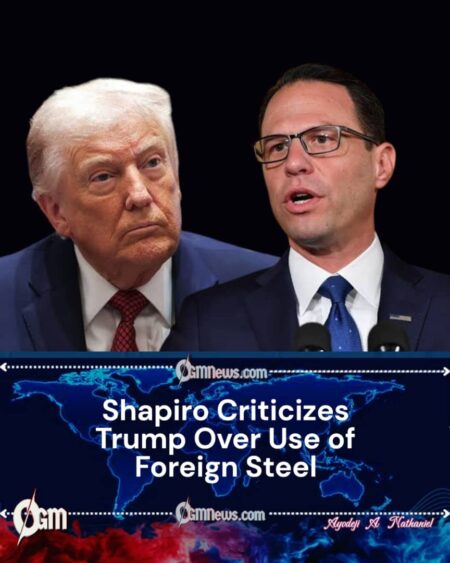
Pennsylvania Governor Josh Shapiro has accused President Donald Trump of using foreign steel in the construction of a ballroom associated with his business interests, raising questions about the consistency of the president’s long-standing “Buy American” messaging.
The allegation has quickly drawn national attention, as it touches on one of the defining themes of Donald Trump’s economic policy—support for domestic manufacturing. While the claim remains subject to verification, it has already fueled a broader political debate over trade policy, construction practices, and public accountability.
The Allegation and Its Political Significance
According to Josh Shapiro, the use of imported steel in a Trump-linked project contradicts the administration’s repeated emphasis on prioritizing American-made materials. The governor framed the issue as one of credibility, suggesting that actions should align with public policy positions.
The criticism comes at a time when economic nationalism remains a central topic in U.S. politics. By highlighting this alleged inconsistency, Josh Shapiro has sought to draw attention to what he and other critics view as a gap between rhetoric and practice.
Political analysts note that such allegations often carry symbolic weight, particularly when they involve industries like steel that are closely tied to national identity and employment.
Trump’s ‘Buy American’ Policy Framework
President Donald Trump has built much of his economic platform around support for domestic industries, including steel manufacturing. His policies have included tariffs on imported metals and public appeals for companies to source materials within the United States.
These initiatives have been widely covered by major outlets and have positioned steel production as a key component of national economic strategy. As a result, any claim suggesting reliance on foreign materials in Trump-affiliated projects is likely to attract heightened scrutiny.
Supporters of the president argue that broader policy measures, rather than individual business decisions, should be the primary metric for evaluating commitment to the domestic industry.
Construction Practices and Global Supply Chains
Industry experts and prior reporting from outlets such as Reuters and Bloomberg indicate that large-scale construction projects often involve a combination of domestic and imported materials. Factors such as cost, availability, and technical specifications can influence sourcing decisions.
In many cases, procurement is handled by contractors rather than project owners, which can complicate efforts to attribute responsibility for specific material choices. This distinction is frequently highlighted in coverage of similar controversies.
As such, even if foreign steel were used, analysts caution that this would not necessarily indicate a direct policy contradiction without further details about procurement processes and contractual arrangements.
Calls for Verification and Transparency
The allegation by Josh Shapiro has prompted calls for greater transparency regarding the sourcing of materials used in the project. Independent verification would likely require access to construction records, supplier data, and contractor disclosures.
Major news organizations typically approach such claims with caution, emphasizing the importance of corroborating evidence before drawing definitive conclusions. As of now, the issue remains in the realm of political accusation rather than confirmed fact.
Observers note that the outcome of any verification process could significantly influence public perception, particularly in the context of ongoing debates about economic policy.
Broader Political and Economic Implications
The controversy highlights the broader intersection of politics, business practices, and public messaging. For President Donald Trump, the issue underscores the challenges of maintaining consistency between policy advocacy and private-sector activities.
For critics, the allegation represents an opportunity to question the effectiveness and authenticity of “Buy American” initiatives. For supporters, it serves as a reminder of the complexities involved in global supply chains and construction logistics.
Ultimately, the debate reflects deeper divisions over trade policy and economic priorities, with implications that extend beyond a single project.
A Debate That Extends Beyond One Project
The accusation by Josh Shapiro against President Donald Trump has opened a wider discussion about the alignment between political messaging and real-world practices.
While the claim remains unverified, it has already contributed to an ongoing national conversation about manufacturing, accountability, and transparency. As further details emerge, the issue is likely to remain a focal point in discussions of U.S. economic policy and leadership.


The weekly tournaments here keep me coming back because the prize pools are surprisingly generous....