







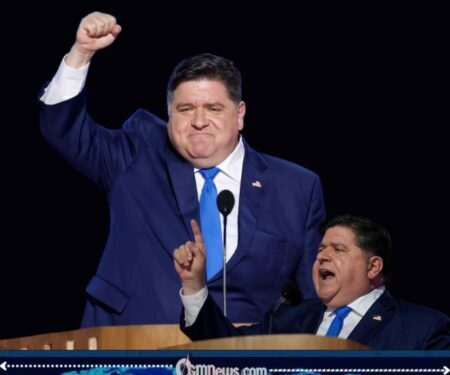
JB Pritzker has made headlines after becoming the first sitting governor in the United States to publicly call for the invocation of the 25th Amendment, marking a dramatic escalation in political rhetoric and raising serious constitutional questions. The Illinois governor’s remarks came during a moment of heightened national tension, where concerns about leadership and stability have increasingly dominated public discourse. His statement has quickly drawn widespread attention across political, legal, and media circles.
The unprecedented nature of the call has prompted immediate reactions from both supporters and critics, with many debating whether such a move is justified or politically motivated. While the 25th Amendment provides a mechanism for addressing presidential incapacity, it has rarely been invoked in modern political discussions at this level.
Observers note that the governor’s comments reflect growing unease in certain political quarters, as well as a willingness to push constitutional boundaries in response to perceived crises. The implications of this moment are likely to reverberate far beyond the immediate news cycle.
Political Reactions and National Debate
JB Pritzker has defended his position by emphasizing what he describes as a responsibility to speak out during moments of national concern, arguing that leaders must prioritize the country’s stability above political considerations. His remarks have resonated with some audiences who share similar concerns.
Across the political spectrum, reactions have been sharply divided, with critics accusing the governor of overstepping his authority and injecting further polarization into an already tense environment. Supporters, however, argue that raising the issue is within his rights and reflects the seriousness of the situation.
The debate has quickly spread beyond traditional media, with social platforms amplifying discussions and bringing a wide range of perspectives into the spotlight. The issue has become a focal point for broader conversations about leadership and accountability.
JB Pritzker and the 25th Amendment Debate
JB Pritzker has placed himself at the center of a complex constitutional debate, as legal experts weigh in on the practicality and implications of invoking the 25th Amendment. The provision allows for the transfer of presidential power under specific circumstances, typically involving incapacity.
Legal scholars have noted that invoking the amendment requires cooperation among key figures within the executive branch, making it a highly structured and rarely used mechanism. As a result, calls for its use often carry significant political weight, even if they do not lead to action.
The governor’s statement has reignited interest in the amendment’s history and application, prompting renewed public curiosity about how it functions and under what conditions it might be considered appropriate.
Historical Context and Constitutional Limits
JB Pritzker has drawn attention to historical precedents, though experts point out that the 25th Amendment has primarily been used in limited, procedural contexts rather than as a response to political disputes. This distinction has become central to the ongoing debate.
Past instances of the amendment’s use have typically involved temporary transfers of power during medical procedures, rather than long-term or contentious situations. This history underscores the gravity of suggesting its broader application.
Analysts caution that expanding the use of constitutional mechanisms beyond their traditional scope could have unintended consequences, potentially altering the balance of power and setting new precedents for future administrations.
Public Response and Media Coverage
JB Pritzker has continued to dominate headlines as media outlets analyze the potential impact of his remarks and explore the broader political context in which they were made. Coverage has ranged from supportive to critical, reflecting the polarized nature of the issue.
Public response has mirrored this divide, with some citizens expressing concern about the implications of such a call, while others view it as a necessary step in addressing serious concerns about governance. The conversation has become a reflection of wider societal divisions.
The role of media in shaping the narrative has been particularly significant, as different outlets emphasize varying aspects of the story, influencing how audiences interpret the governor’s statement and its significance.
JB Pritzker has indicated that his comments are part of a broader effort to encourage discussion and reflection, rather than an immediate call to action. This framing suggests that the debate may continue to evolve in the coming weeks.
Political observers note that the long-term impact of this moment will depend on how other leaders respond and whether the conversation leads to tangible developments or remains largely symbolic. The situation remains fluid and unpredictable.
As the national conversation unfolds, the governor’s remarks serve as a reminder of the complexities of constitutional governance and the challenges of navigating political crises in a deeply divided environment.
FoSEnYRcnzkCFxcrkTIkEJxP