













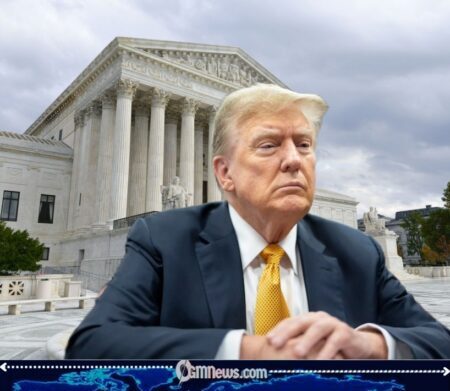
The United States Supreme Court on Wednesday cast significant doubt on an executive order by President Donald Trump seeking to end automatic birthright citizenship, as justices questioned both the constitutional foundation and practical implications of the policy. The high-stakes case, Trump v. Barbara, tests a central pillar of the administration’s immigration agenda and could reshape long-standing interpretations of American citizenship.
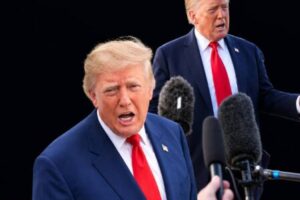
During oral arguments, a majority of the justices appeared skeptical of the Trump administration’s position, with members across ideological lines pressing government lawyers on the meaning of the Citizenship Clause in the Fourteenth Amendment to the United States Constitution. The President Trump, attending part of the session alongside senior officials, later defended his stance publicly, underscoring the political and legal stakes surrounding the case.
Judicial Scrutiny Dominates Proceedings
The courtroom exchanges reflected deep concern among the justices regarding the scope and justification of the executive order. Chief Justice John Roberts questioned whether the Trump administration’s interpretation stretched narrow historical exceptions into a sweeping rule affecting millions of individuals.
Other members of the bench echoed similar reservations. Justice Elena Kagan suggested that the constitutional text did not support the government’s argument, while Justice Amy Coney Barrett raised doubts about whether the framers of the amendment intended such a restrictive approach without explicitly stating so.
Even conservative-leaning justices posed probing questions, highlighting uncertainty within the court. Justice Neil Gorsuch focused on the logistical challenges of determining legal domicile for newborns, while Justice Samuel Alito pointed to humanitarian concerns surrounding undocumented families.
Trump Administration’s Argument: A Narrower Interpretation
Representing the Trump administration, Solicitor General D. John Sauer argued that birthright citizenship has been misinterpreted for decades. He contended that the phrase “subject to the jurisdiction thereof” should apply only to individuals lawfully present and intending permanent residence in the United States.
Sauer relied heavily on the 1898 Supreme Court decision United States v. Wong Kim Ark, asserting that references to “domicile” in the ruling support a more restrictive understanding of citizenship. According to the Trump administration, extending citizenship universally diminishes its value and creates incentives for practices such as “birth tourism.”
However, justices repeatedly challenged this interpretation. Chief Justice Roberts described the Trump administration’s reliance on limited historical examples as insufficient to justify such a broad policy shift, emphasizing that constitutional interpretation must remain grounded in consistent legal principles.
Practical Concerns Over Implementation
Beyond constitutional interpretation, the court examined how the executive order would function in practice. Justice Ketanji Brown Jackson questioned how authorities would determine a newborn’s citizenship status, asking whether documentation checks would occur immediately after birth.
Justice Barrett also highlighted complications involving children whose parentage is unknown or whose parents were trafficked into the country. Such scenarios, she noted, could create administrative uncertainty and legal disputes under the proposed framework.
Justice Sonia Sotomayor warned that adopting the Trump administration’s reasoning might open the door to retroactive challenges to citizenship, potentially affecting millions of Americans across generations.
Challengers Warn of Far-Reaching Consequences
Opponents of the executive order, represented by Cecilia Wang of the American Civil Liberties Union, argued that the policy would disrupt established legal frameworks and undermine fundamental rights.
Wang cautioned that thousands of children could immediately lose citizenship if the order were upheld, while the legal status of millions more could be thrown into uncertainty. She maintained that the longstanding interpretation of the Fourteenth Amendment, reinforced by precedent, clearly supports birthright citizenship regardless of parental status.
The justices engaged extensively with her reading of the Wong Kim Ark decision, particularly regarding whether “domicile” was central to the ruling. Justice Brett Kavanaugh suggested that agreement with the challengers’ interpretation could lead to a relatively straightforward decision against the administration.
Historical and Legislative Context
For more than a century, the Citizenship Clause of the Fourteenth Amendment has been understood to grant automatic citizenship to nearly all individuals born on U.S. soil. This interpretation was reinforced by Congress in the Immigration and Nationality Act of 1952, which adopted similar language.
During arguments, Justice Kavanaugh questioned why Congress would replicate this language if it intended to limit the scope of birthright citizenship. His remarks underscored the importance of legislative intent in interpreting both statutory and constitutional provisions.
The Trump administration, however, argued that evolving global conditions—including increased international mobility—necessitate revisiting earlier interpretations. Critics countered that such changes do not alter the meaning of constitutional text.
Awaiting a Landmark Decision
The Supreme Court is expected to deliver its ruling by late June or early July, with potentially far-reaching consequences for immigration policy and constitutional law. If the justices strike down the executive order, they may do so on constitutional grounds, statutory interpretation, or both.
Conversely, a decision in favor of the administration could significantly redefine the criteria for American citizenship, marking one of the most consequential shifts in U.S. legal doctrine in decades.
As the nation awaits the outcome, the case stands as a critical test of the balance between executive authority and constitutional protections, with implications extending well beyond immigration policy.

Logging in is a breeze and the site stability is amazing even during peak hours....