





















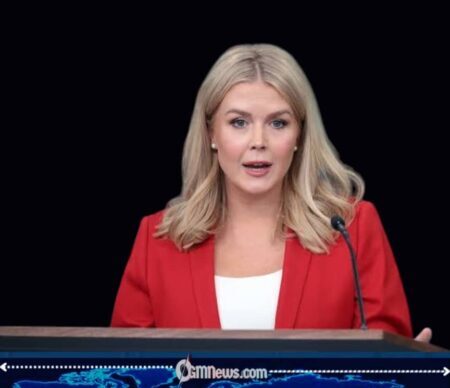
Karoline Leavitt has positioned the SAVE America Act as a “common sense” reform aimed at strengthening election integrity across the United States, following its passage in the House of Representatives. Leavitt argues the legislation reflects widespread public support for voter identification requirements, while critics warn it could create barriers for eligible voters. As the bill advances to the Senate, the debate underscores deep divisions over how to balance election security with voter access.
Karoline Leavitt Frames the Bill as Election Integrity Reform
Karoline Leavitt has repeatedly emphasized that the SAVE America Act is designed to ensure that only eligible U.S. citizens participate in federal elections. She maintains that the legislation reinforces existing laws prohibiting non-citizen voting while introducing verification standards to ensure compliance.
According to Leavitt, uniform voter identification requirements would increase public confidence in election outcomes by eliminating inconsistencies among states. Supporters echo her position, arguing that standardized rules would simplify enforcement and strengthen trust in democratic institutions.
Critics, however, contend that Leavitt’s framing overlooks the rarity of documented non-citizen voting cases and fails to address concerns about access for voters lacking documentation.
Core Provisions: Federal Standards for Voter Identification
The SAVE America Act establishes nationwide requirements for voter verification, including proof of U.S. citizenship during registration and government-issued photo identification for in-person voting. Supporters, including Karoline Leavitt, argue these measures modernize election safeguards and align federal standards with policies already adopted in several states.
Proponents say the bill will create consistency across jurisdictions, reducing confusion for voters who move between states. They also assert that stronger verification processes will deter fraud and enhance election credibility.
Election administrators caution that implementing the new standards could require significant system upgrades, including database integration and training for poll workers.
Critics Warn of Barriers for Eligible Voters
Opponents argue that stricter identification requirements may disproportionately affect certain groups. Civil rights advocates warn that elderly citizens, low-income voters, naturalized Americans, and rural residents could face challenges obtaining required documentation.
Karoline Leavitt has responded to these concerns by stating that the legislation includes provisions intended to streamline documentation processes and improve access. Nevertheless, advocacy groups remain skeptical about whether safeguards will be sufficient.
Experts also highlight potential complications for voters whose legal names differ from official records, noting that administrative hurdles could discourage participation even among eligible citizens.
Administrative and Financial Challenges for States
State and local election officials have raised concerns about the logistical and financial demands of implementing federal voter ID standards. Many jurisdictions lack real-time citizenship verification systems, which could slow voter registration processing.
Karoline Leavitt has suggested that federal support and phased implementation could ease the transition, though details on funding and timelines remain limited. Officials warn that new training requirements and public education campaigns will be essential to ensure compliance.
Despite these concerns, supporters argue that long-term benefitssuch as increased voter confidence and standardized procedures—justify the initial investment.
Political Divide and Senate Uncertainty
The SAVE America Act has intensified partisan divisions, with Republicans largely backing the measure as a safeguard against fraud and Democrats warning it could suppress turnout. Karoline Leavitt has framed the bill as a bipartisan opportunity to strengthen democracy, citing polling that indicates broad public support for voter ID laws.
The bill’s future in the Senate remains uncertain, where procedural hurdles and calls for compromise could reshape its provisions. Lawmakers from both parties have signaled openness to negotiations, though fundamental disagreements persist.
Analysts suggest the debate may influence campaign narratives and voter priorities in upcoming elections, making the legislation a focal point in national political discourse.
Historical Context: Voter ID Laws in the United States
Voter identification requirements have long been a contentious issue in U.S. election policy. Several states have implemented photo ID laws, while others rely on alternative verification methods such as signature matching.
Karoline Leavitt has pointed to state-level adoption as evidence that voter ID laws can be implemented without suppressing turnout. Critics counter that the impact varies by demographic group and region, highlighting the need for careful evaluation of national standards.
The SAVE America Act represents one of the most significant federal efforts to standardize voter identification requirements, potentially reshaping election administration nationwide.
National Leadership and Broader Implications
The legislation has gained support from allies of Donald Trump, the current U.S. president serving a second term, whose administration has emphasized election integrity as a central domestic priority. Supporters argue federal standards could strengthen democratic institutions, while critics warn the law’s long-term impact will depend on implementation and judicial review.
Policy experts note that the Senate’s decision and any subsequent legal challenges will determine whether the SAVE America Act becomes a defining feature of U.S. election law.
[…] […]