



























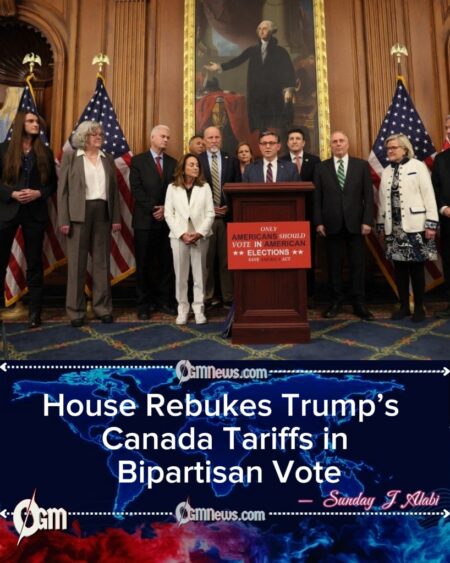
In a closely watched vote that underscored divisions within the Republican Party, the U.S. House of Representatives has passed a resolution seeking to overturn tariffs imposed on Canadian goods by President Donald Trump, who is currently serving his second term in office. The measure, approved by a 219 to 211 margin, saw six Republican lawmakers join Democrats in backing the effort.
While largely symbolic at this stage, the vote marks a notable congressional challenge to one of President Trump’s key trade policies. The resolution must still pass the Republican-controlled Senate and would ultimately require the President’s signature — an outcome widely viewed as unlikely.
A Narrow Vote Reflects Deep Divisions
The House vote revealed the fragile balance of power in the chamber, where Republicans hold only a slim majority. With near-unanimous Democratic support for the resolution, the defection of six Republicans proved decisive.
The measure was introduced by Representative Gregory Meeks, the top Democrat on the House Foreign Affairs Committee. He argued that the President had “weaponized tariffs” against U.S. allies, warning that such policies risk destabilizing long-standing trade relationships and disrupting global markets.
House Speaker Mike Johnson, a key ally of President Trump, had attempted to prevent the measure from reaching the floor. His procedural efforts failed, allowing lawmakers to debate and vote on the resolution in full view of the public.
Trump Defends Tariffs as Economic Shield
As the vote unfolded, President Trump took to Truth Social to defend his tariff strategy and caution Republican lawmakers against opposing it. In a strongly worded post, he warned that any Republican who voted against tariffs would “seriously suffer the consequences come Election time.”
The President maintained that tariffs have strengthened both economic and national security, framing them as essential tools in safeguarding American industries. “TARIFFS have given us Economic and National Security,” he wrote, adding that no Republican should be responsible for undermining those gains.
Since his re-election, President Trump has expanded his tariff agenda, including threatening a 100% import tax on certain Canadian goods in response to Canada’s proposed trade agreement with China. The move intensified tensions between the two North American trading partners.
Economic Concerns Drive Bipartisan Opposition
Several lawmakers cited economic impacts as the primary reason for supporting the resolution. Representative Don Bacon of Nebraska, one of the six Republicans who voted with Democrats, described tariffs as a “net negative” for the U.S. economy.
He argued that tariffs function as a tax borne by American consumers, manufacturers, and farmers. According to Bacon and others, higher import duties have contributed to increased costs for businesses and households, particularly in industries reliant on cross-border supply chains.
Democrats echoed those concerns, asserting that strained relations with Canada — one of America’s largest trading partners — could have long-term consequences. Meeks contended that the tariffs have harmed bilateral ties and inadvertently pushed Canada closer to China in trade negotiations.
An Uncertain Path in the Senate
Despite the House vote, the resolution faces steep odds in the Senate, where Republicans also hold a majority. Even if the measure were to pass, it would require President Trump’s approval to become law — a scenario widely regarded as improbable given his firm stance on tariffs.
As a result, many analysts view the House action as a political statement rather than a legislative breakthrough. It nevertheless signals that opposition to the administration’s trade strategy extends beyond party lines.
The debate also reflects broader questions within the Republican Party about economic policy, free trade, and the use of tariffs as leverage in international negotiations.
Legal Challenges Add Another Layer
Beyond the legislative battle, President Trump’s tariff authority is under judicial review. The U.S. Supreme Court is expected to rule soon on a case that questions the legal basis for the President’s imposition of certain levies.
The outcome of that case could have far-reaching implications for executive power in trade policy. Should the Court limit presidential authority, it may reshape how future administrations deploy tariffs.
Meanwhile, Representative Meeks has indicated that the Canada resolution is only the beginning. He has announced plans to introduce additional measures aimed at reversing tariffs on Mexico, Brazil, and what he termed the administration’s broader “Liberation Day” global tariff initiative
Broader Implications for U.S.–Canada Relations
The tariff dispute arrives at a delicate moment in U.S.–Canada relations. Trade between the two nations accounts for hundreds of billions of dollars annually, with deeply integrated supply chains spanning automotive manufacturing, agriculture, and energy.
Diplomatic observers note that sustained trade friction could complicate cooperation on issues ranging from border security to environmental policy. Canadian officials have previously expressed concern that escalating tariffs risk undermining decades of economic integration under agreements such as the United States–Mexico–Canada Agreement (USMCA).
While the immediate impact of the House vote remains limited, it underscores mounting pressure within Washington to reassess the costs and benefits of an assertive tariff strategy.

[…] […]