












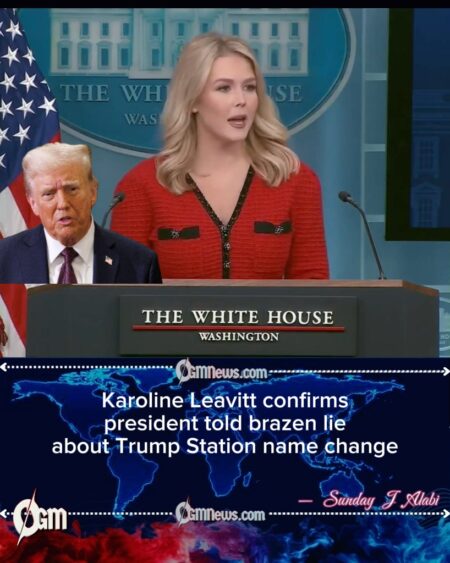
A routine White House press briefing this week took an unexpected turn when press secretary Karoline Leavitt addressed questions about a proposed renaming of New York’s Penn Station. Her response appeared to validate claims that President Donald Trump, now serving his second term, personally floated the idea—contradicting the president’s earlier public assertion that the suggestion originated with Senate Minority Leader Chuck Schumer.
Leavitt was asked why the president had approached Schumer about the potential name change. Rather than disputing the premise, she replied that the renaming was “something the President floated” during a conversation with the New York Democrat. The statement effectively aligned the White House with Schumer’s account of events.
The moment drew attention because it appeared to undermine the president Trump’s comments made days earlier aboard Air Force One, where he told reporters that Schumer had proposed the rebranding. The inconsistency has since fueled debate about transparency and accountability at the highest levels of government.
Competing Accounts and a Public Rebuttal
Following the president Trump’s remarks last week, Senator Schumer swiftly rejected the claim, calling it an “absolute lie” in a post on X and insisting that the idea did not originate with him. Schumer emphasized that he neither proposed nor supported renaming the historic transit hub.
Leavitt’s comments at Tuesday’s briefing, however unintentionally, reinforced Schumer’s position. By not challenging the question’s framing and by explicitly stating that the idea came from the president, the press secretary appeared to close the door on alternative interpretations.
The episode has drawn coverage across major media outlets, with analysts noting that such discrepancies—especially when clarified by official spokespeople—can carry political consequences beyond a single news cycle.
Infrastructure Funding and the Gateway Tunnel Dispute
At the center of the controversy is the Gateway Tunnel project, a long-delayed rail infrastructure initiative designed to connect New York City and New Jersey. The $16 billion project would replace the aging North River Tunnel, which has been in service since 1910 and requires extensive rehabilitation to meet modern standards.
Federal funds for the project were paused last Friday, halting progress and raising alarms among regional leaders. The Trump administration cited concerns over diversity, equity, and inclusion (DEI) initiatives as the reason for the funding freeze.
According to reporting by The New York Times, senior administration officials suggested to Schumer that cooperation on renaming Penn Station—and Washington Dulles International Airport—could help unlock the stalled funds. Schumer declined, noting that he lacks direct authority over such name changes.
Political Reactions and State-Level Criticism
The funding pause prompted sharp reactions from Democratic leaders in New York. Governor Kathy Hochul criticized the decision at a press conference, describing it as politically motivated and harmful to regional transportation needs.
Schumer, for his part, argued that only the president has the power to restart the project, underscoring the centralized nature of the decision-making process. He framed the situation as an inappropriate linkage between federal infrastructure funding and personal branding.
The White House has maintained that funding decisions were addressed separately from any discussion of renaming, though critics argue that the overlapping timelines and reported conversations raise legitimate concerns.
Legacy, Branding, and President Trump
The Penn Station episode fits into a broader pattern of President Trump’s efforts to leave a visible imprint during his second term. With nearly three years remaining, the president Trump has pursued several high-profile initiatives that blend governance with personal legacy.
These include plans to construct a new ballroom at the White House, controversial renovations at the Kennedy Center bearing Trump’s name, and the approval of commemorative Trump $1 coins for the nation’s 250th anniversary. Supporters view these actions as bold expressions of leadership, while detractors argue they blur the line between public service and self-promotion.
As debates continue over infrastructure priorities and presidential conduct, the remarks from Tuesday’s briefing have added a fresh layer of scrutiny—one that underscores how a few words from the podium can reverberate far beyond the briefing room.

[…] […]