



























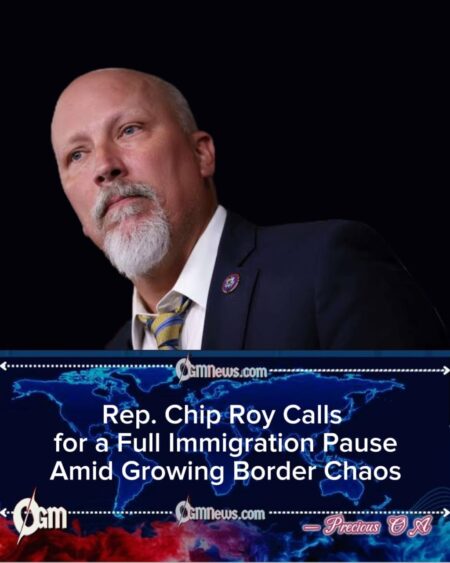
Rep. Chip Roy set off a renewed debate in Washington after declaring that the United States should pause all immigration until lawmakers and federal agencies can “figure out what the h-ll is going on,” framing the issue as one of basic governance rather than ideology. His remarks quickly circulated across political media, drawing both strong support from conservatives and sharp criticism from immigration advocates.
The statement came amid ongoing disputes over border enforcement, asylum processing backlogs, and disagreements between Congress and the executive branch over how to handle record migration flows. Supporters of the proposal argue that the scale of current challenges has overwhelmed existing systems, while opponents say a total pause is unrealistic and harmful.
Rep. Chip Roy emphasized that his position reflects frustration with what he describes as a lack of transparency and accountability in immigration policy. He argued that before expanding or even maintaining current levels of legal immigration, the government must first demonstrate that it can enforce existing laws effectively.
Border Pressures and Policy Gridlock
Border security has remained one of the most divisive issues in U.S. politics, with repeated efforts at comprehensive reform stalling in Congress. Lawmakers from both parties acknowledge strains on border communities, immigration courts, and social services, yet consensus on solutions has remained elusive.
Rep. Chip Roy has long positioned himself as a hardliner on immigration enforcement, frequently criticizing bipartisan deals that he says fail to address root causes. In this context, his call for a pause is being interpreted by allies as a negotiating tactic designed to force broader reforms.
Critics, however, argue that halting all immigration would have sweeping consequences for the economy, including labor shortages in healthcare, agriculture, and technology sectors. They warn that such a move could disrupt families, universities, and businesses that rely on legal immigration pathways.
Political Reactions Across the Spectrum
Rep. Chip Roy received immediate backing from several conservative lawmakers who echoed concerns about border security and federal oversight. They argue that a temporary halt could provide breathing room to audit agencies and reassess enforcement strategies.
Democrats and immigrant advocacy groups responded by calling the proposal extreme, noting that legal immigration is already tightly regulated. They contend that the challenges at the southern border should not be conflated with lawful immigration programs that operate separately.
Rep. Chip Roy countered those criticisms by insisting that the system functions as an interconnected whole, where failures in enforcement undermine public trust across all immigration channels. From his perspective, a pause would signal seriousness about restoring order.
Rep. Chip Roy and the Conservative Strategy
Within conservative circles, the proposal reflects a broader strategy to shift the immigration debate toward enforcement-first policies. Many on the right argue that previous compromises promised stronger enforcement but delivered limited results.
Rep. Chip Roy framed his remarks as a response to years of broken assurances, suggesting that incremental reforms have failed to stem illegal crossings or reduce bureaucratic chaos. He maintains that more dramatic steps are necessary to force change.
Others within the Republican Party are more cautious, warning that a blanket pause could alienate business interests and moderate voters. Still, the statement underscores internal debates over how aggressively the party should pursue immigration restrictions.
Economic and Social Implications
Rep. Chip Roy acknowledged that immigration plays a role in the U.S. economy but argued that economic considerations should not override the need for lawful processes. He claimed that unmanaged systems ultimately harm both citizens and immigrants.
Economists, however, point out that immigrants contribute significantly to economic growth, innovation, and tax revenues. A complete pause, even if temporary, could ripple through industries already struggling to fill positions.
Rep. Chip Roy responded by suggesting that domestic workforce participation and wage growth could improve if immigration pressures were reduced. This argument remains contested, with studies offering mixed conclusions.
What Comes Next in the Debate
As Congress continues to grapple with funding bills and border policy proposals, the idea of pausing immigration is unlikely to advance as formal legislation. Nevertheless, it has shifted the tone of the conversation and forced lawmakers to confront unresolved questions.
Rep. Chip Roy has indicated that he will continue pressing the issue through hearings, amendments, and public statements, keeping immigration at the forefront of conservative priorities.
The broader debate now centers on whether dramatic proposals like this can translate into practical policy or whether they primarily serve as pressure points in a deeply polarized system. What is clear is that immigration will remain a defining issue in the months ahead.


Casinoabc999? Good Site. The interface is sleek, and there is a lot of stuff to...