





















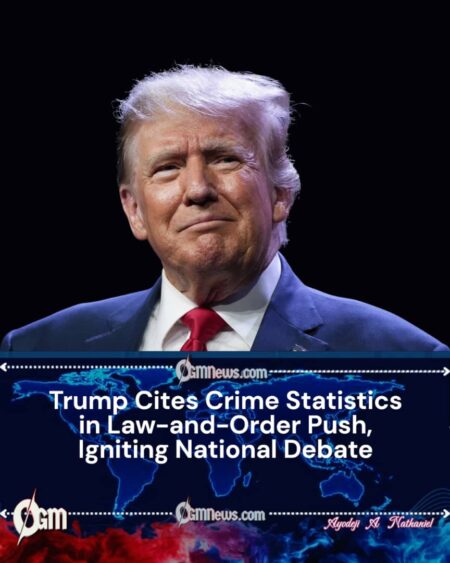
Washington, D.C. President Donald Trump, currently serving his second term as U.S. president, has sparked renewed national debate after asserting that a small share of the population is responsible for a disproportionate amount of violent crime. The remark, delivered during a public appearance and quickly amplified online, was framed by the president as a call for stronger law enforcement support and a renewed focus on public safety.
The statement immediately drew attention from policymakers, civil rights groups, criminologists, and media organizations, underscoring how discussions around crime statistics remain among the most contentious issues in American public life.
The President’s Statement and Its Framing
In his remarks, President Trump argued that honest discussion of crime data is necessary to restore law and order. He positioned the comment as a challenge to what he described as reluctance within mainstream discourse to address uncomfortable facts about violent crime.
Administration allies echoed the sentiment, saying the president was emphasizing accountability and the need for data-driven policing. They argue that ignoring crime patterns undermines effective law enforcement strategies and public confidence in safety institutions.
Immediate Political and Media Reaction
The statement prompted swift reaction across the political spectrum. Supporters praised the president for addressing crime directly, framing the remark as a candid assessment aligned with his long-standing law-and-order platform.
Critics, however, accused president trump of oversimplifying complex crime dynamics and using statistics without sufficient context. Several media outlets and commentators called for careful examination of the data underlying the claim, warning against interpretations that could stigmatize communities.
What Crime Data Typically Shows
Criminology experts note that violent crime patterns are influenced by multiple factors, including socioeconomic conditions, geography, policing practices, and reporting methods. While crime is often concentrated in specific areas and among repeat offenders, specialists caution that broad population-level claims can be misleading without precise definitions and sourcing.
Researchers also emphasize that crime statistics vary by year, jurisdiction, and measurement standards. As a result, responsible use of data typically requires detailed context to avoid misinterpretation or politicization.
Law Enforcement and Policy Implications
Police organizations and law enforcement advocates seized on the broader message of the president’s remarks, highlighting ongoing concerns about officer shortages, morale, and public support. They argue that clearer backing from political leadership is essential for effective crime prevention.
Policy analysts note that focusing solely on enforcement, without parallel investments in prevention and community programs, may have limited long-term impact. Many stress that balanced approaches combining policing, social services, and judicial reform tend to produce more sustainable results.
Civil Rights and Community Perspectives
Civil rights groups expressed concern that generalized crime claims risk reinforcing negative stereotypes and eroding trust between communities and law enforcement. They argue that public safety strategies must avoid language that could deepen social divisions.
Community leaders called for dialogue grounded in verified data and inclusive policy design. Several emphasized that public safety improves most when residents, police, and local institutions work collaboratively rather than in opposition.
A Familiar Theme in Trump’s Presidency
Crime and law enforcement have been recurring themes throughout President Trump’s political career. His latest remarks are consistent with previous calls for tougher policing, stricter sentencing, and a more confrontational approach to crime narratives.
As the debate continues, analysts expect the issue to remain central to broader discussions about governance, civil liberties, and the role of data in shaping national policy.


[…] […]