



























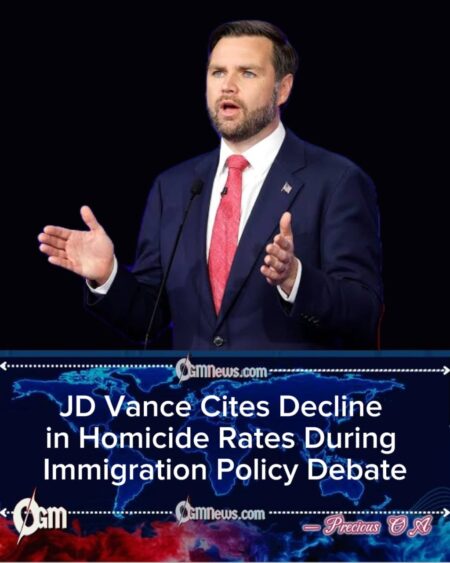
JD Vance addressed the national immigration debate by highlighting recent crime statistics, arguing that public safety outcomes should be considered when evaluating federal border and enforcement policies. His remarks were delivered during a public appearance and quickly circulated among lawmakers and political analysts.
JD Vance pointed to preliminary data indicating a decline in homicide rates in 2025, suggesting that enforcement-focused immigration policies have not resulted in the public safety harms alleged by critics.
The comments added fuel to an already contentious debate in Washington, where immigration enforcement and border security remain central points of division between Republicans and Democrats.
JD Vance Challenges Democratic Criticism
JD Vance criticized Democratic lawmakers for what he described as selective use of data when discussing immigration policy. He argued that crime trends are often overlooked in favor of broader ideological arguments.
JD Vance said that public discourse should include measurable outcomes, including violent crime rates, when assessing the effectiveness of federal enforcement strategies.
His remarks were framed as a rebuttal to ongoing criticism from Democratic leaders who argue that stricter immigration enforcement undermines humanitarian obligations and civil liberties.
Context Behind the Crime Data
JD Vance cited national crime statistics that suggest a year-over-year decrease in homicide rates, though experts caution that such figures can vary by region and reporting methodology.
JD Vance acknowledged that crime trends are influenced by multiple factors, but argued that immigration enforcement should not be blamed without clear evidence linking policy changes to crime increases.
Criminologists note that national crime data is often revised over time, and they urge policymakers to interpret early figures carefully while maintaining transparency.
Political Response and Reactions
JD Vance’s comments prompted swift reactions from Democratic lawmakers, some of whom disputed the interpretation of the data or emphasized other social indicators beyond homicide rates.
JD Vance maintained that the administration’s approach prioritizes enforcement while allowing for legal pathways, framing the policy as balanced rather than punitive.
Observers say the exchange reflects broader partisan divides, where data points are often used to reinforce competing narratives rather than foster consensus.
Broader Immigration Policy Implications
The debate comes as Congress continues negotiations over border security funding and immigration reform measures. Lawmakers remain divided over enforcement levels, asylum standards, and the role of federal agencies.
Republican leaders argue that consistent enforcement deters unlawful entry and supports public safety, while Democrats emphasize humanitarian protections and systemic reform.
The contrasting approaches have made comprehensive immigration legislation difficult to advance, despite widespread acknowledgment that the system requires modernization.
Looking Ahead in the Policy Debate
Future discussions are expected to focus on updated crime reports, border encounter data, and the long-term impacts of enforcement-driven strategies.
Both parties have indicated that immigration will remain a central issue heading into upcoming election cycles, ensuring continued scrutiny of policy outcomes.
As the debate evolves, analysts stress the importance of grounding policy arguments in verified data while recognizing the complex social and economic factors that shape crime and migration trends.

My interest in numismatics has grown recently. I was looking for numismatic articles, but many...