

























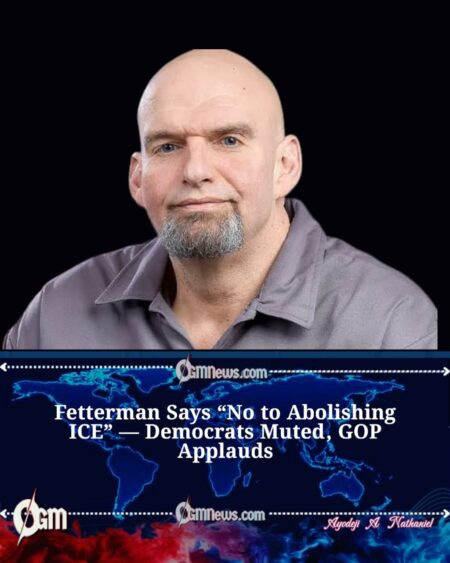
Democratic Senator John Fetterman has taken a public stance against growing calls within his party to require Immigration and Customs Enforcement (ICE) agents to reveal their identities, pushing back on demands to “unmask” federal officers during immigration operations.
The senator’s comments add a new layer to the already heated national debate around immigration enforcement, federal authority, and public accountability. While some Democrats argue that masking undermines transparency and enables abuse, Fetterman’s position reflects a competing concern: that forcing identification could expose agents to threats, harassment, or retaliation in a polarized climate.
Fetterman’s Position: Officer Safety Over Political Pressure
Fetterman’s opposition to unmasking ICE agents frames the issue as primarily one of operational security and officer protection, rather than ideology. His stance suggests that he views the push to unmask agents as potentially reckless, particularly in situations where immigration enforcement has triggered protests or heightened community tension.
Supporters of Fetterman’s view argue that anonymity can be necessary for law enforcement personnel operating in hostile environments. They note that officers—especially those involved in controversial enforcement missions—can face doxxing campaigns, intimidation, and threats against their families.
This argument is increasingly common among officials who prioritize public order and enforcement continuity, even as political debate around ICE remains deeply divisive.
Democrats Split: Accountability vs Enforcement Realities
Within Democratic circles, the “unmask ICE” push has gained traction among lawmakers and activists who see anonymity as a symbol of excessive federal force. They argue that visible identification is essential for oversight, civil rights accountability, and public trust, especially in encounters involving vulnerable communities.
In that view, masking creates conditions where misconduct is harder to track and victims may struggle to file complaints or identify officers involved in incidents. Critics also say that hiding identity can fuel fear and escalate conflict during enforcement actions.
Fetterman’s stance highlights an internal party divide: between those pushing for structural constraints on ICE and those emphasizing practical law enforcement realities, even when enforcement is unpopular with the party’s progressive base.
Political Impact: Fetterman’s Brand as a Party Outlier
Fetterman has increasingly built a public identity as a Democrat willing to reject party orthodoxy on high-profile issues—especially where he believes public opinion is less aligned with progressive messaging. His position on ICE masking fits that pattern, placing him closer to a “law-and-order” framing than many Democratic colleagues.
To supporters, this makes Fetterman a credible independent voice and a potential bridge to swing voters who are uncomfortable with anti-police rhetoric. Some even argue that his approach reflects a political realism the party needs as immigration and public safety remain top voter concerns.
To critics, however, his stance risks legitimizing ICE practices they view as abusive and signals weakness in confronting enforcement agencies.
The Larger Debate: What Should ICE Look Like in 2026?
The masking controversy is part of a wider national question: what role should ICE play, and how should it operate? Immigration enforcement has become one of the most politically charged arenas in the country, and ICE is frequently at the center of that conflict.
Supporters of ICE argue the agency is necessary to enforce immigration law and remove individuals who pose public safety risks. Opponents argue the agency has evolved into an institution associated with aggressive tactics and community intimidation.
By opposing unmasking, Fetterman is implicitly defending a model of enforcement that prioritizes agent protection and operational effectiveness—even as other Democrats seek reforms aimed at transparency and restraint.
What Comes Next: A Legislative Flashpoint
Calls to unmask ICE agents could emerge as proposed legislation, state-level policies, or congressional oversight demands. But such measures would face major resistance from Republicans and likely from federal agencies themselves, who may argue that operational anonymity is essential in the modern security environment.
Fetterman’s stance may give bipartisan cover to lawmakers who want to resist the unmasking push without appearing extreme. It could also encourage more Democrats to take a more cautious position—especially those representing competitive states.
At the same time, progressive lawmakers and advocacy groups are likely to intensify their push, framing identification as a non-negotiable reform tied to accountability.


[…] […]