





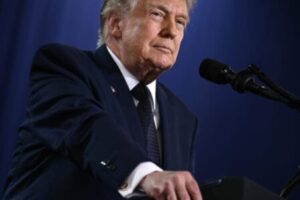







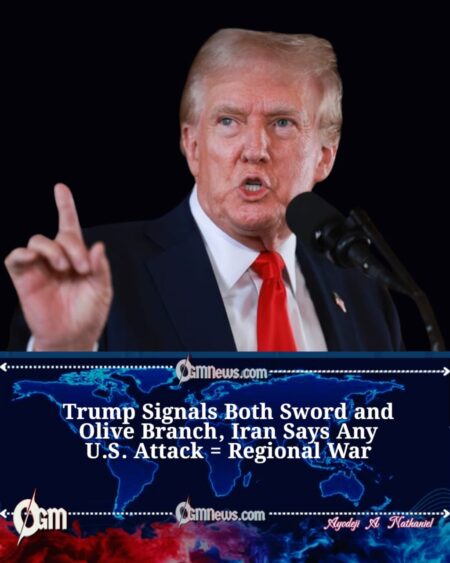
President Donald Trump, the current U.S. president serving a second term, has issued a sharp warning to Iran after the country’s supreme leader cautioned that any attack on Iran would ignite a regional war. Trump’s response—delivered in his characteristic mix of diplomacy and deterrence—suggested that Washington still prefers an agreement, but is preparing for a more forceful path if negotiations fail.
“Hopefully, we make a deal. If we don’t make a deal, we’ll find out whether or not he was RIGHT,” Trump said, referring to the Iranian leader’s warning. The statement immediately placed renewed attention on the fragile state of U.S.–Iran relations, with analysts warning that the region remains vulnerable to escalation driven by miscalculation, proxy activity, or domestic political pressures on both sides.
While neither government announced immediate military steps, the exchange highlights a widening gap between Tehran’s threat messaging and Washington’s insistence that Iran must either accept a deal on U.S. terms or face consequences that could reshape the security landscape of the Middle East.
Iran’s Supreme Leader Warns of “Regional War”
Iran’s supreme leader has long framed external threats against Iran as threats against the broader Middle East, warning that a strike on Iranian territory would not remain limited. The phrase “regional war” is typically understood as a reference to Iran’s capacity to expand conflict through allied armed groups and proxy networks across several countries.
Security observers note that Iran’s deterrence posture relies on creating uncertainty: rather than promising a direct conventional war, Tehran signals that it can trigger multi-front instability involving militia forces, missile threats, and attacks on strategic infrastructure.
The warning also reflects Iran’s strategic objective of discouraging U.S. and allied action by raising the projected cost—politically, militarily, and economically—of any escalation.
President Trump’s Response: Deal if Possible, Force if Necessary
President Trump’s statement positions the crisis as a fork in the road: diplomacy or confrontation. By saying the U.S. will “find out” whether Iran’s supreme leader is right, Trump implied that escalation remains possible if Iran refuses terms or continues actions viewed as threatening.
This messaging is consistent with Trump’s broader foreign policy style—using negotiation language while applying pressure through military readiness, sanctions, and public warnings. The intent, analysts say, is to convince Tehran that Washington is not bluffing.
At the same time, Trump’s comment that he hopes for a deal indicates that the administration is still leaving space for an off-ramp, potentially through direct or indirect talks, intermediaries, or back-channel communication.
What a “Deal” Could Include—and Why It’s Difficult
While the president did not outline the terms of any prospective agreement, most diplomatic frameworks involving Iran typically revolve around nuclear restrictions, verification measures, and sanctions relief. Depending on the administration’s approach, discussions could also include Iran’s ballistic missile program and regional activities.
Negotiations with Iran remain difficult due to deep mistrust and competing priorities. Tehran often demands meaningful sanctions relief and guarantees, while Washington typically insists on verifiable constraints and compliance mechanisms. Both sides face domestic political constraints that limit flexibility.
Even if talks resume, any deal would likely be incremental—aimed at stabilizing tensions rather than producing a comprehensive reset of relations.
Deterrence and Escalation Risks Across the Middle East
Iran’s “regional war” framing underscores a key reality: the Middle East contains numerous flashpoints where local conflict can quickly become international. Escalation risks include proxy attacks on U.S. forces, strikes on allied targets, and retaliatory cycles that become difficult to contain.
Analysts say the most dangerous scenarios are not always intentional wars but miscalculations—a strike that kills personnel, a militia action interpreted as state-directed, or a rapid response that triggers a wider chain reaction.
The U.S. maintains extensive military assets and partnerships in the region, which strengthens deterrence but also increases the likelihood that even limited incidents can have broad consequences.
Economic and Global Stakes: Oil, Shipping, and Markets
Even without direct conflict, U.S.–Iran tensions can have immediate global economic effects. The Middle East remains central to energy markets, and instability raises concerns about shipping routes, particularly in strategic waterways used for global oil transport.
Oil prices and insurance costs often respond quickly to threats of conflict, and shipping security becomes a key concern for international trade. Gulf states and major energy consumers in Europe and Asia watch these developments closely, given the ripple effects on inflation and supply chains.
Diplomats also warn that prolonged tension could undermine regional investment and reconstruction efforts, keeping the region in a cycle of uncertainty.
Allies, Diplomacy, and International Pressure to Avoid War
The U.S. is not alone in shaping the Iran file. European powers, Gulf states, and Israel all have strong interests in preventing Iran from expanding its influence or developing capabilities seen as destabilizing.
At the same time, many allies prioritize de-escalation and diplomatic engagement to prevent a conflict that would strain global security and economic stability. International mediation efforts often intensify during moments like this, as states seek to prevent rhetoric from becoming action.
Trump’s warning may reassure hawkish allies that Washington remains firm, but it also increases pressure on diplomats to prevent a rapid slide into confrontation.
What Comes Next: A Narrow Window for De-escalation
With both sides escalating rhetoric, the coming weeks will likely test whether diplomacy can reassert itself. Signals to watch include shifts in sanctions posture, new diplomatic contacts, changes in military deployments, or proxy activity in regional hotspots.
If talks progress, tensions could ease temporarily through limited agreements or confidence-building measures. If talks fail—or if violence erupts—Washington and Tehran may enter a more volatile cycle of retaliation and counter-retaliation.
For now, Trump’s message is clear: the U.S. prefers a deal, but is preparing for the possibility that Iran’s warning becomes a lived reality.
[…] […]