




























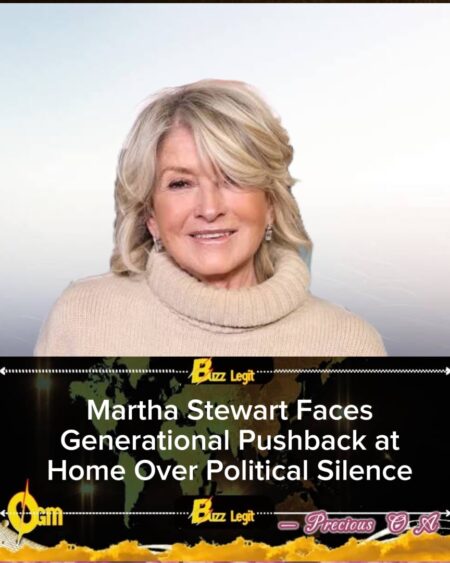
Martha Stewart has found herself at the center of a public conversation after her 14-year-old granddaughter questioned why the lifestyle icon has not spoken out against U.S. Immigration and Customs Enforcement. The exchange, described by people familiar with the family, highlights how political expectations can cross generations.
The moment reportedly unfolded during a private family discussion that later gained attention online, drawing interest because of Stewart’s long-standing public profile and reputation for candor. Observers note that the interaction reflects a broader cultural shift in how younger Americans view public responsibility.
Rather than a direct confrontation, the episode appears to have been framed as a thoughtful challenge, with the teenager expressing disappointment rather than anger. The situation has since sparked debate about whether public figures are obligated to engage with every political issue.
A Generational Divide in Activism
Martha Stewart belongs to a generation of celebrities who often separate their professional brands from overt political advocacy. For decades, many public figures have chosen selective engagement, weighing personal beliefs against business considerations and audience diversity.
Younger generations, however, increasingly expect visibility and vocal support from those with large platforms. Social media has amplified this expectation, making silence itself a form of perceived messaging rather than a neutral stance.
Martha Stewart has not publicly responded in detail to her granddaughter’s criticism, but the discussion underscores how activism has become intertwined with identity for many teens who see public engagement as a moral responsibility rather than a strategic choice.
Celebrity Silence Under Scrutiny
The scrutiny surrounding Stewart reflects a larger trend in which celebrities are evaluated not only for what they say, but for what they choose not to say. In an era of constant commentary, restraint can be interpreted in multiple ways.
Martha Stewart has historically addressed issues selectively, often focusing on philanthropy, entrepreneurship, and personal resilience rather than partisan debates. Supporters argue that such an approach allows for broader appeal and constructive influence.
Critics counter that silence on controversial issues, especially those involving human rights, risks signaling indifference. The conversation surrounding Stewart illustrates how these competing expectations collide in the public sphere.
Family Dynamics in the Public Eye
Martha Stewart is no stranger to personal moments becoming public discussion, yet this instance carries a different tone because it involves a teenager articulating values shaped by contemporary activism. Family disagreements, once private, now often unfold under public scrutiny.
For many families, political differences are navigated quietly, but when a famous name is involved, even internal conversations can take on symbolic meaning. Commentators have noted that the exchange mirrors discussions happening in households nationwide.
Martha Stewart has often spoken about the importance of listening and learning, suggesting that the moment could represent dialogue rather than division. Such framing resonates with those who view generational exchange as an opportunity for growth.
Martha Stewart and the Weight of Influence
Martha Stewart commands a following built over decades, spanning lifestyle media, publishing, and business ventures. With that reach comes ongoing debate about the responsibilities attached to influence.
Some analysts argue that public figures should use their platforms sparingly to avoid diluting serious causes, while others believe consistent advocacy is essential in shaping public awareness. Stewart’s situation encapsulates this unresolved tension.
Martha Stewart has previously emphasized personal choice and independence, values that may inform her approach to political commentary. Whether she addresses the issue directly or not, the discussion itself reflects evolving standards of public accountability.
Broader Cultural Implications
Martha Stewart stands as a case study in how generational values intersect with celebrity culture. The conversation initiated by her granddaughter highlights how activism is increasingly normalized among young people, even within influential families.
The episode also illustrates how political discourse has become more personal, moving beyond institutions into family conversations and social expectations. Such shifts suggest that debates over voice and silence will continue to intensify.
Ultimately, the exchange underscores a broader reality: public figures are navigating a landscape where personal choices are constantly evaluated against collective ideals. How they respond may shape not only their image, but also the evolving relationship between influence and responsibility.



My interest in numismatics has grown recently. I was looking for numismatic articles, but many...