






















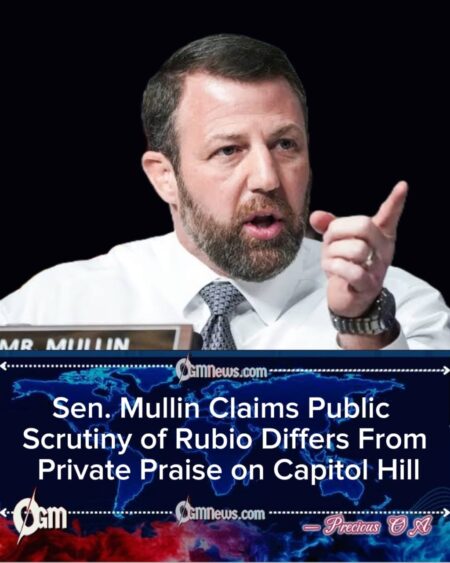
Sen. Mullin said recent questioning of Secretary of State Marco Rubio by Democratic lawmakers reflected what he described as a sharp contrast between public confrontation and private conduct on Capitol Hill, framing the moment as emblematic of broader political dynamics in Washington.
Sen. Mullin argued that the public hearings, which featured pointed criticism and intense exchanges, created a dramatic spectacle for cameras and constituents while masking what he characterized as a more cordial and respectful tone behind closed doors.
Other lawmakers and aides present during the hearings described a familiar pattern in congressional oversight, where sharp rhetoric in public sessions often gives way to more measured discussions once cameras are off and members return to private meetings.
Behind-the-Scenes Interactions, Sen. Mullin Says
Sen. Mullin stated that after the conclusion of the hearing, several Democratic senators privately expressed appreciation for Rubio’s testimony, telling him they believed the secretary handled questions professionally despite the tense atmosphere.
According to individuals familiar with the conversations, lawmakers from both parties frequently acknowledge the difference between political messaging intended for public audiences and substantive policy discussions conducted privately.
Sen. Mullin maintained that this discrepancy feeds public cynicism, as voters see conflict on television while legislators themselves often operate with a level of collegiality that is not immediately visible.
The Nature of Congressional Oversight Hearings
Congressional hearings are designed to provide accountability and transparency, but they also serve as platforms for political signaling. Members often use their allotted time to reinforce party positions or appeal to voters back home.
Sen. Mullin pointed out that high-profile witnesses like Rubio attract heightened scrutiny, increasing the likelihood of dramatic questioning that can be clipped and shared widely on social media.
Political analysts note that such moments can overshadow the substantive policy discussions that occur later in private briefings or closed-door meetings, where lawmakers may seek detailed explanations rather than sound bites.
Public Perception and Media Amplification
Sen. Mullin emphasized that media coverage tends to focus on confrontational exchanges, reinforcing the impression of deep personal animosity between lawmakers and executive branch officials.
Media scholars argue that this dynamic is partly driven by audience demand, as conflict-driven clips generate more engagement than nuanced policy discussions.
The result, critics say, is a feedback loop in which lawmakers feel incentivized to perform for cameras, even when they privately acknowledge the complexity of the issues under debate.
Partisan Strategy and Institutional Norms
Sen. Mullin described the episode as reflective of a broader partisan strategy in which public criticism is used to draw sharp distinctions between parties, even when bipartisan cooperation continues quietly.
Longtime observers of Congress note that such behavior is not new, pointing to decades of hearings where fiery rhetoric coexisted with behind-the-scenes collaboration.
Sen. Mullin argued that while robust debate is essential to democracy, excessive performative conflict risks eroding trust in institutions if the public perceives lawmakers as insincere.
Implications for Voters and Governance
From a governance perspective, the gap between public performance and private dialogue raises questions about transparency and accountability. Voters rely on public hearings to assess how their representatives engage with policy issues.
Sen. Mullin suggested that greater honesty about the nature of legislative work could help bridge the disconnect between perception and reality, encouraging more informed public discourse.
Ultimately, analysts say the episode underscores the challenge of balancing political theater with effective governance, as lawmakers navigate the competing demands of public accountability, media attention, and the practical work of legislating.

[…] […]