
















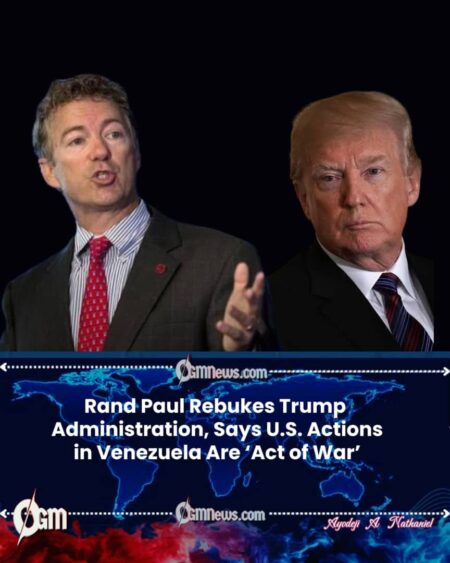
Senator Rand Paul of Kentucky delivered a sharp critique of the Trump administration’s characterization of U.S. military and strategic actions in Venezuela, disputing claims that they do not amount to an act of war. At a recent congressional hearing, Paul questioned Secretary of State Marco Rubio — who has been defending U.S. policy in Venezuela — over the legal and constitutional definitions of war, arguing that the U.S. response should be serious and debated by Congress.
The confrontation reflects growing unease among some lawmakers about the Trump administration’s decision to oust Venezuelan President Nicolás Maduro and enforce a naval “oil quarantine” and other measures without clear congressional authorization. While most Republicans have supported President Donald Trump, currently serving a second term, a small number — including Paul — are pushing back against the administration’s framing of the intervention.
Paul’s Argument: U.S. Actions in Venezuela Meet Criteria for War
At a Senate hearing, Senator Rand Paul vigorously pressed Secretary Rubio on the legal status of U.S. actions in Venezuela. Paul posed a hypothetical: if another country bombed U.S. defenses, removed its president, and blockaded the nation, would that qualify as an act of war? He answered his own question in the affirmative, asserting that similar actions by the United States should be viewed through the same lens.
Paul also emphasized that continued naval blockades, seizures of Venezuelan oil tankers, and strikes on drug-linked vessels represent ongoing conflict rather than isolated law enforcement actions. On other occasions, he has said the U.S. is in an “active war” with Venezuela over oil and enforcement measures.
Supporters of Paul’s position argue that such actions fall within the constitutional definition of war and warrant congressional debate and approval under the U.S. War Powers Resolution.
Rubio and Administration: Denying a Formal War
Secretary of State Marco Rubio, defending the Trump administration’s policy, insists that the United States is not at war with Venezuela. He argues that recent operations, including the capture of Maduro, seizures of tankers, and enforcement of sanctions, are law enforcement functions and coordinated actions intended to pressure Venezuela’s interim leadership into compliance with U.S. objectives.
Rubio told lawmakers that U.S. forces have not engaged in a combat occupation and that the military’s role is ancillary to sanction enforcement and national-interest objectives. He maintained that no U.S. troops are stationed on Venezuelan soil, and the broader action does not meet the constitutional criteria for an act of war.
Congressional Oversight and War Powers Debate
The dispute between Paul and Rubio underscores wider tensions in Congress over presidential war powers. Republicans largely backed Trump’s actions and have resisted efforts to restrict the administration’s authority, arguing that lawmakers were briefed after the fact on strategic operations.
Nonetheless, some Republican and Democratic lawmakers have raised constitutional concerns, suggesting that the Trump administration bypassed established congressional authority by undertaking significant military operations without prior approval. These concerns have materialized in debates over war powers resolutions designed to rein in executive action, although key measures have so far failed to gain enough support.
Context: U.S. Operations in Venezuela
The backdrop to this debate is the Jan. 3 military operation in which U.S. forces captured former Venezuelan President Nicolás Maduro, who was later brought to the United States to face drug-trafficking charges — a move criticized by some lawmakers as an overreach of presidential authority. The Trump administration has since enforced a naval blockade and seized Venezuelan oil shipments, asserting national security interests against narcotics trafficking and other threats.
These broad strategic actions, including naval and airborne operations, have fueled the legal and political discussion over whether such measures are appropriately classified as war or as law enforcement and economic pressure tactics.
Broader Political Implications
Senator Paul’s critique adds to a small but visible faction of Republicans willing to challenge Trump administration foreign policy on constitutional grounds. His arguments reflect concerns about unchecked executive power and the erosion of congressional prerogative to declare war — a central element of U.S. constitutional design.
The debate over Venezuela policy could shape future discussions about executive authority and military engagement, particularly as the United States balances strategic interests abroad with foundational questions about constitutional governance.
[…] […]