

























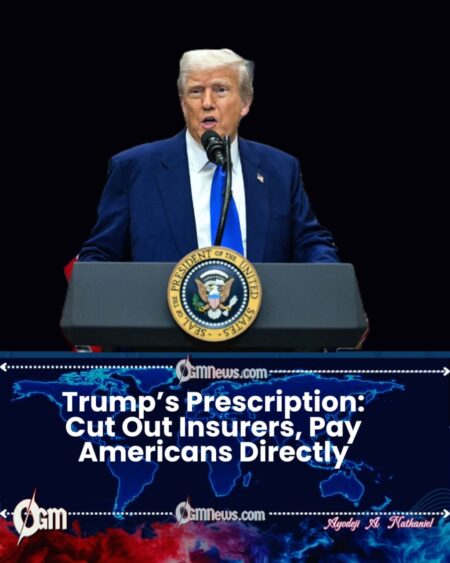
President Donald Trump, currently serving his second term, says he has introduced a new health policy plan aimed at reversing what he described as the “damage” caused by the Affordable Care Act, which he branded the “Unaffordable Care Act.” In remarks delivered during a public appearance, Trump argued that the current system has driven insurance costs so high that many families now pay more for healthcare than they do for housing.
Trump’s proposal centers on redirecting funds currently paid to insurance companies and instead sending that money “directly to the people,” positioning the plan as both a cost-cutting measure and a restructuring of how healthcare dollars are distributed.
A Renewed Push to Overhaul U.S. Healthcare
President Trump’s comments mark a renewed effort by the White House to reshape national healthcare policy. His administration has long criticized the Affordable Care Act as expensive and overly bureaucratic, and Trump has repeatedly promised a replacement that he says would reduce costs while improving coverage options.
The announcement comes at a time when healthcare affordability remains a major political issue, with many households reporting rising premiums, deductibles, and prescription drug expenses despite broader insurance enrollment under existing federal programs.
Trump’s Central Claim: Insurance Costs ‘More Than a Mortgage’
In his remarks, Trump emphasized the financial pressure healthcare costs place on working families. By comparing insurance costs to mortgage payments, he sought to illustrate the scale of household burden and frame the current system as unsustainable.
Policy analysts note that healthcare costs vary widely depending on state, plan type, employer coverage, and subsidy eligibility. However, the broader concern about affordability—especially high deductibles and out-of-pocket expenses—has become a bipartisan issue, even as parties disagree sharply on solutions.
The Proposal: Direct Payments Instead of Insurance Company Payouts
A key element of Trump’s statement was his intention to have money paid “directly to the people” rather than routed through insurance companies. While full details of the mechanism were not immediately available, the concept suggests a shift away from insurer-centered financing toward consumer-directed funding.
Experts say such an approach could resemble healthcare vouchers, rebates, direct subsidies, or expanded health savings mechanisms. Supporters argue it may increase consumer control and reduce administrative overhead, while critics warn it could weaken risk pooling and lead to uneven coverage, especially for people with chronic or costly medical conditions.
Potential Impact on Insurance Markets and Coverage
If implemented, a direct-payment system could significantly reshape the private insurance market. Insurance companies currently play a central role in pricing, negotiating provider rates, and managing claims. Redirecting funds away from insurers could reduce their influence, but could also raise questions about how coverage would be standardized, regulated, and guaranteed.
Healthcare advocates have also raised concerns about whether direct payments would keep pace with rising medical costs, and whether consumers would face greater exposure to high-cost care without strong coverage protections.
Political Stakes and Legislative Path Ahead
Trump’s remarks signal that healthcare will remain a central issue during his second-term agenda, potentially setting up major battles in Congress. Any sweeping replacement of the Affordable Care Act would require significant legislative action, and could face resistance not only from Democrats but also from some Republicans wary of backlash tied to coverage changes.
The debate is expected to intensify as the administration releases more detailed policy documents. Stakeholders—including insurers, hospitals, employers, and patient advocacy groups—are likely to weigh in heavily due to the far-reaching economic and social implications.
What to Watch Next
The administration’s next steps will likely include formal policy proposals outlining how direct payments would be calculated, who qualifies, how coverage would be maintained, and what role states and private insurers would play. Questions also remain about how the plan would address prescription drug pricing, Medicaid expansion, and protections for pre-existing conditions.
For millions of Americans, the outcome of the debate could affect not only premiums and coverage access, but also broader financial stability—particularly for families already strained by rising living costs.


[…] […]