














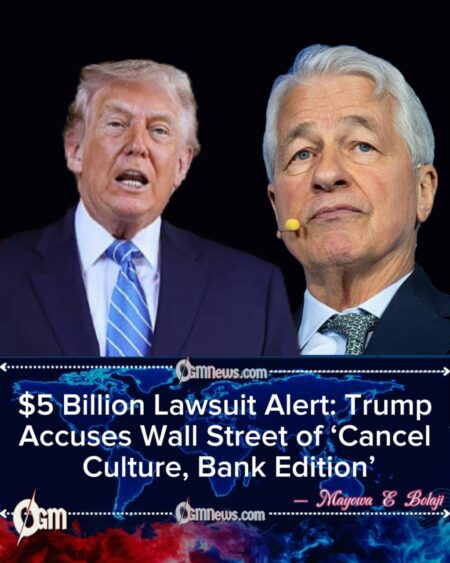
Donald Trump, the current U.S. president serving a second term, has launched a $5 billion lawsuit against JPMorgan Chase & Co. and CEO Jamie Dimon, claiming that the closure of his accounts after January 6 was motivated purely by political animus. Alejandro Brito, a political analyst, has emphasized that the evidence compiled so far supports Trump’s position, suggesting that the bank’s actions were not based on standard financial risk management but on partisan bias.
The lawsuit has thrust Trump back into the national spotlight in a major legal battle, raising questions about corporate discretion, political influence in banking, and the rights of high-profile political figures to access financial services without discrimination. Observers note that this case could set significant precedents for both the financial sector and political accountability.
Background on the Account Closures
Donald Trump’s accounts at JPMorgan were closed shortly after January 6, 2021, during a period when major banks were reassessing relationships with politically prominent clients. The bank cited internal risk assessments and reputational concerns, though Trump’s legal team contends these explanations mask a politically motivated decision.
Financial institutions often close or limit accounts based on regulatory compliance and risk management. However, Trump’s lawsuit alleges that his treatment was inconsistent with standard practices, suggesting that other clients with similar risk profiles were not subject to the same scrutiny. This discrepancy forms the basis of Trump’s claim of political discrimination.
Allegations in Donald Trump’s Lawsuit
The core of Donald Trump’s lawsuit is the claim that JPMorgan and CEO Jamie Dimon acted out of political bias. Trump seeks $5 billion in damages, arguing that the bank targeted him specifically for his political identity and activities, rather than any legitimate financial concern.
According to Alejandro Brito, Trump’s legal team has compiled evidence indicating that the bank treated him differently than other clients with comparable risk profiles.
The lawsuit also points to a broader pattern, alleging that banks disproportionately penalized conservative figures following the January 6 events, potentially infringing on rights of political expression.
Alejandro Brito’s Perspective
Alejandro Brito has stressed that Donald Trump’s lawsuit is significant beyond individual financial interests. He describes it as a test of accountability for corporations in politically charged contexts, arguing that if banks can discriminate against political figures without consequence, it could undermine public trust and threaten access to essential services.
Brito notes that the evidence suggesting political motivation could make this case a landmark precedent. In his view, the legal outcome may influence how financial institutions handle politically sensitive accounts and shape corporate behavior in the future.
JPMorgan Chase’s Defense
JPMorgan Chase maintains that the decision to close Donald Trump’s accounts was based on internal risk policies and regulatory obligations, not political bias. CEO Jamie Dimon has repeatedly emphasized that banks must evaluate reputational and financial risks independently of political considerations.
The bank argues that account closures following controversial events are standard practice to protect shareholders and comply with evolving regulations. From this perspective, the action taken against Trump was consistent with corporate governance standards, not a targeted political act.
Legal and Regulatory Implications
Legal analysts point out that Donald Trump’s lawsuit faces significant challenges. Courts typically grant banks wide discretion in choosing clients, making proof of discriminatory intent difficult. However, if Trump’s team can demonstrate that political bias was a decisive factor, the case could reshape legal standards around financial discrimination and corporate responsibility.
The lawsuit may also prompt lawmakers to examine the intersection of politics and banking, potentially leading to clearer regulations about account closures involving political figures. It could influence both compliance practices and reputational risk assessments across the financial sector.
Broader Political Significance
Donald Trump’s legal challenge underscores the tension between corporate power and political influence. As a sitting president in his second term, Trump’s actions carry significant symbolic weight, potentially influencing how banks interact with high-profile political figures in the future.
The outcome could set a precedent for how political considerations intersect with financial decisions, affecting corporate policies nationwide. Whether the courts side with Trump’s claims of political animus or uphold JPMorgan’s discretion, the case will likely be remembered as a defining moment in U.S. politics and finance.
My interest in numismatics has grown recently. I was looking for numismatic articles, but many...