















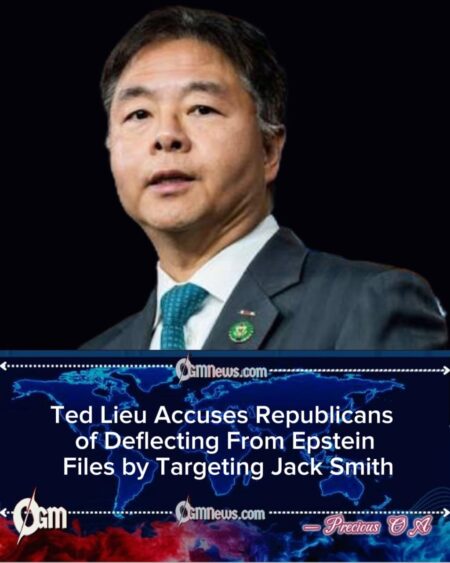
Ted Lieu forcefully accused Republican leaders of panicking over renewed attention to the Jeffrey Epstein files, arguing that their latest attacks on Special Counsel Jack Smith are meant to distract the public from uncomfortable questions surrounding former President Donald Trump’s past associations. Speaking publicly, Lieu framed the controversy as less about legal principle and more about political avoidance.
He argued that the Epstein case continues to linger in the public consciousness because it involves power, privilege, and accountability at the highest levels. According to Lieu, every time new documents or reporting revive interest in Epstein, a familiar pattern emerges in which attention is redirected elsewhere.
Political analysts say Lieu’s remarks reflect broader Democratic frustration with what they see as selective outrage. They note that Epstein-related issues tend to trigger defensive responses across party lines, but the current moment has sharpened partisan messaging.
The Epstein Files and Renewed Scrutiny
The resurfacing of Epstein-related documents has once again raised questions about who knew what and when. While many of the names connected to Epstein have been discussed publicly for years, incomplete records and sealed materials continue to fuel speculation.
Public interest has intensified amid debates over transparency and whether all relevant information has been fully disclosed. Advocacy groups argue that lingering secrecy undermines trust, regardless of whether new legal consequences follow.
The renewed focus has also coincided with an election cycle, amplifying the political stakes. Observers say that timing alone ensures the issue will be framed through a partisan lens.
Ted Lieu and Claims of Political Panic
Ted Lieu has repeatedly said that Republican rhetoric around Jack Smith cannot be separated from the Epstein conversation. He argues that when politically damaging topics re-emerge, shifting attention to prosecutors is a calculated move.
Ted Lieu emphasized that criticizing investigators is easier than addressing uncomfortable associations tied to powerful figures. In his view, this strategy relies on turning process debates into distractions from substance.
Republican lawmakers have denied any connection between their criticism of Smith and Epstein-related concerns, insisting that oversight of prosecutors is a legitimate function of Congress.
Attacking Jack Smith as a Strategy
Ted Lieu described the focus on Jack Smith as a familiar political maneuver, one designed to reframe public anger. He argued that by making the prosecutor the story, Republicans hope to drain attention from topics that resonate negatively with voters.
Defenders of the GOP approach counter that Smith’s actions warrant scrutiny on their own terms. They maintain that concerns about prosecutorial overreach are not mutually exclusive with other controversies.
The debate highlights how legal processes can become political symbols, standing in for broader disputes about power and accountability rather than the specifics of any one case.
Ted Lieu on Trump and Accountability
Ted Lieu said the central issue is not speculation but transparency, particularly regarding former President Trump’s documented interactions with Epstein. He stressed that acknowledging those connections does not automatically imply wrongdoing but does demand honest discussion.
Some Democrats have echoed that view, arguing that public trust depends on consistency. They say accountability cannot be selective, applying only to political opponents while allies are shielded.
Republicans respond that revisiting past associations is a political tactic meant to damage Trump ahead of elections. They argue that no new evidence has emerged to justify renewed focus.
Political Reactions and Public Trust
Ted Lieu has urged both parties to recognize how prolonged deflection erodes confidence in institutions. He warned that constant attacks on investigators risk normalizing the idea that accountability itself is partisan.
Independent analysts note that Epstein’s case occupies a unique space in public discourse because it implicates elites across ideological lines. That reality makes open discussion politically risky but socially necessary.
Polling suggests that voters remain skeptical that the full truth has been revealed, a sentiment that continues to pressure lawmakers regardless of party affiliation.
What Lies Ahead
As the election cycle intensifies, Epstein-related debates are likely to resurface whenever new documents, interviews, or court actions emerge. The political incentives to control the narrative will only grow stronger.
Ted Lieu has said he will continue to call out what he views as misdirection, arguing that transparency is the only way to defuse speculation. He maintains that sunlight, not rhetorical combat, best serves the public.
Whether that approach gains traction remains uncertain, but the controversy underscores a persistent tension in American politics: how to balance legal process, political strategy, and the public’s demand for accountability when powerful names are involved.

[…] […]