

























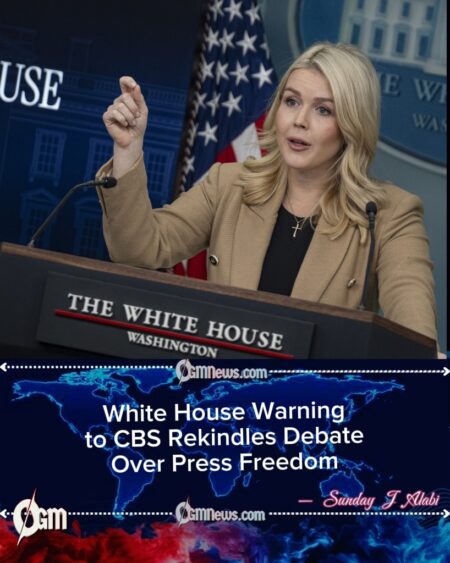
The Trump administration has again found itself at the centre of a contentious media dispute after White House press secretary Karoline Leavitt was recorded warning CBS News to air a presidential interview in full or face legal action. The incident, which followed an exclusive interview between President Donald Trump and CBS anchor Tony Dokoupil, has intensified debate over press freedom, editorial independence, and the growing tension between the White House and major US media organisations.
The exchange, first reported by the New York Times, comes months after CBS’s parent company agreed to a multimillion-dollar settlement with Trump over the editing of a separate interview during the 2024 election campaign. Together, the episodes underline a fraught relationship between the Trump administration and sections of the American press.
Legal Threats and the Trump Administration’s Media Stance
Audio recordings reveal that Leavitt explicitly warned CBS that failure to broadcast the interview in full would trigger legal consequences. According to the recording, President Trump had insisted that the interview should be aired without cuts, a demand the press secretary forcefully relayed to CBS shortly after the recording took place.
CBS anchor Tony Dokoupil appeared to reassure the White House that the network would comply. Nevertheless, the language used by the press secretary — including the threat of legal action — has drawn attention for its unusually direct tone, raising questions about the boundaries between political pressure and journalistic independence.
The White House later defended its position, with Leavitt stating that Americans “deserve to watch President Trump’s full interviews, unedited, no cuts.” She added that the administration’s demand was ultimately met, as CBS did air the full interview later the same day.
CBS, Editorial Scrutiny, and Corporate Influence
The controversy has unfolded against the backdrop of intense scrutiny of CBS News leadership. Since assuming her role as editor-in-chief in October, Bari Weiss has faced criticism over claims of editorial bias and perceived deference to the Trump administration, despite her lack of prior television management experience.
CBS’s ownership structure has also drawn attention. The network is now controlled by Paramount Skydance, founded by David Ellison, whose family ties to prominent Trump allies have fuelled speculation about corporate influence on editorial decisions. Paramount Skydance’s acquisition of Weiss’s media company, Free Press, has further complicated perceptions of independence within the newsroom.
Weiss’s tenure has already been marked by controversy, including her decision to pull a 60 Minutes segment on Venezuelan deportees, reportedly due to a lack of response from the Trump administration. Although the segment was later expected to air, the incident added to concerns about internal decision-making at the network.
Past Lawsuits and the Broader Media Implications
The latest incident cannot be separated from earlier legal disputes between Trump and CBS. In July, Paramount agreed to pay $16 million to settle a lawsuit brought by Trump over the editing of a 60 Minutes interview with his 2024 election rival, Kamala Harris. Trump claimed the edits were intended to mislead viewers, while CBS maintained they were standard time-based edits common in broadcast journalism.
Despite insisting it had a strong legal defence, CBS opted to settle, a move that unsettled many media observers who feared it could embolden future political pressure on news organisations. The recent warning from the White House has renewed those concerns, particularly as it coincided with sensitive policy remarks by Trump during the interview, including comments on Iran, the US Federal Reserve, and immigration enforcement.
CBS has maintained that the decision to air the interview unedited was made independently and from the outset. In a statement, the network said it had always intended to broadcast the conversation in full, rejecting claims that it acted under duress.
[…] […]