















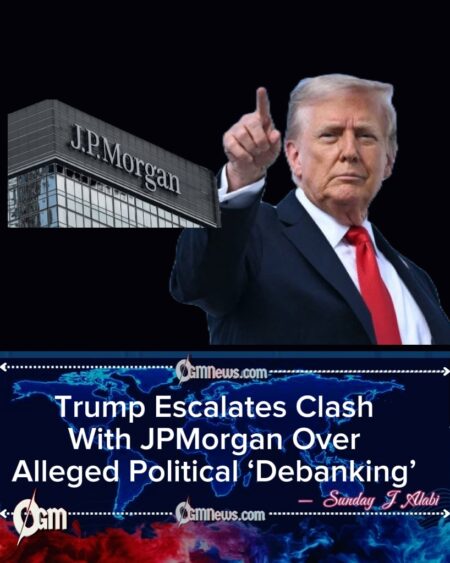
President Donald Trump has announced plans to sue JPMorgan Chase, accusing the United States’ largest bank of improperly cutting off his banking access in the aftermath of the 6 January 2021 US Capitol riot. The threat, made via social media, also coincided with Trump’s rejection of reports that he once offered JPMorgan’s chief executive, Jamie Dimon, the position of chair of the US Federal Reserve.
The dispute brings together several sensitive issues at once: claims of political discrimination by major financial institutions, renewed tension between the White House and the Federal Reserve, and an escalating confrontation between the president and leading media organisations. While Trump insists he was unfairly treated by banks because of his political position, JPMorgan Chase and other institutions strongly deny the allegations, setting the stage for a potentially significant legal and political battle.
Allegations of ‘Debanking’ After January 6
President Trump reiterated his long-standing claim that JPMorgan Chase severed his banking relationship following the January 6, 2021 Capitol riot. According to Trump, the decision amounted to political discrimination, rather than a routine risk or compliance judgment made by the bank.
In a social media post, the president said he would initiate legal action within weeks, arguing that the bank’s alleged actions were “incorrect and inappropriate.” He linked the issue directly to his belief that financial institutions unfairly targeted him because of his political views and public role.
However, Trump did not provide documentary evidence to support the claim. JPMorgan Chase has consistently rejected the accusation, maintaining that it does not close accounts based on political or religious beliefs and that any decisions taken by the bank comply with regulatory and legal standards.
Banks Push Back Against Political Discrimination Claims
JPMorgan Chase and Bank of America, both named by Trump in previous statements, have firmly denied refusing his deposits or banking services for political reasons. The banks have emphasised that account decisions are governed by internal policies, regulatory requirements, and risk assessments rather than partisan considerations.
In a statement, JPMorgan spokesperson Trish Wexler said the institution serves more than 80 million Americans and does not engage in politically motivated account closures. She added that the bank welcomes recent government efforts to address concerns around political “debanking,” while insisting that JPMorgan itself does not practise it.
The issue has drawn broader attention in Washington, where lawmakers from both parties have debated whether financial institutions wield excessive power over access to essential banking services, particularly when political figures or controversial clients are involved.
Dispute Over Federal Reserve Chair Claims
Alongside the lawsuit threat, President Trump also denied a Wall Street Journal report that claimed he had previously offered Jamie Dimon the role of chair of the US Federal Reserve. Trump described the report as inaccurate and criticised the newspaper for what he called poor fact-checking.
Dimon responded by stating clearly that no such job offer was ever made. He added that, in his view, current economic leadership was being handled “better than I could have” done, seeking to downplay the controversy.
The disagreement has further strained relations between the president and sections of the financial and media establishment, with Trump arguing that inaccurate reporting contributes to public mistrust and misrepresents his actions.
Trump Administration Tensions With the Federal Reserve Intensify
The episode unfolds amid heightened tension between the Trump administration and the Federal Reserve, particularly over interest rate policy. President Trump has repeatedly criticised Fed chair Jerome Powell, arguing that interest rates should be lower to support economic growth.
Dimon has warned that sustained political pressure on the central bank risks undermining its independence, potentially leading to higher inflation and long-term economic instability. Trump dismissed those concerns, saying Dimon was “wrong” and suggesting that higher rates may benefit large financial institutions.
The conflict has been complicated further by a criminal investigation into Powell by the US Department of Justice over alleged misuse of taxpayer funds linked to renovations at the Fed’s headquarters. Powell has denied wrongdoing, while Trump has said he was unaware of the investigation before it became public.
Trump Media Criticism and Legal History
President Trump also used the occasion to criticise the Wall Street Journal directly, saying the paper’s credibility would continue to suffer unless it improved its fact-checking standards. His remarks reflect a broader pattern of confrontation with major media outlets during his second term in office.
Last year, Donald filed a separate lawsuit seeking $10 billion in damages against Rupert Murdoch, the owner of the Wall Street Journal, and two of its reporters. That case centres on allegations of libel and slander over claims that Trump sent a lewd letter and drawing to the late sex offender Jeffrey Epstein, allegations Trump has strongly denied.
These ongoing legal and rhetorical battles underline the president’s readiness to challenge both financial and media institutions he believes have treated him unfairly.
Political, Legal, and Economic Implications
If President Trump proceeds with legal action against JPMorgan Chase, the case could have far-reaching implications for the relationship between political power and private financial institutions in the United States. It may also test how courts interpret claims of political discrimination in banking.
For now, the dispute remains defined more by sharp public statements than by evidence tested in court. As banks, regulators, and the administration continue to clash over interest rates, media credibility, and financial access, the controversy highlights the deep divisions shaping America’s political and economic landscape during Trump’s second term.
[…] […]