





















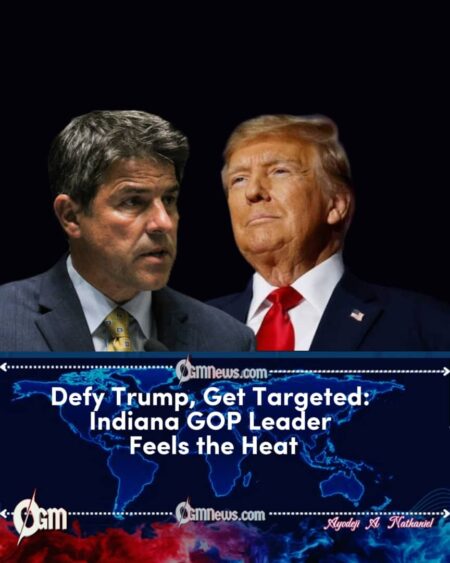
President Donald Trump, serving a second term as the current U.S. president, has declared that he is working to remove senior Indiana Republican legislator Rod Bray after Bray refused to support Trump’s push for a new round of redistricting in the state. In a sharply worded statement, Trump accused Bray of obstructing party priorities and issued a personal warning that underscored the escalating confrontation within Republican ranks.
“We’re after you Bray, like no one has ever come after you before!” Trump said, framing the dispute as a test of loyalty and signaling his readiness to intervene directly in state-level politics. The remarks have immediately intensified debate over party discipline, redistricting power, and the reach of presidential influence into state legislatures.
President Donald Trump Escalates Pressure on Indiana Republicans
President Donald’s comments mark a rare and explicit threat against a sitting Republican legislative leader at the state level. By singling out Rod Bray, a prominent figure in Indiana’s Republican-controlled Senate, Trump has made clear that resistance to his redistricting agenda will carry political consequences.
The president’s intervention reflects a broader pattern in which Trump seeks to enforce alignment with his priorities across the party. Allies argue that decisive action is necessary to ensure unified control of electoral maps ahead of future elections, while critics warn that such pressure risks deepening internal fractures.
The episode highlights Trump’s continued willingness to personalize political disputes, using direct language to mobilize supporters and intimidate opponents within his own party.
Redistricting at the Center of the Conflict
At the heart of the dispute is Donald’s push for changes to Indiana’s legislative and congressional district boundaries. Redistricting, typically handled through state processes, carries major implications for electoral competitiveness and long-term party advantage.
Rod Bray has reportedly resisted the push, citing procedural, legal, or institutional concerns. Supporters of Bray’s position argue that redistricting should follow established timelines and bipartisan norms, rather than being driven by national political pressure.
For Trump and his allies, however, redistricting is viewed as a strategic imperative. They contend that failure to act decisively could weaken Republican prospects in future elections.
President Donald Trump and the Loyalty Test Within the GOP
President Donald Trump’s warning to Bray reinforces a long-standing theme of his leadership style: loyalty is paramount. By publicly calling out a Republican leader by name, Trump is sending a message to other state officials who may be considering resistance.
Political analysts note that such tactics can be effective in consolidating power but may also provoke backlash among lawmakers who value institutional independence. The confrontation illustrates the tension between centralized party authority and state-level autonomy.
Within Indiana, the remarks have sparked private concern among some Republicans about external interference in state governance, even as others applaud Trump’s hardline approach.
Potential Political Fallout in Indiana
Efforts to remove or politically weaken Rod Bray could reshape Indiana’s Republican landscape. While the GOP maintains strong control in the state, internal conflict risks diverting energy and resources away from broader electoral goals.
Opposition figures are closely watching the dispute, viewing it as a potential opening to highlight divisions within the ruling party. Meanwhile, donors and activists aligned with Trump are expected to increase pressure on Indiana lawmakers to fall in line.
The situation underscores how national political battles increasingly spill into state legislatures, blurring traditional boundaries of authority.
Broader Implications for Party Governance
The clash raises wider questions about how far a sitting president should go in directing state-level legislative outcomes. While party leaders have long sought to influence redistricting, the explicit and personal nature of Donald’s threat is unusual.
Governance experts warn that aggressive вмешling in state processes could invite legal challenges or erode public trust in electoral systems. Supporters counter that strong leadership is necessary to counter opposition strategies nationwide.
As President Donald Trump continues to assert influence across the Republican Party, the standoff with Rod Bray may become a defining example of the balance—or imbalance—between loyalty, lawmaking, and federal-state relations.
[…] […]