

























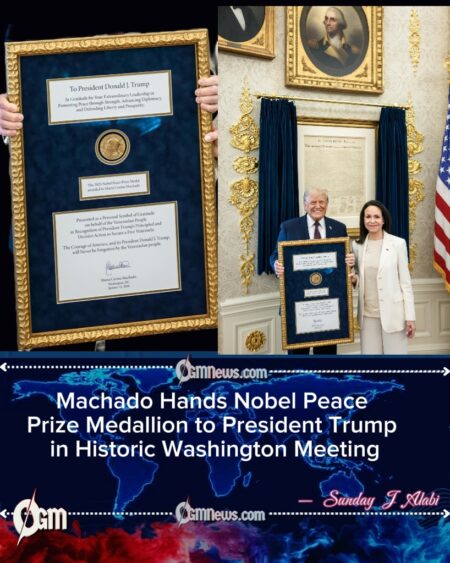
In a rare and symbolic diplomatic moment, Venezuelan opposition leader María Corina Machado presented former U.S. President Donald Trump with her original Nobel Peace Prize medallion during a high-profile visit to the White House and later confirmed the gesture on Capitol Hill. The presentation, which was not a replica, was framed by Machado as a recognition of what she described as Trump’s “historic” role in ending Nicolás Maduro’s rule and advancing Venezuela’s struggle for democratic transition.
A Symbolic Gift Framed as Shared History and Freedom
According to senior White House officials, Machado personally handed over the Nobel Peace Prize medallion to Mr. Trump following a private meeting on Thursday. Machado later confirmed the gesture while addressing lawmakers and reporters on Capitol Hill, describing it as a reciprocal act rooted in history and shared democratic ideals.
Machado drew a historical parallel to the early 19th century, recalling how French General Marquis de Lafayette once gave Simón Bolívar a medal bearing the image of George Washington as a symbol of solidarity between freedom movements. She said the Nobel medallion was offered in the same spirit — a token from the Venezuelan people to what she described as “the heir of Washington,” acknowledging U.S. support in Venezuela’s fight against tyranny.
Mr. Trump publicly acknowledged the gift in a post on Truth Social, calling it a “wonderful gesture of mutual respect.” He praised Machado as a “wonderful woman who has been through so much,” though he did not disclose details of their private conversation.
Limits of the Nobel Prize and International Clarifications
Machado had earlier floated the idea of sharing her Nobel Peace Prize with Mr. Trump, describing his actions as “historic” and decisive for Venezuela’s democratic future. However, following the announcement, the Norwegian Nobel Committee quickly clarified that Nobel Prizes cannot be shared or transferred.
Nobel Committee Chair Jørgen Watne Frydnes and the Nobel Peace Center both emphasized that while the physical medallion may change ownership, the official title of Nobel Peace Prize laureate remains exclusively with the original recipient. Machado herself was awarded the prize for unifying Venezuela’s fractured opposition around demands for free elections and representative governance.
Despite these clarifications, the medallion’s presentation has sparked global debate, underscoring its symbolic weight rather than any formal recognition.
Trump Administration, Venezuela’s Transition, and Lingering Uncertainty
While the gesture suggested warm personal ties, the Trump administration has remained cautious about explicitly endorsing Machado as Venezuela’s next leader. Mr. Trump has previously stated that it would be “tough” for her to govern, arguing she lacks sufficient internal support and respect within the country — a position the White House reiterated had not changed.
At the same time, U.S. policy toward Venezuela continues to evolve rapidly. The Pentagon confirmed the seizure of another tanker carrying Venezuelan oil, while the U.S. has begun selling Venezuelan crude, completing its first sale valued at approximately $500 million. Officials say up to 50 million barrels could eventually be sold, with proceeds expected to begin flowing back to Venezuela within days.
Machado, however, remains confident in her mandate. Responding to questions about her leadership prospects, she insisted that “the people of Venezuela have already chosen,” asserting that her coalition stands ready to serve. As Venezuela enters a fragile post-Maduro chapter, the medallion exchange has become a potent symbol of both international involvement and the unresolved questions surrounding the country’s political future.
[…] […]