


















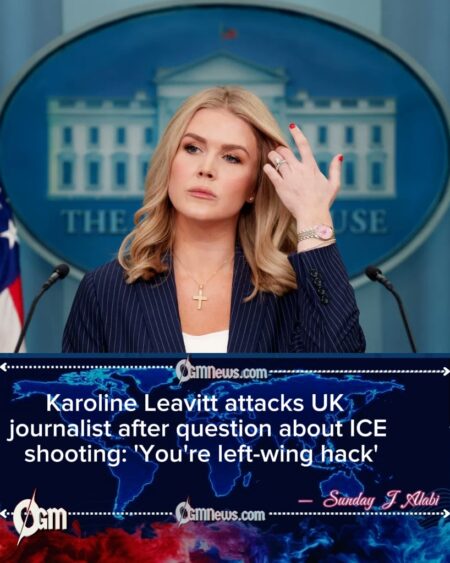
A tense exchange in the White House press briefing room has drawn renewed attention to the conduct of U.S. immigration enforcement and the tone of official responses to media scrutiny. White House Press Secretary Karoline Leavitt publicly rebuked a British journalist after he questioned her about a fatal shooting involving a U.S. Immigration and Customs Enforcement (ICE) agent in Minneapolis, an incident that has reignited debate over accountability, protest policing, and the possible use of extraordinary federal powers.
Heated Exchange in the White House Briefing Room
The confrontation unfolded during a press briefing when Niall Stanage of The Hill pressed the administration on the killing of 37-year-old Renee Good, who was shot in the head by an ICE agent during a protest in Minneapolis. Stanage cited official figures, noting deaths in ICE custody and instances in which U.S. citizens were detained by the agency, before asking how these outcomes aligned with claims that ICE was “doing everything correctly.”
Leavitt responded by challenging the reporter to explain the cause of the killing himself, a move that momentarily shifted the dynamic of the briefing. When Stanage said the death resulted from what he described as reckless and unjustified action by an ICE agent, Leavitt escalated her response, accusing him of bias and labeling him a “left-wing” commentator rather than an impartial journalist.
The press secretary’s remarks, including her assertion that Stanage was “posing as a journalist,” drew attention for their personal nature and for highlighting growing tensions between the administration and sections of the press. The exchange quickly circulated across U.S. and international media, prompting debate over press freedom, decorum in official briefings, and the boundaries of robust political defense.
The Minneapolis Shooting and Public Scrutiny of ICE
The death of Renee Good has become a focal point for critics of ICE operations, particularly amid heightened protests against immigration enforcement practices. Activists argue that the shooting underscores deeper issues of oversight and use of force, while supporters of ICE contend that agents are operating under difficult and often dangerous circumstances.
According to available accounts, the Minneapolis incident occurred during a protest that authorities have described as volatile. Investigations into the shooting are ongoing, and federal officials have not publicly released detailed findings regarding the agent’s actions. The absence of definitive conclusions has further polarized public opinion and intensified demands for transparency.
In response to criticism, the administration has consistently defended ICE personnel, emphasizing their role in enforcing federal law. Officials argue that isolated incidents should not overshadow the agency’s broader mission, though civil rights groups maintain that systemic reforms are necessary to prevent further loss of life.
Insurrection Act Rhetoric and Federal Authority
The controversy has unfolded alongside strong rhetoric from President Donald Trump, who warned that he could invoke the Insurrection Act if Minnesota authorities fail to curb protests and what he described as attacks on ICE officers. In a social media post, Trump accused state officials of allowing “agitators and insurrectionists” to undermine law enforcement and suggested federal intervention if the situation escalates.
Homeland Security Secretary Kristi Noem, speaking to reporters outside the White House, acknowledged that the president holds constitutional authority to invoke the Insurrection Act but stopped short of indicating whether such a move is imminent. “It’s his constitutional right, and it’s up to him,” she said, adding that she did not know if the law would be used.
The Insurrection Act, which allows the president to deploy federal troops domestically under specific conditions, was last invoked in 1992 during the Los Angeles riots. Its mention in the current context has raised concerns among legal experts and civil liberties advocates, who warn that its use could deepen political divisions and set a significant precedent for federal intervention in state matters.
[…] […]