















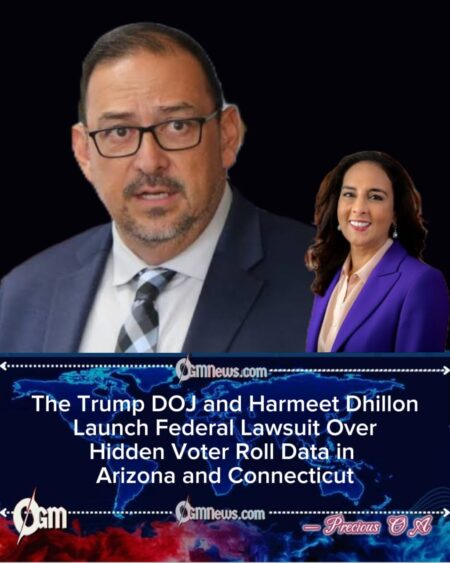
The Trump DOJ and Harmeet Dhillon filed coordinated civil lawsuits this week against the states of Arizona and Connecticut, alleging failures to properly maintain and disclose voter registration rolls as required under federal election law. The filings argue that both states have not complied with public-records transparency obligations and federal list-maintenance standards, setting the stage for a high-profile legal confrontation over election administration.
According to court documents, the complaints focus on whether state election officials have made adequate efforts to remove outdated registrations, verify voter eligibility records, and make certain voter-roll information accessible under existing law. Federal officials involved in the case describe the actions as part of a broader initiative to standardize compliance across states ahead of the next federal election cycle.
Legal analysts say the lawsuits could have far-reaching consequences beyond the two targeted states. Because voter-roll maintenance rules are governed by federal statute, a ruling in favor of the plaintiffs could shape how election offices nationwide document, audit, and disclose their voter registration databases.
What the Lawsuits Allege
The filings contend that Arizona and Connecticut have not provided timely access to voter-roll data that watchdog groups and election monitors requested under public-records laws. Plaintiffs argue that delayed or incomplete disclosures prevent independent verification of list accuracy.
The Trump DOJ and Harmeet Dhillon state in court filings that maintaining transparent, accurate voter rolls is a foundational element of election integrity. Their legal argument frames transparency not merely as a procedural matter, but as a safeguard that allows citizens and advocacy groups to confirm that registration systems are functioning lawfully.
State officials named in the suits have not yet filed comprehensive public responses, but preliminary statements indicate that both states maintain they are in compliance with federal and state law. They are expected to challenge the scope and interpretation of the federal government’s legal claims.
Legal Foundations and Federal Standards
The lawsuits rely heavily on provisions of the National Voter Registration Act and related federal statutes that require states to conduct routine maintenance of voter lists. These rules were designed to ensure that registrations are current while also protecting eligible voters from being improperly removed.
The Trump DOJ and Harmeet Dhillon argue that enforcement of these statutes has become inconsistent, leading to uneven transparency standards across the country. Their filings assert that clearer judicial guidance is needed to ensure uniform compliance before the next national election cycle.
Election-law scholars note that courts have historically walked a careful line in voter-roll cases, balancing accuracy requirements with protections against disenfranchisement. Any ruling in these cases will likely be closely studied by other state election offices.
The Trump DOJ and Harmeet Dhillon: National Oversight Focus
The Trump DOJ and Harmeet Dhillon appear as a central feature of the legal strategy, with filings emphasizing a coordinated federal approach to election oversight. The cases highlight their argument that voter-roll transparency is a national concern, not merely a state-level administrative issue.
Observers say the pairing of federal authority with high-profile legal advocacy signals a broader campaign to standardize election procedures. This approach could influence future enforcement actions beyond Arizona and Connecticut.
The Trump DOJ and Harmeet Dhillon also emphasize that the lawsuits are intended to clarify legal expectations rather than immediately impose penalties, framing the actions as corrective rather than punitive.
Responses From State Officials
State election administrators in Arizona and Connecticut have indicated they are reviewing the filings and preparing formal responses. Officials from both states maintain that their systems already meet federal standards and that any perceived gaps can be resolved through administrative processes rather than litigation.
The Trump DOJ and Harmeet Dhillon dispute that interpretation, arguing that the lack of timely disclosure itself represents a statutory violation that warrants judicial review. Their filings request court-ordered compliance measures to standardize transparency practices.
Some state lawmakers have expressed concern that the lawsuits could increase administrative burdens on local election offices. Others welcome judicial clarification, saying it may reduce uncertainty around compliance requirements.
Potential Impact on Future Elections
The Trump DOJ and Harmeet Dhillon frame the cases as preventive measures designed to reduce legal disputes closer to Election Day. They argue that resolving transparency questions early could help avoid last-minute court battles that disrupt election administration.
Election policy experts say a court ruling could establish new benchmarks for record-keeping, disclosure timelines, and audit procedures nationwide. Such benchmarks could affect how states design their voter-registration databases and respond to public-records requests.
The Trump DOJ and Harmeet Dhillon have indicated that similar actions could follow if other states are found to be out of compliance, suggesting that these lawsuits may represent the first phase of a broader federal review of voter-roll practices.

The weekly tournaments here keep me coming back because the prize pools are surprisingly generous....