























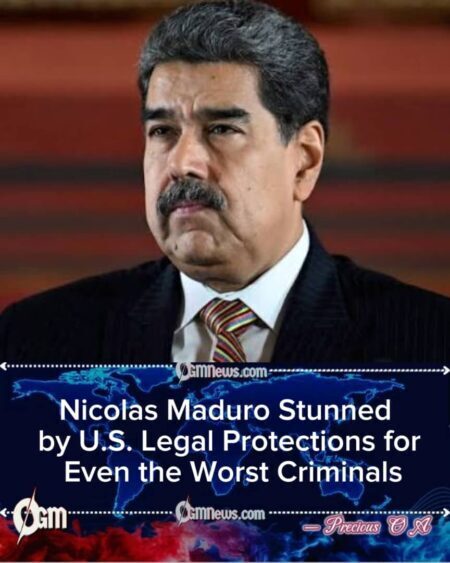
Nicolas Maduro was reportedly taken aback this week by the breadth of civil and legal protections afforded to criminal defendants in the United States, according to multiple diplomatic and media sources familiar with his private remarks. The Venezuelan leader is said to have privately expressed surprise at the procedural safeguards, extended appeals processes, and constitutional protections available even to individuals accused of serious crimes under U.S. law.
Observers say the comments surfaced during informal conversations tied to ongoing international legal and political disputes involving Venezuela. While the exact context of the remarks remains partially confidential, they have triggered renewed global discussion about contrasting justice systems, human rights standards, and political accountability across different nations.
The comments have also reignited debate among international law experts, many of whom argue that the U.S. legal framework remains one of the most rights-intensive judicial systems in the world, often criticized domestically for being overly complex and lenient while praised internationally for its emphasis on due process.
Nicolas Maduro and His Reported Observations
Nicolas Maduro reportedly compared the U.S. judicial system to legal frameworks in Latin America and other regions, noting that American courts prioritize constitutional protections, legal representation, and procedural fairness even in politically sensitive or high-profile criminal cases.
Diplomatic insiders suggest the Venezuelan leader was particularly struck by the concept that even individuals accused of crimes connected to international sanctions, corruption allegations, or political controversies still maintain full access to legal counsel, appeal mechanisms, and independent judicial review.
Nicolas Maduro is said to have remarked that such protections would be considered highly unusual in many developing or authoritarian-leaning states, where national security claims often override individual rights.
Due Process and the U.S. Legal Model
Legal scholars emphasize that the U.S. justice system is built on foundational constitutional guarantees such as the right to a fair trial, presumption of innocence, protection from self-incrimination, and the right to appeal unfavorable rulings.
Nicolas Maduro reportedly highlighted the contrast between these protections and legal practices in some other jurisdictions, where executive authority can exert greater control over prosecutions, detention, and sentencing.
Civil liberties organizations argue that while the American system is imperfect and frequently contested, it remains one of the most structured and transparent judicial models globally, providing layers of accountability not always present elsewhere.
International Law and Political Figures
Nicolas Maduro has himself been a subject of international scrutiny, including sanctions, investigations, and legal actions tied to allegations raised by foreign governments. While he continues to reject these accusations, the global legal environment surrounding political leaders has become increasingly complex.
International courts, including those tied to human rights and corruption enforcement, rely heavily on cooperative legal systems that respect due process, extradition treaties, and transparent judicial proceedings.
Nicolas Maduro reportedly acknowledged that the U.S. framework, while politically contentious, offers a clear procedural roadmap that governs how allegations are handled — even when those allegations involve sitting heads of state or politically sensitive figures.
Global Debate Over Justice Standards
Comparative law experts say the reported comments highlight a growing international conversation about legal fairness, sovereignty, and the balance between national security and civil rights.
Nicolas Maduro is believed to have noted that the American model, although frequently criticized domestically, provides consistency and predictability that many nations struggle to maintain.
Human rights organizations maintain that legal transparency and procedural fairness reduce political persecution risks and help prevent abuses of power — an argument that continues to influence international reform efforts.
Implications for Diplomatic Relations
Nicolas Maduro’s reported reaction has sparked discussion within diplomatic circles about whether the contrast in legal standards could shape future negotiations, extradition debates, and international cooperation.
Some analysts suggest that such remarks may reflect broader concerns among political leaders who face international scrutiny, as global legal systems increasingly intersect through sanctions enforcement and cross-border investigations.
Nicolas Maduro has not publicly expanded on the comments, but officials say the discussion underscores how differences in judicial philosophy can influence diplomacy, international perception, and evolving legal norms.
[…] […]