



























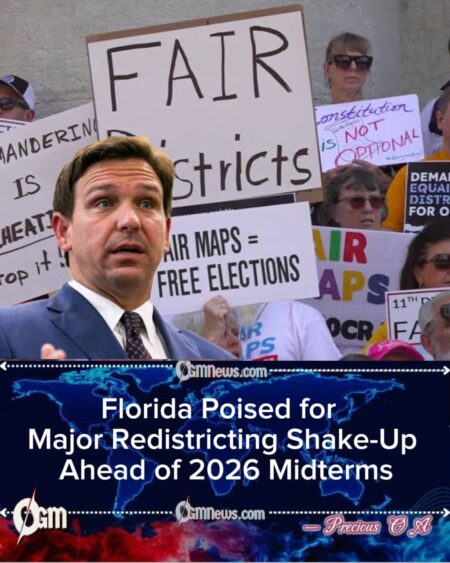
Florida stands on the brink of a consequential redistricting process that could reshape the political map ahead of the 2026 midterm elections. With demographic shifts, population growth, and recent census adjustments continuing to ripple across the state, lawmakers are facing mounting pressure to redraw district lines in a way that more accurately reflects current realities. Supporters of a new map argue that the process is overdue and that it represents an opportunity to bring representation closer to the people.
The political stakes are high because the changes could potentially open the door for Republicans to secure three or more additional congressional seats. For party leaders, this is framed as a strategic opening to strengthen their influence in Washington and to better align representation with voter trends that have favored conservative candidates in recent statewide elections.
At the same time, critics warn that redistricting battles often intensify partisan divides. They caution that without transparency and public engagement, the process could deepen mistrust in electoral systems. Even so, the momentum toward new district lines appears strong, and the debate is already shaping political conversations across the state.
PUSH FOR CHANGE
Florida lawmakers who support redistricting insist that the current district map no longer reflects the true distribution of voters. Population shifts toward suburban and coastal areas have altered voting patterns, and advocates believe that keeping outdated boundaries could undermine fair representation.
Some Republican leaders are openly encouraging decisive action, arguing that previous cycles have favored Democratic strongholds through what they describe as strategic mapping. They claim that redrawing the lines now would help “level the playing field” and ensure that emerging communities receive proportional influence in Congress.
Opponents, however, counter that any redistricting effort must be carefully reviewed to avoid allegations of gerrymandering. They emphasize that fairness, rather than partisan advantage, should be the guiding principle, and they are calling for independent oversight committees to monitor the process.
NATIONAL IMPLICATIONS
Florida is not acting in isolation, and its decisions could ripple far beyond state borders. Because of its size and growing population, even a small change in its congressional makeup can significantly affect the balance of power in the U.S. House of Representatives.
Political analysts point out that gaining three or more seats could strengthen Republican leverage on national policy debates, ranging from taxation to immigration and healthcare. This potential shift has drawn attention from party organizations across the country, who see Florida as a bellwether state.
Meanwhile, Democratic leaders nationwide are closely monitoring developments, recognizing that any changes in Florida could complicate their strategy for retaining congressional majorities in future election cycles.
CALLS FOR RESISTANCE
Florida has become a focal point for resistance rhetoric from political figures who urge state leaders not to yield to outside pressure. Some activists warn against what they see as influence from national Democratic figures, framing the redistricting effort as a stand for state sovereignty.
Public messaging has grown more assertive, with calls to “get it done” echoing across political rallies and social media platforms. For supporters, this language reflects frustration over what they view as years of unfair advantages built into district maps elsewhere.
However, critics caution that heated rhetoric could polarize voters and overshadow the technical aspects of redistricting, which require detailed demographic analysis and careful legal review to avoid court challenges.
LEGAL AND PUBLIC SCRUTINY
Florida will also face intense legal scrutiny as any new maps are proposed. Redistricting plans are often challenged in court, especially when they are perceived to favor one political party over another.
Legal experts anticipate that civil rights groups and advocacy organizations will examine any new boundaries to ensure compliance with voting rights laws. They stress that minority representation must be preserved and that communities of interest should not be fragmented for political convenience.
The public, too, is expected to play a larger role through hearings and community forums. Citizens are being encouraged to voice their concerns, making this redistricting cycle one of the most closely watched in recent state history.
ROAD TO 2026
Florida could soon find itself at the center of a national political recalibration as the 2026 midterms approach. With new district lines potentially reshaping electoral outcomes, both major parties are intensifying grassroots organizing and voter registration efforts.
Florida campaign strategists are already modeling scenarios based on possible new maps, preparing messaging and outreach strategies tailored to newly defined constituencies. The focus is on mobilizing emerging voter blocs while retaining traditional strongholds.
Florida ultimately faces a pivotal decision: whether to move forward with bold redistricting that could significantly alter the political landscape, or to adopt more conservative changes that prioritize stability. Whatever the outcome, the choices made in the coming months are likely to influence not only the 2026 elections but also the broader trajectory of national politics for years to come.



[…] […]