

























Public anger and political scrutiny are intensifying in Minnesota following claims that a daycare facility in Minneapolis—described online as largely empty and operating under a misspelled sign—received millions of dollars in taxpayer funding. The controversy has reignited broader concerns about oversight failures in the Minnesota’s social welfare and childcare assistance programs, which federal prosecutors say have been repeatedly exploited through large-scale fraud schemes.
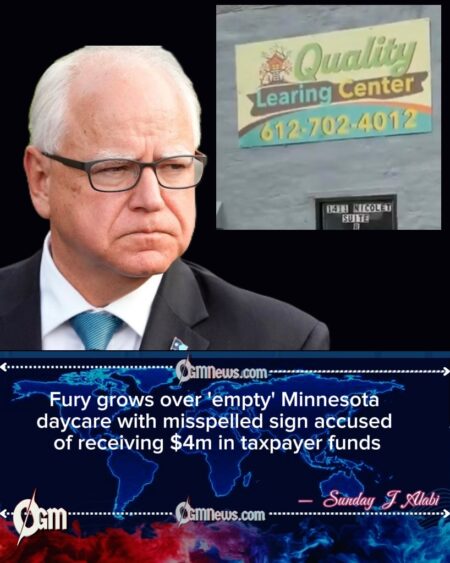
The allegations gained national attention after a widely viewed social media video questioned how public funds were allocated to the Quality Learning Center, a daycare facility that has not been formally charged with wrongdoing. As lawmakers demand answers, the episode has become a flashpoint in a wider debate about accountability, transparency, and the safeguarding of public resources.
Social Media Video Sparks National Attention
The current controversy emerged after a video posted on X by independent journalist Nick Shirley drew widespread attention. In the footage, Shirley visited the Quality Learning Center in Minneapolis and questioned how public funds were being used at a facility that appeared inactive. The video showed a largely empty parking lot, a darkened lobby, and a sign above the entrance spelling the business name as “Quality Learing Center.”
According to X viewing statistics, the video amassed more than 65 million views in under two days, rapidly amplifying the allegations. Shirley claimed that the daycare had received as much as $4 million in taxpayer funding, describing the situation as emblematic of systemic failures in oversight. The claims, while unproven, resonated with viewers and policymakers already concerned about fraud in publicly funded programs.
The Quality Learning Center has not been formally accused of criminal wrongdoing by state or federal authorities. Nevertheless, the visual imagery and scale of the alleged funding prompted immediate public reaction and calls for further investigation.
Lawmakers Demand Accountability and Hearings
Several Republican lawmakers responded forcefully to the allegations. Minnesota Representative Tom Emmer criticized the situation on social media, questioning how an education-related facility could receive substantial public funding while appearing unable to meet basic operational standards.
Congressman Mike Lawler of New York went further, stating that those responsible should be arrested and prosecuted if wrongdoing is confirmed. He also called for accountability at the highest levels of state government, urging Congress to hold immediate hearings to determine how taxpayer funds were distributed and monitored.
These reactions reflect a growing bipartisan concern that insufficient oversight may be enabling misuse of public funds, particularly in programs designed to serve vulnerable populations such as children and low-income families.
Broader Allegations of Fraud in Minnesota Programs
The daycare controversy is unfolding against the backdrop of much larger fraud cases in Minnesota’s social safety net. Federal prosecutors have alleged that the state was defrauded of at least $1 billion through programs intended to feed children, assist the homeless, and provide autism therapy.
According to prosecutors, fraudulent providers submitted false invoices for services that were never delivered, receiving reimbursements funded by taxpayers. Of the 86 individuals charged in connection with these schemes, 59 have been convicted so far, underscoring the scale and seriousness of the misconduct.
One of the most prominent cases involved the nonprofit Feeding Our Future, which claimed to serve large numbers of meals to low-income children during the pandemic. Prosecutors now allege that many of those meals never existed and that approximately $250 million was diverted to luxury purchases and overseas real estate.
Questions Over Oversight and Enforcement
State inspection records have added further complexity to the situation surrounding the Quality Learning Center. Government documents indicate that the daycare accumulated numerous violations over several years, including issues related to child safety, staff qualifications, medication procedures, and background checks.
Despite more than 100 recorded violations since 2022, state records show that the facility faced only minimal financial penalties, consisting of two $200 fines. Critics argue that such enforcement measures are insufficient to deter misconduct or ensure compliance with childcare regulations.
Minnesota House Speaker Designate Lisa Demuth has publicly described the situation as evidence of serious oversight deficiencies, pointing to repeated and documented failures that did not result in meaningful corrective action.
Federal Scrutiny and Medicaid Concerns
The controversy has also drawn attention at the federal level, particularly because many Minnesota social programs are funded in part through Medicaid. In early December, Dr. Mehmet Oz, Administrator of the Centers for Medicare & Medicaid Services, warned that federal Medicaid funding could be withheld unless substantial reforms were implemented.
Oz’s warning highlighted concerns that weak oversight at the state level could place federal funds at risk. Medicaid plays a central role in financing childcare assistance, healthcare, and social services, making accountability essential to maintaining continued support.
Federal authorities have emphasized that investigations remain ongoing and that not all recipients of public funds are implicated. Still, the scale of confirmed fraud cases has intensified pressure for systemic reform.
Political Reactions and Public Trust
Public figures outside government have also weighed in on the issue. Businessman Elon Musk commented that Americans would be “horrified” if they fully understood how taxpayer money was allegedly being misused, echoing sentiments expressed by many critics online.
Vice President JD Vance addressed the broader situation in Minnesota without naming specific entities, describing it as a symptom of deeper problems involving fraud, political incentives, and weak enforcement. His remarks framed the issue as a zero-sum game in which public trust and resources are undermined.
As investigations continue, state officials face growing demands to restore confidence in public institutions by strengthening oversight mechanisms, improving transparency, and ensuring that funds reach their intended beneficiaries.

[…] […]