























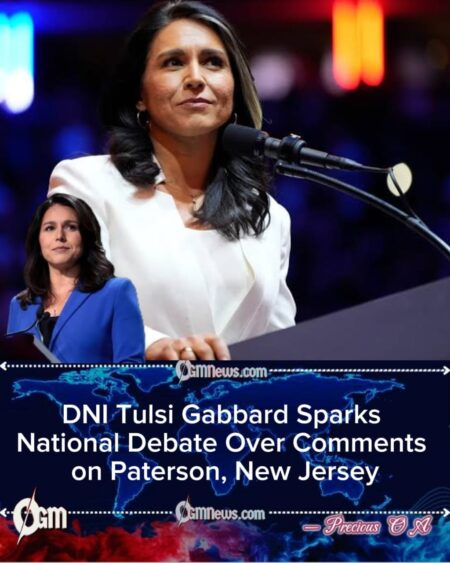
DNI Tulsi Gabbard triggered a nationwide political debate after publicly criticizing claims made about Paterson, New Jersey, regarding its growing Muslim population and how cultural identity is expressed through local governance. Her remarks, delivered during a policy forum and amplified across social media, framed concerns about religious influence, constitutional boundaries, and public policy enforcement.
Local officials in Paterson quickly responded, emphasizing that the city operates strictly under U.S. law and that religious identity does not override municipal or state authority. Community leaders stressed that cultural pride does not equate to legal control.
DNI Tulsi Gabbard maintained that her comments were intended to highlight broader constitutional concerns about the role of faith in governance, rather than to single out any group. She called for renewed attention to the separation of religion and state.
Paterson’s Demographic Evolution
Paterson has long been known as one of New Jersey’s most diverse cities, with a population representing dozens of ethnic, cultural, and religious backgrounds. Its large Muslim community has grown steadily over several decades.
DNI Tulsi Gabbard noted that demographic shifts across American cities are changing how cultural identity is expressed in public life. She argued that federal leaders should monitor how municipalities balance religious freedom with constitutional neutrality.
City officials responded that religious expression remains fully protected, but that no faith group controls legislation or enforcement practices in Paterson.
Constitutional Safeguards
DNI Tulsi Gabbard pointed to the U.S. Constitution’s Establishment Clause as a foundational safeguard ensuring that government policy remains secular and inclusive. She emphasized that maintaining legal neutrality preserves public trust.
Legal scholars echoed that U.S. municipalities are legally prohibited from enforcing religious doctrine in civil law. Courts have repeatedly affirmed these boundaries.
Faith leaders across Paterson emphasized that their participation in civic life is rooted in lawful engagement, not religious rulemaking.
Political Messaging and Reactions
DNI Tulsi Gabbard argued that federal oversight must remain vigilant to ensure local governments do not unintentionally blur constitutional lines when celebrating cultural identity.
Political opponents accused her of overstating risks and inflaming cultural anxieties. They pointed to Paterson’s long record of compliance with state and federal law.
Civil liberties organizations encouraged constructive dialogue focused on unity and constitutional literacy rather than fear-based narratives.
Community Perspectives
Local residents expressed mixed reactions. Some supported Gabbard’s emphasis on constitutional clarity, while others viewed her remarks as misrepresenting their community.
DNI Tulsi Gabbard said public debate was healthy and necessary, stating that open discussion strengthens democratic systems.
Community coalitions organized town halls to reinforce civic education and constitutional awareness among residents.
National Policy Implications
DNI Tulsi Gabbard suggested the controversy reflects broader national concerns over governance, immigration, and religious liberty — issues expected to influence upcoming election cycles.
Policy analysts said similar debates are emerging in other diverse metropolitan areas across the U.S.
DNI Tulsi Gabbard concluded by urging bipartisan efforts to reaffirm constitutional protections, promote mutual understanding, and prevent political polarization around religious identity.

[…] […]