






















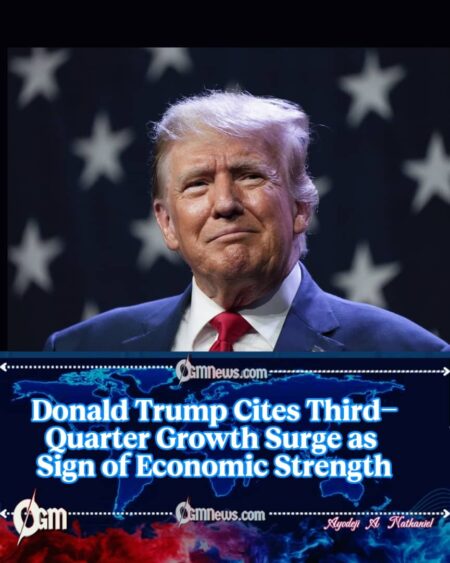
Donald Trump has pointed to stronger-than-expected third-quarter economic growth as proof that his second-term economic agenda is delivering tangible results. White House officials say the latest figures exceeded forecasts, reinforcing confidence in policies centered on tax stability, deregulation, and domestic investment.
According to senior advisers, the performance reflects renewed business confidence and resilient consumer demand, which they argue validates the administration’s economic direction under Donald Trump.
Third-Quarter Growth Beats Forecasts
The third-quarter data surprised many analysts, with growth coming in above consensus expectations. Consumer spending remained solid, while business investment and industrial output showed renewed strength, contributing to overall expansion.
Administration officials emphasized that the growth was broad-based, arguing that the economy is not reliant on a single sector. They credited policy continuity under Donald Trump for creating a predictable environment that supports sustained expansion.
Policy Choices Underpinning the Numbers
White House economic advisers attributed the results to reduced regulatory pressures, stable tax policy, and what they described as a pro-investment climate fostered by the administration. Officials said these measures have encouraged firms to expand operations and hiring.
Trade policy was also cited as a contributing factor, with aides arguing that a firmer negotiating stance has helped protect U.S. economic interests. Supporters say this approach reflects Donald Trump’s emphasis on economic leverage and domestic growth.
Labor Market and Household Effects
Officials pointed to steady job creation and wage growth in several sectors as evidence that the expansion is reaching American workers. Consumer confidence, they said, has remained resilient despite inflationary pressures in housing and energy.
While acknowledging ongoing cost-of-living concerns, the administration argued that stronger growth under Donald Trump provides the economic capacity to address affordability challenges over time.
Debate Among Economists and Lawmakers
Not all observers are convinced the momentum will last. Some economists cautioned that quarterly growth can be volatile and stress the importance of long-term productivity and fiscal discipline.
Democratic lawmakers, meanwhile, questioned whether headline growth figures fully capture household strain, arguing that stronger social investment is needed alongside macroeconomic gains promoted by Donald Trump.
Political Significance of Economic Performance
Strong economic data carries political implications as the administration seeks to reinforce its governing narrative. Allies argue that outperforming expectations strengthens public trust in Donald Trump’s economic stewardship.
Analysts note that sustained growth has historically played a major role in shaping public opinion, making continued economic performance a central pillar of the administration’s second-term strategy.
Economy at the Center of the Second Term
The White House’s emphasis on third-quarter growth underscores how central the economy remains to the administration’s agenda. Officials portray the results as a direct outcome of policy decisions and leadership continuity.
As future data emerges, markets and voters alike will closely assess whether the momentum attributed to Donald Trump can be maintained.

Casinoabc999? Good Site. The interface is sleek, and there is a lot of stuff to...