












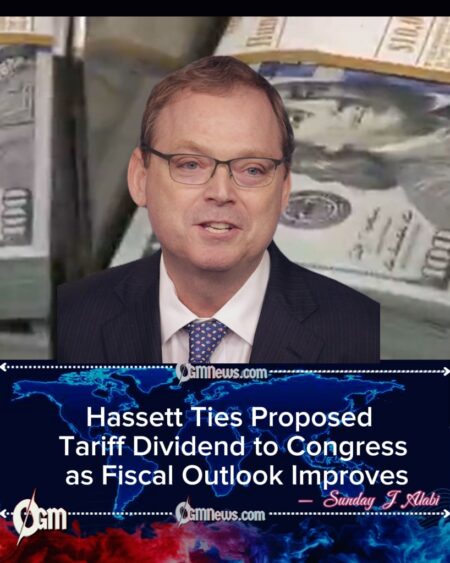
The possibility of $2,000 tariff-funded checks for millions of Americans has moved closer to the center of Washington’s economic debate, as White House officials signal growing confidence in the nation’s fiscal space. Kevin Hassett, Director of the National Economic Council, said the proposal championed by President Donald Trump during his second term would ultimately depend on congressional action, even as administration officials argue that recent economic performance has strengthened the case for such payments.
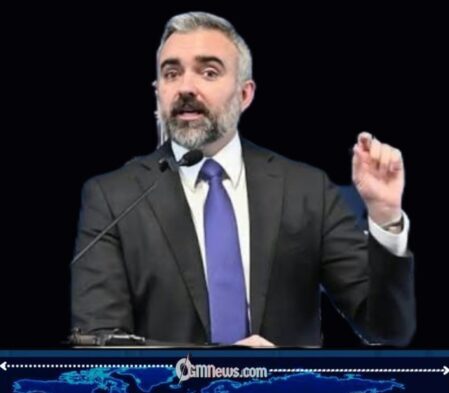
Speaking on Face the Nation with Margaret Brennan, Hassett framed the idea as part of a broader policy discussion expected to unfold in the new year. While the president has publicly promoted the concept as a “dividend” drawn from tariff revenue, Hassett stressed that the constitutional power of the purse rests with Congress, making legislative approval the decisive factor.
A Proposal Rooted in Tariff Revenue
Since July, President Trump has floated the idea of providing Americans with rebate-style checks funded by revenue generated from tariffs. The concept gained renewed attention last month when the president posted on social media that a “dividend of at least $2,000 a person” could be paid, excluding high-income earners.
Administration officials have described the idea as a way to return tariff proceeds directly to citizens. The proposal aligns with the president’s broader argument that tariffs can serve not only as a trade tool but also as a revenue source that benefits domestic households.
However, officials have emphasized that the proposal remains under discussion rather than finalized policy. Hassett said he expects the president to formally bring the matter before Congress in the new year, initiating what could be a contentious legislative process.
Income Limits and Eligibility Under Discussion
While the administration has not released a detailed framework, Treasury Secretary Scott Bessent has offered some insight into possible eligibility criteria. In comments last month, Bessent suggested the checks would likely target households earning less than $100,000 annually.
He also cautioned that discussions were ongoing and that no final decisions had been made regarding income thresholds or distribution mechanisms. The emphasis on excluding higher-income Americans reflects the administration’s effort to frame the proposal as targeted economic relief rather than a universal payout.
Such parameters, if adopted, would likely shape congressional negotiations, as lawmakers debate fairness, cost, and the broader economic impact of the payments.
Improved Fiscal Picture Bolsters Confidence
Hassett pointed to recent economic data as a key reason the administration now sees room for the checks. He cited nearly two consecutive quarters of close to 4% economic growth, alongside what he described as a short-term government surplus and a deficit reduced by roughly $600 billion compared with last year.
“In the summer, I wasn’t so sure that there was space for a check like that,” Hassett said, adding that the improved fiscal outlook has changed his assessment. The comments reflect growing optimism within the administration about the sustainability of additional spending initiatives.
Economists note that while short-term fiscal improvements can support such proposals, long-term budget implications will likely dominate congressional scrutiny.
Hassett :Congress Holds the Final Authority
Despite the administration’s confidence, Hassett underscored that Congress retains ultimate control over federal spending decisions. Tariff revenue, like all government income, flows into the broader pool of federal funds before being allocated through the appropriations process.
“In the end, we get taxes, we get tariffs, we get revenue from lots of places, and then Congress decides how to spend that money,” Hassett said. His remarks highlight the legal and procedural constraints facing any executive-led spending proposal.
This reality sets the stage for negotiations that could test bipartisan support, particularly amid differing views on tariffs, deficits, and direct payments to citizens.
Tariffs as a Signature Economic Policy
The proposal comes as President Trump continues to defend tariffs as one of his administration’s defining economic strategies in his second term. The White House has argued that tariffs have helped raise revenue, reduce the trade deficit, and encourage investment in U.S. manufacturing.
Hassett said most tariffs imposed this year “have proven their mettle,” pointing to strong growth and reduced imports from China as evidence. He suggested that these outcomes have reinforced the administration’s belief in tariffs as an effective policy tool.
At the same time, Hassett acknowledged feedback from trading partners and companies that rely heavily on U.S. trade, indicating that some aspects of the tariff regime may warrant adjustment.
Adjustments, Exemptions, and Legal Challenges
Hassett said there is growing openness within the administration to exempt certain goods from tariffs if they are impractical to produce domestically due to factors such as climate. He noted that U.S. Trade Representative Jamieson Greer is leading efforts to evaluate such exemptions.
The administration is also awaiting a Supreme Court decision on whether the president has the authority to impose tariffs unilaterally under a federal emergency powers law. The White House has relied on this law to impose duties on nearly all U.S. trading partners.
Hassett expressed confidence that the justices will side with the administration, a ruling that could have significant implications for both the tariff regime and the proposed rebate checks.
Logging in is a breeze and the site stability is amazing even during peak hours....