

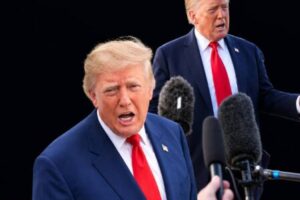











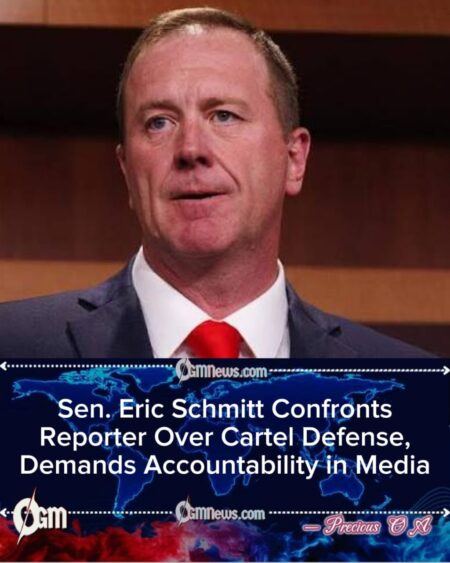
Sen. Eric Schmitt steps toward the reporter moments after the tense exchange, calling out what he described as an alarming attempt to justify violent narco-terrorist networks. The crowded hallway falls silent as he firmly challenges the reporter’s remarks, drawing immediate attention from staff, aides, and journalists nearby who are struggling to capture the unfolding moment. The tension is palpable, with multiple onlookers whispering about the intensity of the exchange and the implications for ongoing policy discussions.
Eric Schmitt emphasizes that defending cartels, even indirectly, sends a dangerous message that ignores the devastation these groups inflict on border communities, families, and small towns across the United States. He underscores that law enforcement personnel risk their lives daily, and to downplay the threat is to undermine the dedication and sacrifices of those protecting American citizens. His tone grows more forceful as he lays out the long-term consequences of misrepresenting cartel violence, warning that inaccurate reporting can embolden criminal enterprises and hamper federal operations.
Eric Schmitt warns that dismissing the brutality of narco-terrorists undermines years of law-enforcement efforts and emboldens organizations responsible for trafficking, kidnappings, and mass violence across the hemisphere. He cites specific examples of recent operations in which intelligence and rapid response saved countless lives, stressing that framing these criminal actors as anything less than dangerous jeopardizes both public safety and national security policy effectiveness.
Clash Over Media Narratives
Eric Schmitt confronts the reporter’s framing, insisting that cartels cannot be softened, glossed over, or explained away with political talking points. He asserts that portraying them as misunderstood actors or politically motivated entities distorts the deadly reality unfolding daily in multiple regions of Mexico, Central America, and along the southern U.S. border. Observers note that Schmitt’s detailed knowledge of cross-border threats lends weight to his arguments.
Eric Schmitt argues that journalists must acknowledge the scale and sophistication of cartel influence, particularly as criminal operations expand into new territories, infiltrate local governments, and weaponize misinformation to manipulate public opinion both domestically and internationally. His comments intensify the ongoing national debate about responsible reporting and the ethics of narrative framing when lives are at stake.
The hallway grows more tense as Schmitt outlines the dangers of promoting narratives that appear to defend or sanitize cartel activity, highlighting how such portrayals hinder effective policymaking. He warns that public misperceptions can lead to policy paralysis, reducing funding, staffing, and the ability to conduct proactive operations that disrupt cartel networks before violence escalates.
Reporter Defends Comments
Eric Schmitt reacts sharply when the reporter attempts to defend her statements by framing cartel violence as a sociopolitical issue rather than deliberate terrorism. He counters by stressing that systemic causes—such as poverty or corruption—do not excuse organized brutality, kidnapping, and illegal arms smuggling orchestrated by these groups.
Eric Schmitt continues pushing back, explaining that while complex economic and social factors exist in certain regions, the deliberate murder, intimidation, and trafficking committed by cartels cannot be contextualized away. He underscores that every day, border communities experience the tangible human cost of inaction or misrepresentation, ranging from loss of life to destabilized local economies. Staffers nearby observe the escalating disagreement with growing concern, noting that this confrontation will likely dominate social media and news coverage in the coming days.
Onlookers watch closely as the back-and-forth intensifies, with Schmitt rejecting any suggestion that cartel violence can be minimized or reinterpreted through narrow political arguments. He stresses that moral clarity is necessary for both public understanding and for guiding effective legislative and law enforcement responses at the national level.
National Security Stakes Rise
Eric Schmitt points out that mischaracterizing cartel operations weakens federal strategies designed to monitor cross-border activity, intercept narcotics shipments, and protect vulnerable communities. His remarks reflect broader concerns among national-security leaders who argue that inaccurate reporting can jeopardize operational secrecy and risk the lives of agents in the field.
Eric Schmitt notes that intelligence agencies have repeatedly warned Congress about cartel alliances, paramilitary structures, and aggressive territorial expansion. He stresses that ignoring these realities enables further violence and fosters a culture of impunity, where traffickers feel emboldened to operate with little fear of law enforcement consequences.
The senator underscores that combating narco-terrorism requires honesty and seriousness. He argues that minimizing the threat only endangers law-enforcement officers, local populations, and the strategic interests of the United States in maintaining secure borders and regional stability. His remarks convey a sense of urgency that resonates with both veteran policy analysts and rank-and-file citizens.
Public Reaction and Media Fallout
Eric Schmitt’s confrontation spreads rapidly online as clips circulate across social platforms, prompting fierce debate over the role of journalists in reporting on transnational crime. Some viewers applaud his firm stance, praising his willingness to directly challenge narratives that seem to excuse criminal behavior.
Eric Schmitt gains support from officials who argue that inaccurate framing can unintentionally amplify cartel propaganda, providing these organizations with unintended legitimacy in the eyes of vulnerable populations. Others note that the exchange highlights a growing divide between policymakers, who see the threats firsthand, and segments of the press, which may rely on simplified or politically motivated narratives.
The public conversation intensifies as commentators examine whether the reporter’s remarks crossed ethical lines or whether Schmitt’s response reflects a rising frustration with selective reporting. Analysts predict that the debate may influence future press coverage and legislative oversight of media reporting standards related to national security matters.
Policy Momentum Builds
Eric Schmitt closes the encounter by reaffirming his commitment to strengthening border-security policy and pursuing measures aimed at dismantling cartel networks at their roots. His final remarks signal upcoming legislative action, including potential funding increases, enhanced surveillance measures, and expanded cooperation with allied countries in Central America.
Eric Schmitt’s office later releases a statement reinforcing his position and calling for increased accuracy in media narratives involving transnational criminal organizations. Supporters argue that such accountability is long overdue, insisting that journalists bear a responsibility to portray threats with clarity, particularly when human lives hang in the balance.
Lawmakers across both chambers prepare for renewed debate on federal counter-cartel strategies, with Schmitt’s confrontation serving as an unexpected catalyst for heightened scrutiny, potential reform measures, and broader public awareness of the stakes involved in combating narco-terrorism.

Logging in is a breeze and the site stability is amazing even during peak hours....