





















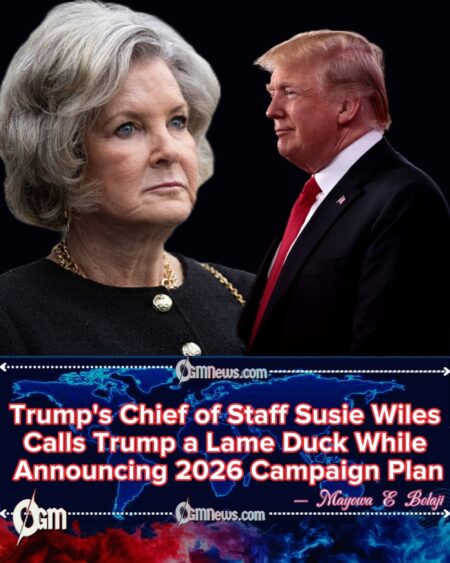
Susie Wiles, Chief of Staff to Donald Trump, declared that the administration intends to place the president “on the ballot” in 2026—an extraordinary break from conventional political practice. Speaking with an air of confidence despite growing internal doubts within the Republican Party, Wiles insisted the move is necessary to stabilize the party’s national influence.
Susie Wiles emphasized that the president’s personal presence remains the most powerful tool available to the GOP heading into a volatile political season. Her remarks suggested a strategy rooted not just in policy defense but in the belief that Trump’s visibility is essential to energizing the party’s base.
Susie Wiles Labels Trump a “Lame Duck” as Prices Surge Nationwide
Susie Wiles referred to President Trump as an “unpopular lame duck,” a phrase that instantly ignited debate across political circles. While the term is typically reserved for presidents nearing the end of their final term, critics say her description reflects broader frustration with the administration’s handling of domestic challenges.
Susie Wiles made the statement even as Americans grapple with rising grocery bills, accelerating healthcare costs, and household budgets stretched to the breaking point. These pressures have contributed to the declining approval ratings that now define much of the Trump administration’s political landscape.
Susie Wiles Defends the Decision Despite Public Economic Anxiety
Susie Wiles argued that the administration must act aggressively in response to public skepticism—especially as inflation continues to dominate national discourse. She claimed that placing the president at the center of the mid-cycle political conversation would show “strength, consistency, and leadership.”
Susie Wiles also maintained that critics underestimate the symbolic value of Trump’s direct engagement with voters. However, analysts warn that the symbolism may be overshadowed by persistent economic anxieties that many Americans feel acutely every week at the grocery store, pharmacy, and hospital.
Susie Wiles Confronts the Risks of Reviving Trump’s Campaign Role
Susie Wiles acknowledged that the strategy carries risks, including the possibility that an unpopular president could drag down Republican candidates in competitive states. Her comments revealed an internal administration calculation that the potential benefits outweigh the dangers, even as some advisors quietly express concerns.
Susie Wiles insisted that Trump’s ability to command media attention and energize loyal supporters is too valuable to sideline. Still, opponents argue that the economic conditions Americans face today could turn Trump’s re-emergence into a liability rather than a political asset.
Susie Wiles Signals Confidence Despite Warnings From Economists
Susie Wiles showed no signs of retreating from her position, expressing confidence that the American electorate will respond positively once the president takes to the campaign trail. Her optimism contrasts sharply with economists and policy experts who warn that families are struggling more than at any time in the past decade.
Susie Wiles framed the upcoming 2026 campaign as a referendum not just on party control, but on how the nation interprets the intertwined relationship between federal leadership and rising costs. As she put it, “You bring the president to the people when the stakes are highest.”

[…] […]