





















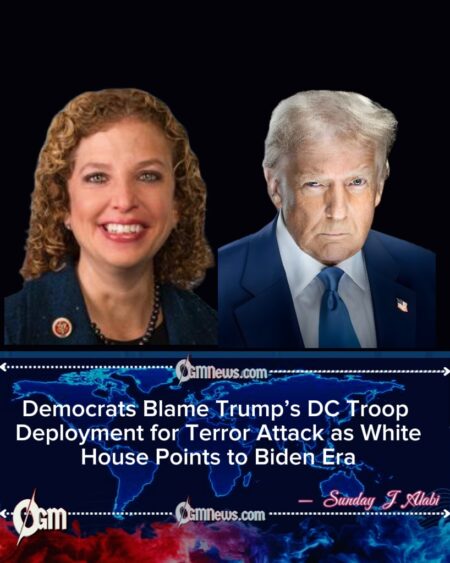
A fresh political storm has erupted in Washington, DC, after the fatal shooting of a National Guard member and the serious wounding of another near the White House was swiftly framed as a consequence of President Donald Trump’s deployment of troops to the nation’s capital.
Afghan national Rahmanullah Lakanwal, 29, allegedly opened fire on two West Virginia National Guard members on Wednesday close to the White House, killing Specialist Sarah Beckstrom, 20, and gravely injuring Staff Sergeant Andrew Wolfe, 24. Authorities are investigating the incident as an act of terrorism.
The attack has reignited a fierce debate over the use of military personnel in domestic law enforcement roles and over immigration and vetting policies. Democrats and liberal commentators have accused President Trump, now serving his second term as the current U.S. president, of placing troops in harm’s way for political reasons, while the White House insists that “dangerous” policies linked to President Joe Biden are to blame for Lakanwal being in the United States at all.
Democrat Lawmaker Links Trump’s Deployment to Attack
Florida Representative Debbie Wasserman Schultz, a former chair of the Democratic National Committee, led the charge in criticizing the president’s role in the tragedy. Speaking on CNN, she argued that Trump’s decision to deploy National Guard troops to Washington, DC, created conditions that made the attack more likely.
She questioned whether Lakanwal would ever have targeted law enforcement officers in the capital if not for the presence of troops on the streets. “This begs the question, would an individual have flown across the country to target law enforcement officers in Washington, DC? And, I mean, the answer is likely no,” she said.
Schultz went on to suggest that President Trump should have reconsidered deploying troops to Washington and other cities, particularly where local law enforcement agencies were already capable of handling security and public order issues. She argued that using the military in policing roles was inappropriate and potentially unlawful. “It’s never the president’s fault or his policies when it comes to his reaction, and it’s pretty disgusting,” she said, accusing the administration of refusing to accept responsibility for the consequences of its decisions.
Posse Comitatus Concerns and Legal Challenges
Central to Schultz’s criticism is the long-standing Posse Comitatus Act of 1878, which generally prohibits the use of the U.S. military to enforce domestic laws. She cited a federal judge’s ruling that Trump’s earlier deployment of troops to Los Angeles had violated the Act, underscoring concerns that the administration’s approach blurs the line between civilian law enforcement and military operations.
Civil libertarians and legal experts have repeatedly raised alarms over the president’s willingness to send military forces into U.S. cities, arguing that it sets a dangerous precedent. The use of troops, they say, risks escalating tensions, undermining public trust, and exposing service members to threats for which they are not trained or properly mandated.
These legal concerns are unfolding in real time. Just hours before the shooting, the Trump administration filed an emergency application with a federal appeals court seeking to overturn a previous ruling that his decision to deploy the National Guard in Washington was illegal. The attack has now intensified scrutiny of the administration’s determination to defend and expand its deployment powers.
White House Hits Back, Blaming Biden-Era Policies
The White House responded forcefully to suggestions that the president’s deployment decisions were responsible for the attack. In a statement to the Daily Mail, spokeswoman Abigail Jackson rejected the criticism as partisan and misdirected, insisting that the real problem lies with policies linked to President Joe Biden.
“This animal would’ve never been here if not for Joe Biden’s dangerous policies which allowed countless unvetted criminals to invade our country and harm the American people,” Jackson said. She claimed that the Trump administration was “taking every measure possible – in the face of unrelenting Democrat opposition – to get these monsters out of our country and clean up the mess made by the Biden Administration.”
Framing Democrats as soft on security, Jackson argued that “instead of defending terrorists, the Democrats should join us in protecting the American people.” The statement encapsulated the administration’s strategy of shifting the focus away from questions about domestic deployment and toward a broader narrative about border security and immigration controls.
The Suspect: Afghan Asylum Recipient with CIA Links
The emerging profile of the alleged shooter, Rahmanullah Lakanwal, has only sharpened the political clash. Lakanwal first arrived in the United States in August 2021 under Operation Allies Welcome, a program designed to relocate Afghans who feared persecution under Taliban rule following the chaotic U.S. withdrawal from Afghanistan. Nearly 200,000 Afghans are reported to have settled in the U.S. under this initiative, later renamed Enduring Welcome.
Lakanwal’s background is particularly sensitive. According to CIA Director John Ratcliffe, he previously worked with the CIA in Afghanistan and was part of the agency’s so-called Zero Units — paramilitary teams tasked with conducting lethal missions against Taliban, al-Qaeda, ISIS and other militant targets. The Washington Post reported that these units carried out some of the most dangerous operations of the war.
Critics of the administration on the left argue that it was the Trump administration itself that granted Lakanwal asylum earlier this year, raising questions about vetting and oversight. Frequent CNN contributor Dean Obeidallah pointedly noted that Lakanwal was granted asylum under Trump, writing on BlueSky: “A CIA trained operative who Trump granted asylum to in April killed a National Guard member who Trump forced to be in Washington DC. Sounds like Trump is one [of] the responsible for this from beginning to end.”
Liberal Commentators Condemn Deployment as ‘Political Show’
Beyond elected officials, a number of liberal commentators seized on the attack as evidence that the president’s domestic deployment strategy is reckless and politicized.
Liberal Christian writer John Pavlovitz wrote on X that “Donald Trump and Pete Hegseth are culpable for endangering the National Guard by putting them in harm’s way.” Wajahat Ali, an opinion writer for The New York Times, argued that the National Guard never should have been deployed to Washington, echoing the broader critique that the troops’ presence was unnecessary and provocative.
Perhaps the most widely shared criticism came from Jane Mayer of The New Yorker. She wrote that the tragedy was “so tragic, so unnecessary,” adding that the guardsmen “should never have been deployed.” Mayer, a Washington resident, said that she had watched the troops “pick up trash” and suggested that their presence was largely for “political show” — a performance of toughness rather than a response to real security needs. “It was for political show and at what a cost,” she wrote.
Bitter Online Clash as White House Calls Critics ‘Sick, Disgusting Ghouls’
The administration’s response to Mayer’s comments illustrated just how raw the debate has become. From its official X account, the White House issued a blistering reply, calling Mayer a “sick, disgusting ghoul.”
“Two of these heroes were just SHOT IN BROAD DAYLIGHT. The Guard has saved countless lives — backed up by evidence (which you’re clearly too stupid to notice). They are American Patriots,” the post said. The message underscored the White House’s insistence that National Guard deployments have prevented violence and protected communities, while portraying critics as disrespectful to fallen and wounded service members.
The heated online exchange highlighted the widening gulf between the administration and many of its critics. For supporters of the president, the Guard represents order, deterrence and resolve. For opponents, the deployments are seen as militarization of domestic politics, with troops placed in danger not by necessity but by presidential choice.
Months of Tension Over Troops in U.S. Cities
The controversy surrounding Wednesday’s shooting did not arise in isolation. For months, President Trump has drawn criticism for sending federal forces and National Guard units into cities led by Democratic officials, often citing unrest, protests or crime as justification.
In June, the president ordered 700 Marines and 4,000 National Guard soldiers from California into Los Angeles to quell the “No Kings” protests. The move sparked widespread debate over proportionality and legality, especially when a federal judge later ruled the deployment violated the Posse Comitatus Act.
In September, troops were dispatched to Memphis, Tennessee, and Portland, Oregon, and several other cities — including New York City, Baltimore, San Francisco and New Orleans — have been warned that federal forces could be sent in. Critics see a pattern of targeting predominantly Democratic, or “blue,” cities in a bid to project strength and appeal to the president’s political base. Supporters counter that the administration is simply responding to legitimate concerns about disorder and public safety.
More Troops Requested as Legal and Political Stakes Rise
In the wake of the attack, rather than scaling back, the administration signaled a desire to increase its presence in the capital. Defense Secretary Pete Hegseth told reporters that President Trump had requested 500 additional troops for Washington, DC, after the shooting.
The request raises fresh questions about whether the attack will be used to justify further deployments, even as legal battles over the president’s authority to send troops into U.S. cities continue. Civil rights advocates warn that the cycle of violence, backlash and escalation may deepen divisions and put more service members at risk.
For Specialist Beckstrom’s family and for Staff Sergeant Wolfe, who is recovering from serious injuries, the political arguments provide little comfort. Yet their tragedy has become the latest flashpoint in a broader struggle over how far a president can go in using military force within the United States — and who bears responsibility when things go fatally wrong.
[…] […]