




























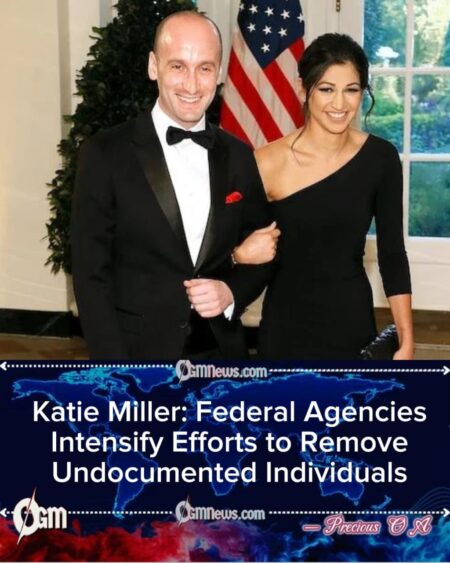
Katie Miller, the wife of senior policy adviser Stephen Miller and a prominent spokesperson for the administration’s immigration policy, delivered an extensive statement outlining the administration’s uncompromising commitment to removing undocumented migrants from the United States. She described the initiative as not only comprehensive but also systematic, emphasizing that federal agencies had meticulously planned the operations to ensure that every undocumented individual within the country would eventually be identified, detained if necessary, and removed in accordance with federal law. In her detailed remarks, she highlighted that these enforcement measures were designed to address public safety concerns, uphold national security, and reinforce legal accountability across all jurisdictions.
Katie Miller further emphasized that the majority of individuals targeted in the removal operations were those who had histories of serious violent crimes, asserting that the administration had relied on detailed intelligence, criminal records, and inter-agency coordination to prioritize these high-risk cases. According to her, this approach not only demonstrated the administration’s dedication to protecting American communities but also illustrated the careful calibration of resources toward individuals most likely to pose a threat. She underscored that while the focus was on dangerous offenders, due process would be rigorously maintained for every individual involved in the enforcement actions.
Katie Miller framed the operation as part of a broader restructuring of federal immigration priorities, describing it as a deliberate and sustained shift toward more assertive law enforcement policies. She explained that these efforts represented the culmination of months of planning, coordination, and strategic resource allocation, including enhanced training, expanded logistical capabilities, and improved information sharing among federal, state, and local agencies. Her remarks conveyed a sense of urgency, stressing that the administration viewed the initiative as central to its overall law-and-order agenda.
Administration Defends Its New Enforcement Strategy
Katie Miller reiterated that the administration was fully prepared for the scale and operational demands of the nationwide removal effort, asserting that federal authorities had the necessary infrastructure, personnel, and legal expertise to implement the policy effectively. She framed the initiative as both deliberate and legally grounded, emphasizing that it reflected a disciplined approach to immigration enforcement that prioritized risk-based targeting rather than indiscriminate action against undocumented populations.
Senior advisers within the administration highlighted that the updated protocol relied heavily on intelligence-led enforcement, including detailed analyses of criminal histories, ongoing investigations, and law-enforcement data. They suggested that this methodological framework represented a major evolution from previous approaches, allowing authorities to focus on individuals deemed the highest risk to public safety while simultaneously adhering to constitutional protections and legal mandates.
Katie Miller insisted that the administration’s commitment to enforcement was unwavering, noting that the policy had been carefully reviewed to ensure compliance with existing federal laws and procedural safeguards. She stated that criticism from opponents, while anticipated, would not deter the administration from pursuing what it described as necessary and lawful actions aimed at safeguarding the country. She also highlighted that public communication and transparency regarding enforcement priorities were essential components of maintaining legitimacy and public confidence in federal operations.
Nationwide Operations and Logistical Coordination
Katie Miller detailed the operational rollout, noting that enforcement teams had already been deployed to major metropolitan areas, border-adjacent communities, and interior regions where undocumented populations were most concentrated. She described the efforts as strategically sequenced to maximize efficiency, minimize logistical disruptions, and ensure that individuals subject to removal would be apprehended in a safe and orderly manner.
Federal officials coordinating the initiative emphasized the importance of inter-agency collaboration, noting that state and local law enforcement, federal investigative teams, and intelligence agencies were all integral to the process. While some jurisdictions actively supported the operations, others maintained a more cautious stance, reflecting differences in local political environments and sanctuary policies. Despite these variations, the administration insisted that progress toward its enforcement goals remained continuous and largely uninterrupted.
Katie Miller explained that logistical preparedness was a critical component of the strategy, including the scaling of transportation capacity, detention facilities, and case management resources. She stressed that the administration had devoted significant attention to ensuring that operations could proceed without undue delays, disruptions, or legal complications, highlighting the sophistication and scope of the planning behind the initiative.
Human Rights Concerns and Opposition Responses
Katie Miller acknowledged that advocacy organizations and critics had raised concerns about the potential social impact of large-scale removals. She argued that many of these groups misunderstood the scope of the policy, emphasizing that due process protections remained central to every enforcement action and that the initiative was carefully structured to distinguish between dangerous offenders and individuals with no criminal history.
Civil-rights advocates cautioned that framing removals primarily in terms of violent offenders could inadvertently stigmatize immigrant communities and create fear among law-abiding residents. They emphasized the need for clarity, transparency, and monitoring to prevent misapplication of enforcement protocols and to ensure that families were not unnecessarily disrupted. Public statements from advocacy groups underscored concerns about how media coverage and official messaging might affect perceptions and behavior within immigrant communities.
Katie Miller responded to these concerns by reiterating that federal authorities were fully committed to legal and procedural compliance, asserting that enforcement was targeted, evidence-based, and designed to minimize unintended consequences. She stressed that the initiative’s focus on high-risk individuals did not reflect bias against immigrant communities as a whole and highlighted the administration’s intention to communicate clearly and responsibly regarding its operations.
Political Impact and National Debate
Katie Miller framed the enforcement strategy as a reflection of widespread public sentiment favoring stricter immigration controls and expressed confidence that the administration’s actions would resonate with supporters seeking accountability and security. She highlighted that public backing for law-and-order measures had been a key consideration in shaping policy priorities, emphasizing the administration’s responsiveness to perceived national needs.
Observers noted that the announcement was likely to deepen existing political divides, particularly in regions with large immigrant populations. Analysts predicted intense debate over the coming months, with discussion spanning national security, human rights, legal authority, and economic implications of large-scale removals. The initiative was described as a polarizing yet pivotal moment in ongoing discussions regarding immigration policy.
Legislators and commentators reacted along partisan lines, with some praising the administration’s assertiveness and others criticizing the approach as excessively aggressive or potentially destabilizing. Policy analysts suggested that the controversy could influence legislative initiatives, public opinion, and the framing of upcoming electoral campaigns, potentially shaping the trajectory of immigration-related debates for years to come.
Outlook for Future Enforcement Waves
Katie Miller indicated that subsequent phases of enforcement had already been planned, designed to extend the initiative’s reach while maintaining operational focus and efficiency. She emphasized that additional resources, including personnel, technological systems, and inter-agency coordination, would be deployed to ensure that enforcement objectives were fully realized.
Officials indicated that future efforts would continue to prioritize high-risk individuals while ensuring that legal protections were upheld for all other undocumented residents. Analysts observed that the phased, strategic approach suggested a long-term commitment to enforcement rather than a temporary campaign, highlighting the administration’s intent to establish lasting impact.
Katie Miller concluded that the administration would persist in its objective of removing every undocumented individual from the country if legally permissible, framing the initiative as a defining national security undertaking. She stressed that federal agencies were prepared for sustained, comprehensive operations, and that enforcement would continue until the administration’s articulated goals were fully achieved.



[…] […]